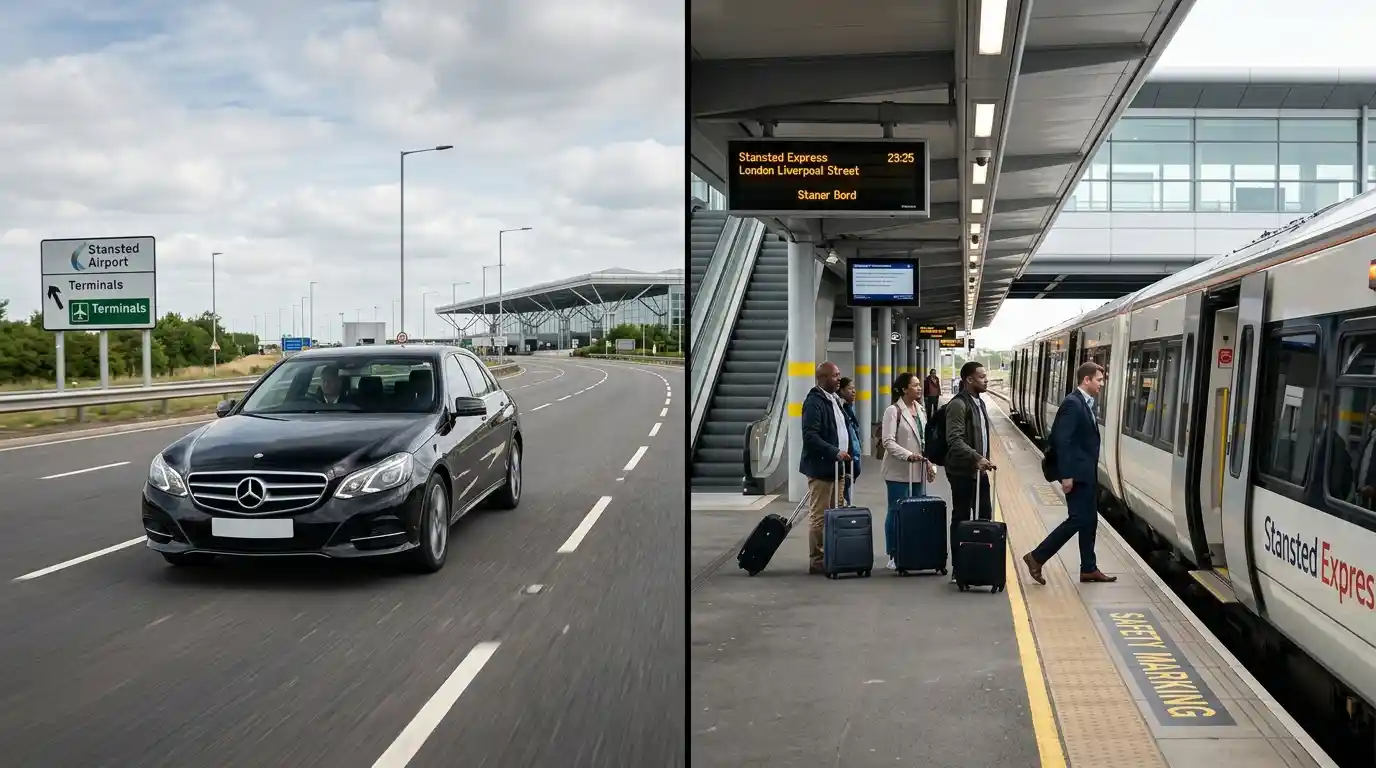
There is no single Stansted journey time. Central London to the airport takes roughly one hour off-peak and up to two in bad traffic by road — but a fixed 48 minutes by rail, regardless of what the M11 is doing. Same trip, same distance, two entirely different kinds of answer. Road times are ranges because roads vary. Rail times are figures because timetables do not.
This guide works through every origin, mode, time of day and condition in turn — with a framework for how much buffer to add on top of any estimate. From Stansted Airport Taxi, a TfL-licensed private-hire operator running pre-booked transfers to and from Stansted at any hour, with flight tracking so your pickup adjusts if your times move. Times last checked: August 2026.
Quick Journey-Time Reference
Road figures are typical driving durations in normal conditions. Rail figures are scheduled times. Neither is a guarantee — the sections below explain the variability in full.
| Journey |
Typical time |
Peak variation |
Mode |
| Central London → Stansted | 1h 00 – 1h 30 | Up to 2h | Road |
| Stansted → Central London | 1h 00 – 1h 30 | Up to 2h | Road |
| Liverpool Street ↔ Stansted | 48 minutes | None | Rail (scheduled) |
| Tottenham Hale ↔ Stansted | 36 minutes | None | Rail (scheduled) |
| Stratford ↔ Stansted | ~1 hour | None | Rail (scheduled) |
| Cambridge → Stansted | 40 – 50 minutes | Just over 1h | Road |
| Heathrow ↔ Stansted | 1h 30 – 2h 00 | 2h 30+ | Road |
| Gatwick ↔ Stansted | 1h 45 – 2h 30 | 3h+ | Road |
| Luton ↔ Stansted | 1h 00 – 1h 30 | 2h | Road |
| London City ↔ Stansted | 1h 00 – 1h 30 | 2h | Road |
| Birmingham → Stansted | 2h 10 – 2h 30 | 3h+ | Road |
| Southend ↔ Stansted | 1h 00 – 1h 30 | 1h 45 | Road |
How to use this table. Use the typical column as your working estimate. Use the peak column as your planning figure for peak hours, school holidays or bank holiday travel. Rail rows show scheduled times — these do not vary with traffic, though services can be delayed.
How Long Does It Usually Take to Get to Stansted Airport?
For most journeys people actually make, the honest range is 40 minutes to two hours. The width of that answer is the point — not a failure to be precise.
What Determines Your Journey Time
Six things, roughly in order of impact:
- Where you start. Cambridge and east London are close and have direct M11 access. West and south London are not, and do not.
- Which mode you use. Rail is fixed at 48 minutes from Liverpool Street. Road is variable by the hour and the day.
- What time you travel. The M11 peaks 07:00–09:00 and 17:00–19:00 on weekdays, and the difference between these windows and off-peak is up to an hour on the same journey.
- Which route you take. M11 direct versus an M25 approach changes the exposure to congestion entirely.
- Road conditions on the day. One incident on the M11 affects every road journey to Stansted simultaneously, because there are limited alternatives.
- Season and date. School holidays and bank holidays raise the baseline across the whole day rather than just at the peaks.
Why the Ranges Are Wide
Because the underlying variability is wide. A page quoting "1 hour from London" describes a good day. A page quoting "2 hours" describes a bad one. Both are honest; neither is complete. The useful figure is not the average — it is the range, plus a sense of which end of it your particular journey sits at.
Rail vs Road — the Core Contrast
The Stansted Express runs from Liverpool Street in a scheduled 48 minutes. That figure does not change with the M11, with the time of day, with the season, or with incidents. A road journey from the same origin is somewhere between one and two hours — which end you land on depends on every factor above. Planning by rail is planning against a timetable. Planning by road is planning against a range, and the range is real.
How Long Does It Take from London to Stansted Airport?
London is not one place, so this is not one number. What separates a fast London journey from a slow one is not how far out you are — it is how many congestion points sit between you and the M11.
Central London to Stansted Airport
By road: typically 1 hour to 1 hour 30 minutes in normal conditions. Off-peak with a clear M11, an hour is realistic. During the weekday peak, or with an incident on the motorway, two hours is possible. "Central London" here means the City and immediate surrounding area — a journey starting at Paddington or Kensington will run longer than one starting near Liverpool Street, before the M11 is even reached.
By rail: 48 minutes, scheduled, from Liverpool Street. This does not change with traffic.
The Direction Effect — Stansted to London Is Not the Mirror
Journey time is directional because peak traffic is directional. The morning peak flows into London — so a 07:30 journey from London out to Stansted runs against the flow and often beats expectations, while the same journey inbound at 07:30 runs with the flow and does not. The reverse applies in the evening. Leaving London for Stansted at 17:30 is slower than arriving into London at 17:30. The practical rule: if your journey runs with the commuter flow, budget the upper end of the range. If it runs against it, the lower end is realistic. Rail is unaffected by any of this.
East and North-East London — Fewest Congestion Points
You reach the M11 from east London without touching the North Circular, the M25 or a river crossing. That single fact makes these the fastest and steadiest London journeys — the gap between a good run and a bad one is around 20 minutes, because there is only one thing that can go wrong. Peak direction is favourable in the morning: you are leaving as the commuter flow arrives.
Central London — Two Congestion Points
Urban roads at the start, then the M11. The spread is wider than the east because the first leg is unpredictable — off-peak, the urban section costs very little; at 08:00, it can cost 30 minutes before you reach a motorway. Peak direction is mixed, depending on which side of the centre you start.
North London — A406 as an Additional Variable
Access to the M11 is good, but the North Circular is a congestion point in its own right and it fails unpredictably. Expect a similar typical time to central London but a longer tail — the bad days here are worse than the bad days in the east. Peak direction is unfavourable in the evening, when the A406 carries outbound traffic.
South London — Three Congestion Points
A river crossing or the M25, then the M25 itself, then the M11. This is where journey time stops tracking distance. Each additional exposed section multiplies the variability rather than adding to it, so the upper end of the range becomes the realistic planning figure rather than the worst case. Peak direction is unfavourable in both directions, because the M25 has no quiet side.
West London — Most Unpredictable
Three exposed sections, and the M25's western section is one of the busiest stretches of motorway in Britain. A route quoted at 90 minutes can take well over two hours with no incident at all — simply because the western M25 runs near capacity for much of the day. These are the longest and least predictable London journeys.
The Pattern That Actually Matters
Journey time rises with the number of exposed sections, not with mileage. One exposed section produces a narrow, predictable range. Three produce a wide one that resists planning. That is why an east London journey and a south London journey of similar length behave completely differently — and why the planning buffer should scale with your exposure count rather than your distance.
Journey Times from Major UK Towns and Cities
Beyond London — how the M11 corridor performs from different origins, and where other road networks take over.
Cambridge — One of the Fastest Airport Journeys in the Region
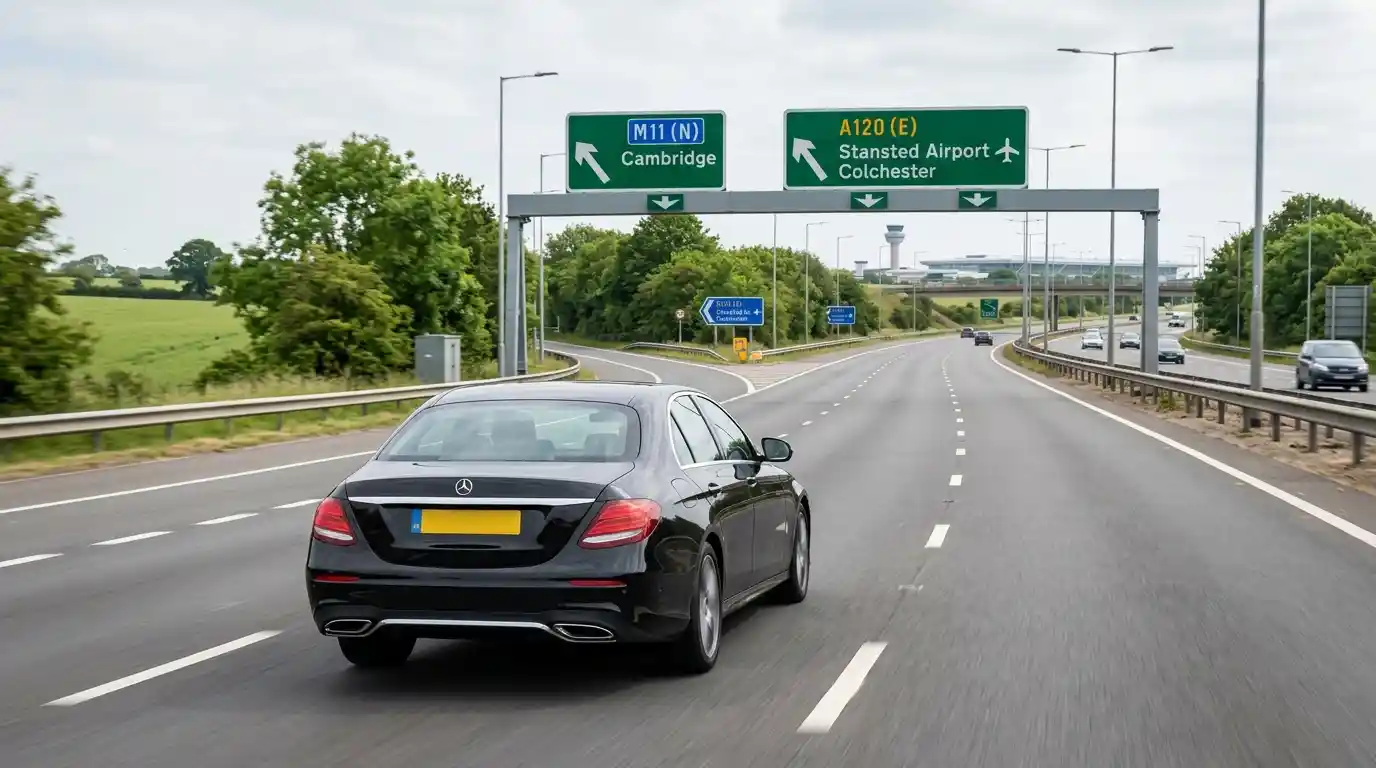
40 to 50 minutes by road via the M11 and A120 in normal conditions, and just over an hour during rush hour. One exposed section, no urban approach, no M25 — that is why Cambridge produces one of the narrowest journey-time ranges of any origin on this page. The gap between a good run and a bad one is around 20 minutes, and the lower end is reliably achievable in daylight off-peak.
East of England
Bishop's Stortford, Harlow, Saffron Walden, Braintree and Chelmsford are all short journeys, generally well under an hour, using the M11 or A120. These are local trips rather than airport expeditions. Colchester, Ipswich and Norwich take longer via the A120 or A14, which carry single-carriageway sections — these widen the range more than motorway miles would.
The Midlands
Roughly two hours ten minutes in clear conditions, via the M11, A14 and M6. Coventry, Leicester and Nottingham sit at comparable ranges. These journeys are dominated by the A14 and M6, so the M11's own peaks matter less than they do on shorter trips. Budget two and a half hours or more at peak periods.
The South and South-East
Oxford, Reading, Brighton, Southampton and Portsmouth all involve the M25, which is the single largest source of variability on any of them. A journey quoted at two hours can become three when the M25 is poor, and that is common rather than exceptional. Treat the upper end of any M25-exposed range as your planning figure.
Northern England
Leeds and Manchester are long-distance journeys where the M11 is a minor component. Total durations are governed by the M6, A1(M) and A14 rather than by anything specific to Stansted. These are full-day travel commitments — allow three to four hours and budget for the worst of whatever motorway governs your route.
Journey Times Between Stansted and Other London Airports
Airport-to-airport journeys are the least predictable trips on this page. Almost all of them involve the M25 — which means a good-day figure and a bad-day figure that bear little relation to each other.
| Route |
Typical |
Peak / worst case |
Main variable |
| Stansted ↔ Heathrow | 1h 30 – 2h 00 | 2h 30+ | M25 western section |
| Stansted ↔ Gatwick | 1h 45 – 2h 30 | 3h+ | M11, M25 and M23 — two exposed sections |
| Stansted ↔ Luton | 1h 00 – 1h 30 | 2h | M11, A505 or M25 northern section |
| Stansted ↔ London City | 1h 00 – 1h 30 | 2h | East London traffic |
| Stansted ↔ Southend | 1h 00 – 1h 30 | 1h 45 | A120 and A130 — avoids London |
Stansted to Heathrow
Typically 1 hour 30 minutes to 2 hours, via the M11 and M25 anticlockwise. The M25 western section is one of the busiest stretches of motorway in Britain and governs this journey entirely. Treat the upper figure as your planning number rather than the lower.
Stansted to Gatwick — the Longest Inter-Airport Journey
Typically 1 hour 45 minutes to 2 hours 30 minutes. The route uses the M11, M25 and M23 — two exposed motorway sections rather than one — which is why this is the longest and least predictable of the inter-airport trips. Treat any figure below two hours as an optimistic estimate.
Stansted to Luton
Typically 1 hour to 1 hour 30 minutes, shorter than Heathrow or Gatwick, using the M11 and A505 or the M25 northern section depending on route. The northern M25 is less congested than the western section, which is why Luton is the most manageable inter-airport trip from Stansted.
The Connection Warning
If you are connecting between airports on separate tickets, none of these ranges is safe to plan tightly against. A journey quoted at 90 minutes can take three hours when the M25 has an incident, and there is no alternative route that avoids the problem. Build in substantially more time than the typical figure — and wherever possible, treat inter-airport transfers as a same-day connection that gives you most of the day, not a 90-minute sprint.
How Much Does Journey Time Change During Peak Hours?
Peak versus off-peak is the largest single variable after origin. On the M11 corridor the difference between them can be an hour on the same journey.
Morning Peak — 07:00 to 09:00 Weekdays
Traffic flows towards London, so journeys into the capital are slowest and journeys out to Stansted are less affected than you might expect. The pinch point for airport traffic is M11 Junction 8 and the A120 approach, where airport-bound vehicles, local commuters and freight converge. If you are heading to Stansted during the morning peak, the M11's own outbound flow is usually manageable — it is the urban approach at the origin end that costs time.
Afternoon and Evening Peak — 17:00 to 19:00 Weekdays
Direction reverses. Journeys out of London to Stansted now run with the flow and are slowest, while inbound journeys ease. Friday evenings are the worst of the week, combining commuter traffic with weekend and holiday travel. A central London to Stansted journey at 17:30 on a Friday can take two hours or more with no incident on the road.
Off-Peak — 10:00 to 15:00 Weekdays
This is when the lower end of every range on this page becomes achievable. The M11 runs freely, Junction 8 is manageable, and the urban approaches clear. If your flight time allows you to leave during this window, the journey is predictable and the lower end of the typical range is realistic.
How Much Difference Does It Make?
On a central London journey: roughly an hour — the difference between the bottom and top of the 1-to-2-hour range. On a shorter journey like Cambridge: a smaller absolute penalty but similar proportionally — 40 to 50 minutes becoming just over an hour. The peak penalty is real on every corridor.
Are Stansted Journey Times Different on Weekdays and Weekends?
Yes — and the pattern is different rather than simply better at weekends.
- Weekdays: sharply peaked. Two clear congestion windows, a genuinely quiet middle of the day, and predictable behaviour you can plan around. The reward for travelling off-peak is real here.
- Weekends: flatter, with no commuter peak but a broader spread of leisure traffic. Saturday mornings and Sunday afternoons carry their own congestion, and the M25 does not empty at weekends. Journey times are generally more predictable than a weekday peak but less so than a weekday midday.
- Bank holidays: the commuter peak disappears but leisure traffic concentrates into the Friday evening before and the Monday evening after. Those two windows can be worse than a normal weekday peak.
- If you have flexibility: weekday midday is the steadiest window on the M11 corridor. Weekend mornings are second. Weekday peaks are the ones to plan around rather than through.
How Long Does It Take to Reach Stansted at Night?
Overnight road journeys are the fastest of the day — and the most relevant for Stansted, given when many of its flights depart.
Night Road Conditions
Between roughly 22:00 and 05:00, the M11 runs freely and journey times drop to the bottom of every range on this page. A central London run that takes 90 minutes at 08:00 can take under an hour at 03:00. This is the window that covers Stansted's concentrated pre-dawn departure wave — which is why so many journeys to this airport happen by road at hours when nobody would otherwise choose to drive.
Rail in the Same Window
The Stansted Express does not run overnight. The last service from Stansted leaves at around 00:30 and the first runs between 05:28 and 05:55 depending on the day. That five-hour gap coincides exactly with the pre-dawn departure window — which is why a pre-booked road transfer is not just convenient but often the only practical door-to-door option for early flights. Stansted Airport Taxi operates 24/7 and covers any pickup time, including 03:00 and 04:00 for first departures.
Overnight Roadworks
Worth knowing: motorway maintenance is scheduled overnight precisely because traffic is light. National Highways has run overnight closures on the M11 between Junctions 7 and 8, adjacent to the airport junction. A clear road at 02:00 is not the same as an open one. Check National Highways for planned closures before an overnight journey rather than assuming empty roads mean a fast run.
Do Stansted Journey Times Change During Holidays?
Yes — in two distinct ways that are worth understanding separately.
- School holidays: the baseline rises across the whole day rather than at the peaks. Leisure traffic fills the midday window that is normally quiet, so the dependable off-peak gap narrows considerably. July and August are the most affected, followed by Easter and the October half term. Add 30 minutes to any journey during a school holiday period as a minimum.
- Bank holidays: the commuter peak disappears but leisure traffic concentrates into the Friday evening before and the Monday evening after. Treat bank holiday Friday and Monday evenings as peak conditions regardless of the hour.
- Christmas and New Year: the quietest driving period of the year on the M11 corridor, with the exception of the days immediately before Christmas. Between Christmas and New Year, journey times are often at their overnight-level best during daylight hours.
What Can Make a Journey to Stansted Take Longer?
The honest list, in rough order of how often each one affects a real journey.
- Peak-hour traffic. The most predictable cause and the easiest to plan around — budget the upper end of the range and you have accounted for it.
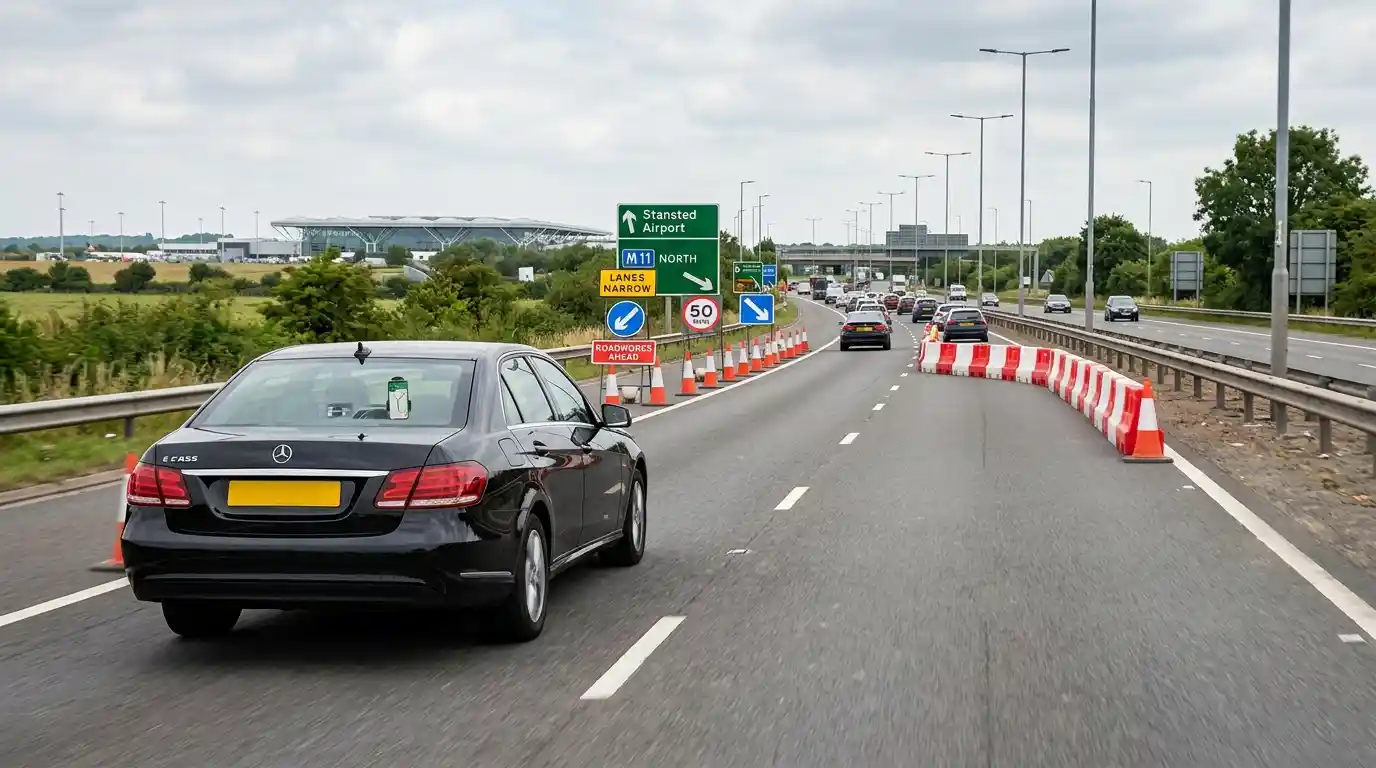
- M11 incidents. The most disruptive. The M11 has limited alternative routes, so an incident affects every road journey to Stansted simultaneously. No amount of planning buffers against an unpredicted closure — it changes the upper end of the range while you are on the road.
- M25 conditions. On any journey approaching from the south or west, or between airports. The western M25 runs near capacity through much of the day and fails unpredictably.
- Junction 8 congestion. The airport junction handles passenger vehicles, taxis, coaches and freight together. It is a known constraint and a target for local improvement schemes.
- Roadworks, particularly overnight closures on the M11 near the airport. Scheduled rather than random — check National Highways before an overnight journey.
- Weather. Fog, heavy rain, ice and high winds all reduce speeds on the M11 corridor, which is exposed in places. Weather-related delays compound peak conditions rather than substituting for them.
- School holidays and bank holidays, which raise the baseline rather than creating a spike.
- Terminal-area traffic at the drop-off forecourt during peak departure waves — the last few hundred metres can add meaningful time when the forecourt is congested.
Are Stansted Airport Journey Times Guaranteed?
No — and understanding why matters for how you plan.
Estimated vs Actual Journey Time
An estimated journey time is a prediction based on stated assumptions — normal conditions, a defined route, a defined start and end point, and typical traffic for the time of day. An actual journey time is what happens on the day, which depends on conditions nobody can see in advance. One incident on the M11 can double a journey with no warning. Every road figure on this page is an estimate in that sense — honest, based on published data, and not a promise.
Why This Matters for Flight Planning
Planning against an estimate as though it were a promise is how people miss flights. The estimate tells you what a normal journey looks like. It tells you nothing about whether today is normal. Use the upper end of any range as your planning figure, not the middle and certainly not the lower — then add a buffer on top of that, as set out below.
Rail Is the Exception
The Stansted Express is scheduled at 48 minutes from Liverpool Street. This holds far steadier than any road estimate — it does not sit in traffic, does not vary with the M11, and does not produce the range that a road journey does. Rail can be delayed, but it cannot be stuck behind an incident for 45 minutes the way a car can.
Why Published Sources Give Different Times
Because they assume different start points, different routes, different times of day, and different traffic conditions. Two sites quoting 60 and 90 minutes for the same journey can both be defensible. This page uses ranges rather than single figures throughout, because a single number implies a precision that road journeys do not have.
How Much Extra Time Should You Allow?
Journey duration and planning buffer are two different things. Conflating them is the most common planning mistake — the buffer sits on top of the journey, not inside it.
Step 1 — Start From Bag Drop, Not Departure
Your airline's bag drop deadline is the real hard deadline — it typically closes 40 to 60 minutes before departure. Add the recommended airport arrival window on top: two hours before European flights, three before long-haul and charter. That gives you a time you must be inside the terminal. Work backwards from there, not from the gate time on your boarding pass.
Step 2 — Use the Upper End of the Journey Range
The upper end of each range on this page describes what a bad-but-not-exceptional journey looks like. Use that figure, not the typical or the lower end. A journey that takes the full two hours when you planned for 90 minutes is not bad luck — it is a predictable outcome of planning against the optimistic end of a range.
Step 3 — Add a Buffer Scaled to Your Exposure Count
The buffer accounts for abnormal events — incidents, closures, weather — that the range does not. Scale it to how many exposed sections your route crosses:
One exposed section (east London, Cambridge): add 20–30 minutes.
Two exposed sections (central or north London): add 30–45 minutes.
Three exposed sections (south or west London, M25 routes): add 45–60 minutes.
Airport-to-airport connections: add significantly more — the M25 makes even the upper end optimistic.
The Overnight Exception
Overnight journeys between 22:00 and 05:00 need a smaller traffic buffer — the M11 runs freely and times drop to the bottom of every range. Replace the traffic buffer with a check for planned roadworks, which are scheduled precisely in this window. A clear road and a closed road are both possible at 03:00.
The Return Leg Is Not the Mirror
Many passengers plan the outbound journey and assume the return takes the same time. It does not — peak traffic is directional, so the same journey at a different hour or in a different direction produces a different result. Plan each leg separately rather than mirroring the outbound.
For a Flight You Cannot Miss
Pre-booked private hire with flight tracking removes the variables you cannot control. Stansted Airport Taxi monitors your flight and adjusts the pickup if your return times move. A fixed fare confirmed at booking, door-to-door from your address, with no peak surges — the option when the upper end of a range and a buffer on top still feel like more risk than the journey warrants.
Stansted Airport Journey-Time Reference Table
Off-peak, typical and peak figures for every major origin. Rail rows show scheduled times, which do not vary with traffic. Road rows show typical driving durations.
| Journey |
Off-peak |
Typical |
Peak / worst |
| Central London → Stansted (road) | ~1h 00 | 1h 00 – 1h 30 | Up to 2h |
| East London → Stansted (road) | Under 1h | ~1h | 1h 30+ |
| West London → Stansted (road) | 1h 15 | 1h 30 | 2h+ |
| South London → Stansted (road) | 1h 15 | 1h 30 | 2h+ |
| Liverpool Street ↔ Stansted (rail) | 48 min | 48 min | 48 min |
| Tottenham Hale ↔ Stansted (rail) | 36 min | 36 min | 36 min |
| Stratford ↔ Stansted (rail) | ~1h | ~1h | ~1h |
| Cambridge → Stansted (road) | 40 min | 40 – 50 min | Just over 1h |
| Birmingham → Stansted (road) | 2h 10 | 2h 10 – 2h 30 | 3h+ |
| Heathrow ↔ Stansted (road) | 1h 30 | 1h 30 – 2h | 2h 30+ |
| Gatwick ↔ Stansted (road) | 1h 45 | 1h 45 – 2h 30 | 3h+ |
| Luton ↔ Stansted (road) | 1h 00 | 1h 00 – 1h 30 | 2h |
| London City ↔ Stansted (road) | 1h 00 | 1h 00 – 1h 30 | 2h |
| Southend ↔ Stansted (road) | 1h 00 | 1h 00 – 1h 30 | 1h 45 |
Related Stansted Airport Guides
Continue with whichever guide covers your next planning step.
The 48-minute figure in full detail — Stansted Express timetables, fares, Railcard rules, the first-train variation by weekday, and the overnight gap that affects early departures.
Train, coach, bus and the overnight gap compared honestly — the companion guide for anyone planning a journey that does not start with a car.
Bag drop deadlines, the 100ml liquid rule and how much time to allow between arriving at the terminal and clearing security — the guide that sets the destination end of any journey-time calculation.
What happens between landing and the car park or train platform — eGates, baggage reclaim, customs and the walking times that determine when you actually leave the terminal.
If you are driving, the car park shuttle times are an extension of your journey time — Mid Stay adds ~20 minutes, Long Stay adds ~35 to 40. This guide covers all five products and the booking decision.
The terminal building itself — satellite walking distances (up to 15–20 minutes to Satellite 3), transport connections and where the railway station and coach station sit relative to the terminal doors.
Frequently Asked Questions
Q: How long does it take to get to Stansted Airport from London?
A: By road, typically one hour to an hour and a half from central London, and up to two hours in bad traffic. By rail, a scheduled 48 minutes from Liverpool Street — this does not change with traffic conditions.
Q: How long is the drive from central London to Stansted?
A: Around an hour with a clear M11, and up to two hours during the weekday peak or after an incident. The wide range is genuine — road journeys on this corridor vary substantially depending on the hour and the day.
Q: How long does the train take from London to Stansted?
A: 48 minutes from Liverpool Street, 36 minutes from Tottenham Hale, and about an hour from Stratford. These are scheduled times and do not vary with traffic — the key advantage of rail over road on this corridor.
Q: Is the journey to Stansted quicker by train or car?
A: By train for central London, and not close. The train is fixed at 48 minutes while the drive ranges from one to two hours. A car wins on door-to-door convenience, groups and luggage — not on time.
Q: How long does it take from Cambridge to Stansted?
A: 40 to 50 minutes by road via the M11 and A120 in normal conditions, and just over an hour during rush hour. One of the shortest and most predictable airport journeys in the region.
Q: How long between Stansted and Heathrow?
A: Typically an hour and a half to two hours by road, via the M11 and M25 anticlockwise. The M25 western section governs this journey — treat the upper figure as your planning number rather than the lower.
Q: How long between Stansted and Gatwick?
A: Typically an hour and 45 minutes to two and a half hours — the longest inter-airport journey, because it uses the M11, M25 and M23 with two exposed motorway sections. Allow at least two hours as your planning figure.
Q: When is traffic worst on the way to Stansted?
A: Roughly 07:00 to 09:00 and 17:00 to 19:00 on weekdays, with Friday evenings the worst of the week. The M11 Junction 8 approach is the main pinch point for airport-bound traffic.
Q: Does the Stansted journey take longer in one direction than the other?
A: It can. Peak traffic is directional — a journey running with the commuter flow is slower than the same journey against it. Leaving London for Stansted at 17:30 is slower than arriving into London at that hour.
Q: How much extra time should I allow for a journey to Stansted?
A: Use the upper end of the relevant range, then add a buffer on top: 20–30 minutes for one exposed section (east London, Cambridge); 30–45 minutes for two; 45–60 minutes for three (south/west London, M25 routes). Work backwards from your bag drop deadline, not your departure time.
Q: Are Stansted journey times guaranteed?
A: No. Every road figure is an estimate based on normal conditions. One incident on the M11 can double a journey with no warning. Use the upper end of each range as your planning figure, and add a buffer on top.
Q: Is it quicker to travel to Stansted at night?
A: Yes. Between roughly 22:00 and 05:00 the M11 runs freely and journeys fall to the bottom of every range. Check for planned overnight roadworks before assuming an empty road — maintenance is scheduled precisely when traffic is light.
Planning Your Journey to Stansted Airport
The single most useful thing to take from this page is that the answer depends on your mode more than your mileage.
By rail, central London to Stansted is 48 minutes. That figure does not move. By road, the same trip is somewhere between one and two hours, and which end you land on depends on the hour, the direction, the day of the week and whether the M11 is having a good afternoon. Plan differently for each. For rail, plan against the timetable. For road, use the upper end of the range and then add a buffer on top — 30 minutes off-peak, 45 to 60 at peak. Three things reliably catch people out: assuming the return mirrors the outbound; planning an airport-to-airport connection against a typical figure; and treating an estimate as a promise.
- ✔ Pre-booked transfers available at any hour — covering the overnight gap when no train runs
- ✔ Fixed fare confirmed at booking — no peak surges, no meter, no variable pricing
- ✔ Flight tracking on every job — pickup adjusts if your landing time moves
- ✔ Door-to-door from your address to the terminal forecourt — no last-mile connection to manage
- ✔ Full vehicle range: Saloon, Estate, MPV5–8, Executive and Minibus for groups
👉 Book your transfer in under two minutes — book online or call +44 20 3617 7825. See also our Rail Services Guide, Public Transport Guide and Check-in & Security Guide.
Last reviewed August 2026 · Stansted Airport Taxi editorial team. Sources: London Stansted Airport; Stansted Express timetables; National Highways M11 maintenance. Next review: February 2027 — journey times shift with roadworks and timetable changes.