Stansted still applies the 100ml liquid limit. Heathrow, Gatwick, Birmingham and Edinburgh no longer do. That single difference catches out more travellers here than anything else — because the scanners at Stansted look identical to the ones that lifted the limit elsewhere, and the rules around laptops and clear plastic bags have changed in exactly the same way. Only the liquid cap remains, and it remains for a specific reason: government approval for the scanner supplier's algorithm is still pending.
This guide covers everything you need before your flight at Stansted — check-in options, bag drop, documents, security screening, restricted items, families, Fast Track and the timing of your whole journey. From Stansted Airport Taxi, a TfL-licensed private-hire operator running 24/7 transfers to and from the airport.
Stansted Check-in & Security: The Short Version
If you only read one section, read this. The essential numbers, the changed rules and the one rule that has not changed — all in one place.
| Item |
What you need to know |
| Arrive | 2 hours before European/domestic flights; 3 hours for long-haul or charter |
| Bag drop closes | Typically 40–60 minutes before departure — airline-set, not airport-set |
| Liquids | 100ml per container — still in force at Stansted (unlike Heathrow, Gatwick, Birmingham, Edinburgh) |
| Clear plastic bag | No longer required — liquids under 100ml can stay in your hand luggage |
| Laptops | Stay in your bag — no need to remove |
| Security Fast Track | From £6.49 per person; open 04:00–20:00; lounge access is separate |
| Free assistance lane | Available at no charge for passengers with infants under 3 or special assistance needs |
| Power banks | Cabin only — never in a checked bag |
The one thing to settle before you travel. The liquid rule is the Stansted-specific trap. If your last flight left from Heathrow or Gatwick, you carried full-size bottles through security. You cannot do that here. Every container in your hand luggage must be 100ml or smaller — transfer anything larger to your hold bag before you leave home.
Preparing Before You Arrive at Stansted Airport
Almost every problem at Stansted departures starts before the airport — a liquid packed in the wrong bag, a passport not checked against the destination's rules, or a journey timed against the departure rather than the bag drop deadline.
How Early Should You Arrive?
Allow two hours for European and domestic flights, and three hours for long-haul or charter departures. Stansted's early-morning waves are the busiest period of the day, so a 6am departure warrants the full two hours rather than a shortened version of it. Work backwards from your airline's bag drop deadline — that is the real hard deadline, typically 40 to 60 minutes before departure — and add your journey time on top.
Passports and Travel Documents
Check your passport expiry against your destination's rules, not against your flight date. Many countries require validity beyond your return date. Check whether your destination needs a visa or an electronic travel authorisation — the airline verifies this at the desk and will refuse boarding without it. Name mismatches between your booking and your passport cause more problems than expired documents, so check the name on your booking is exactly as it appears on your passport.
Boarding Pass
Download your boarding pass and screenshot it. Airport Wi-Fi at Stansted is free and generally reliable, but a screenshot works when the network does not. If your airline requires a printed boarding pass for your nationality or route, arrange that at home rather than at the airport — some low-cost carriers are firm on this.
Cabin and Checked Baggage
Weigh and measure your cabin bag before leaving home. Low-cost carriers at Stansted enforce dimensions strictly at the gate, and gate bag fees are considerably higher than the online equivalent. Measure with handles and wheels included, because that is how the sizer measures. Pack any liquids over 100ml into your hold bag while you still can — once the hold bag has been checked in, that option is gone.
Pre-Departure Checklist
- Passport: valid for your destination's full entry requirement, not just your travel dates.
- Visa or travel authorisation: obtained where required by your destination country.
- Boarding pass: downloaded, screenshotted, added to your phone wallet.
- Liquids: every container in your hand luggage is 100ml or smaller — anything larger is in the hold bag.
- Cabin bag: weighed and measured within your airline's allowance, handles and wheels included.
- Hold bag: within your airline's weight limit.
- Power banks: in your hand luggage, not your hold bag.
- Arrival time: two hours before European/domestic, three hours before long-haul.
- Transport to Stansted: confirmed — especially for early departures before trains run.
Stansted Airport Check-in Options Explained
Four ways to check in — each suited to a different type of passenger and booking. Online is the default; everything else handles what online cannot.
| Check-in method |
Best for |
Notes |
| Online check-in | Hand luggage only; standard bookings | Most airlines open 24–48 hrs ahead; some low-cost carriers open earlier. Do it as soon as it opens. |
| Mobile check-in | Hand luggage only; tech-comfortable travellers | Add the pass to your phone wallet. Keep screen brightness high — barcode readers struggle with dim displays. |
| Self-service kiosk | Passengers with hold bags who did not check in online | Print bag tags at the kiosk, then take the tagged bag straight to bag drop belt. |
| Staffed desk | Complex bookings, document checks, group travel | Desks track individual flights, not the building's hours — typically open a few hours before each departure. |
| Special assistance desk | Passengers who need support at check-in | Central part of the terminal between check-in and arrivals. Arrange assistance with your airline 48 hrs ahead. |
Which Option Is Right for You?
- Hand luggage only, checked in online: walk straight to security — you do not need the check-in hall at all.
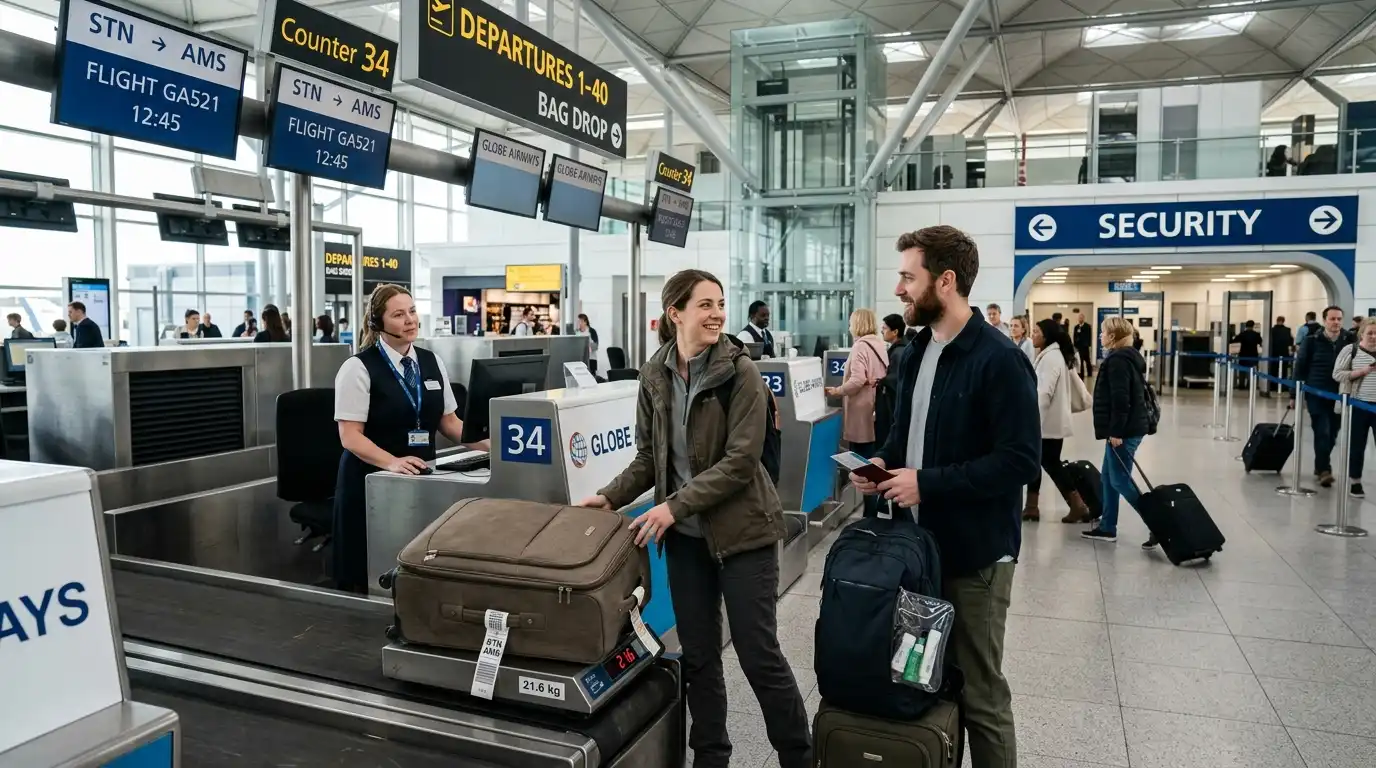
- Hold bag, checked in online: use a kiosk to print bag tags, then self-service bag drop.
- Hold bag, not yet checked in: kiosk to check in and tag, then bag drop.
- Complex booking or documents to verify: staffed desk is the right choice, even if it means a queue.
When Check-in Opens and Closes
Airlines set their own deadlines and they are firm. Bag drop typically closes 40 to 60 minutes before departure, and gates typically close 20 to 30 minutes before. Missing the bag drop deadline by minutes usually means missing the flight — there is no discretion at the desk once the belt has closed.
Bag Drop Process at Stansted Airport
Bag drop is the hardest deadline in the whole departure process. Everything before it is preparation; missing it ends the journey.
Self-Service Bag Drop
If you checked in online and have tagged bags, self-service bag drop places the tagged bag directly on the belt. Scan your boarding pass, place the bag, confirm the weight. It is faster than a staffed desk when it works, and slower when something needs manual override — weight discrepancies, missing tags and system errors all push you to a staffed desk regardless.
Staff-Assisted Bag Drop
Staffed desks handle anything the machines cannot: overweight bags, unusual items, missing tags and group bookings. If your bag is close to the weight limit, a staffed desk is the better choice — an agent can tell you the excess charge before you commit, rather than discovering it after the bag is on the belt.
Cabin vs Checked Baggage — the Liquid Rule
Cabin baggage passes through security and faces the 100ml liquid limit. Checked baggage goes into the hold and does not. The practical rule: anything liquid over 100ml belongs in the hold bag. Once the hold bag has been checked in at bag drop, that option is closed — anything over 100ml in your hand luggage from that point will be confiscated at security.
Oversized and Special Baggage
Oversized items — skis, golf clubs, bicycles, large instruments — go to a separate handling desk rather than the standard belt. Declare them at check-in so you are directed correctly. Allow extra time, because oversized handling is a separate queue and is not always adjacent to your check-in bank.
Mobility Equipment and Medical Items
Wheelchairs and mobility aids travel free and are handled separately from standard baggage. Tell your airline at booking and at least 48 hours before departure. Medical equipment and prescription medication can travel in the cabin — the security section below covers what documentation to carry.
Three Common Bag Drop Mistakes
- Arriving after the deadline: bag drop deadlines are earlier than most people expect — 40 to 60 minutes before departure, not at departure.
- Liquids in the wrong bag: liquids over 100ml must go in the hold bag, but the hold bag has already been checked in. This is always avoidable if you pack correctly at home.
- Power bank in the hold bag: power banks and spare lithium batteries are not permitted in checked baggage. They will be removed by handlers if found, potentially delaying your hold bag. They must be in your hand luggage.
Travel Documents and Passenger Verification
Airlines verify documents because they carry liability for passengers refused entry at the destination. That is why the check at the desk can feel more rigorous than a border control — have everything accessible rather than buried.
Passport Verification
Your airline checks your passport at bag drop or the gate, and again for international departures. The check confirms the document is valid, matches your booking, and satisfies your destination's entry rules. Name mismatches between booking and passport are the most common cause of a hold-up — check the name on your ticket matches your passport exactly, including middle names where the airline has included them.
Visas and Electronic Authorisations
Where your destination requires a visa or an electronic travel authorisation (such as the EU ETA, US ESTA or similar), the airline verifies it before boarding. Requirements depend on your nationality and your destination, and they change. Check the official government source for your destination country rather than a travel forum — and check it close to your departure, not at the time of booking.
Boarding Pass Requirements
You need a boarding pass to pass security. Digital passes are accepted throughout Stansted. Some airlines require certain passengers to hold a printed pass — usually where documents need manual verification — so check your booking confirmation for that instruction. If a printed pass is required, print it at home rather than at the airport.
International Travel Documentation
Beyond passport and visa, some destinations require onward tickets, proof of accommodation, travel insurance or health documentation. These are destination-country requirements rather than airport ones, but the airline enforces them at check-in. If you are unsure what your destination requires, check before the day of travel — not at the desk.
What Happens if a Document Is Missing
If a required document is missing, the airline will not board you. There is no discretion at the desk. Some documents — electronic travel authorisations, for example — can be applied for online while at the airport, but processing time is not guaranteed and cutting it fine is a significant risk. The only safe approach is to check everything before you leave home.
Stansted Airport Security Screening Process
The process itself is straightforward. The rules around what has changed and what has not are where Stansted travellers need to pay attention — particularly if your last flight departed from a different airport.
What Happens at Security
You show your boarding pass, place your belongings in a tray, walk through a body scanner, and collect your things on the other side. At Stansted, every lane now carries next-generation scanning equipment, which changes what you have to unpack — but not the liquid limit itself.
Preparing Before You Reach the Lane
- Boarding pass: have it ready — phone unlocked and the pass showing, or the printed copy in hand.
- Pockets: empty everything into your bag rather than into a tray. Coins, keys and phones in trays slow everyone down and get left behind.
- Coat and belt: remove your coat and any belt with a substantial metal buckle before you reach the front of the queue.
- Liquids: they can stay in your bag at Stansted — no clear plastic bag is required. But every container must be 100ml or under. If any container is larger, it will be confiscated.
- Laptop: stays in your bag. No need to remove it at Stansted.
Cabin Baggage Screening — What Has Changed
Passengers at Stansted no longer need to remove large electrical items such as laptops from their hand luggage, and no longer need to place liquids in clear plastic bags. The new scanners produce three-dimensional images, so bags can be read without being unpacked. This is a genuine improvement over the previous process — but it has not changed the 100ml cap on liquid containers.
Personal Screening
You walk through a body scanner. Staff may ask you to remove shoes — particularly boots and thick-soled footwear — and may carry out a hand search either randomly or because the scanner flagged something. A private search area is available if you would prefer not to be searched in public; tell an officer before the process begins.
Additional Checks and Manual Searches
The new scanners are sensitive, and manual bag searches are more common than they were under the old equipment. Ordinary items — certain bottles, dense food items, stacked electronics — can trigger them. A search is not a suspicion; it is the equipment flagging something it cannot fully read. An organised bag is repacked in seconds; a jumbled one takes minutes.
After Completing Security
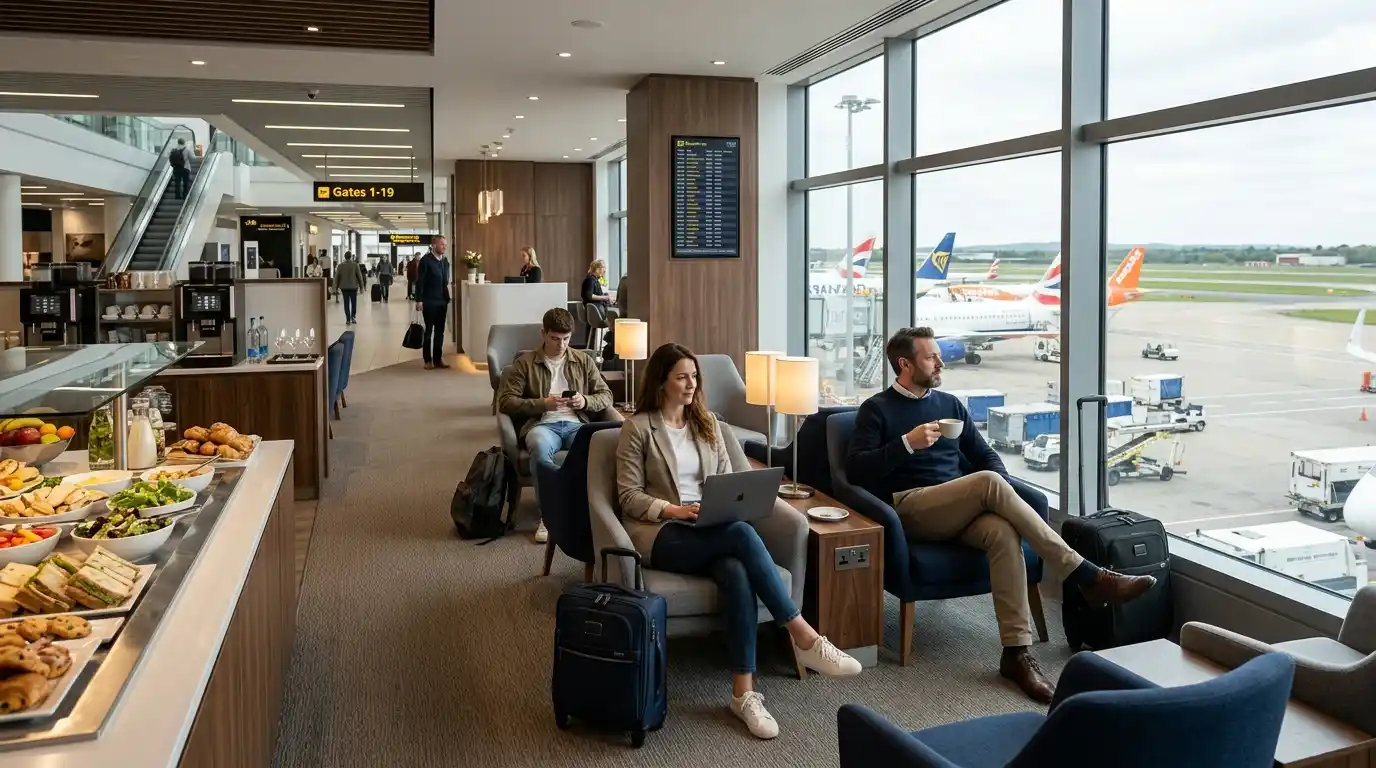
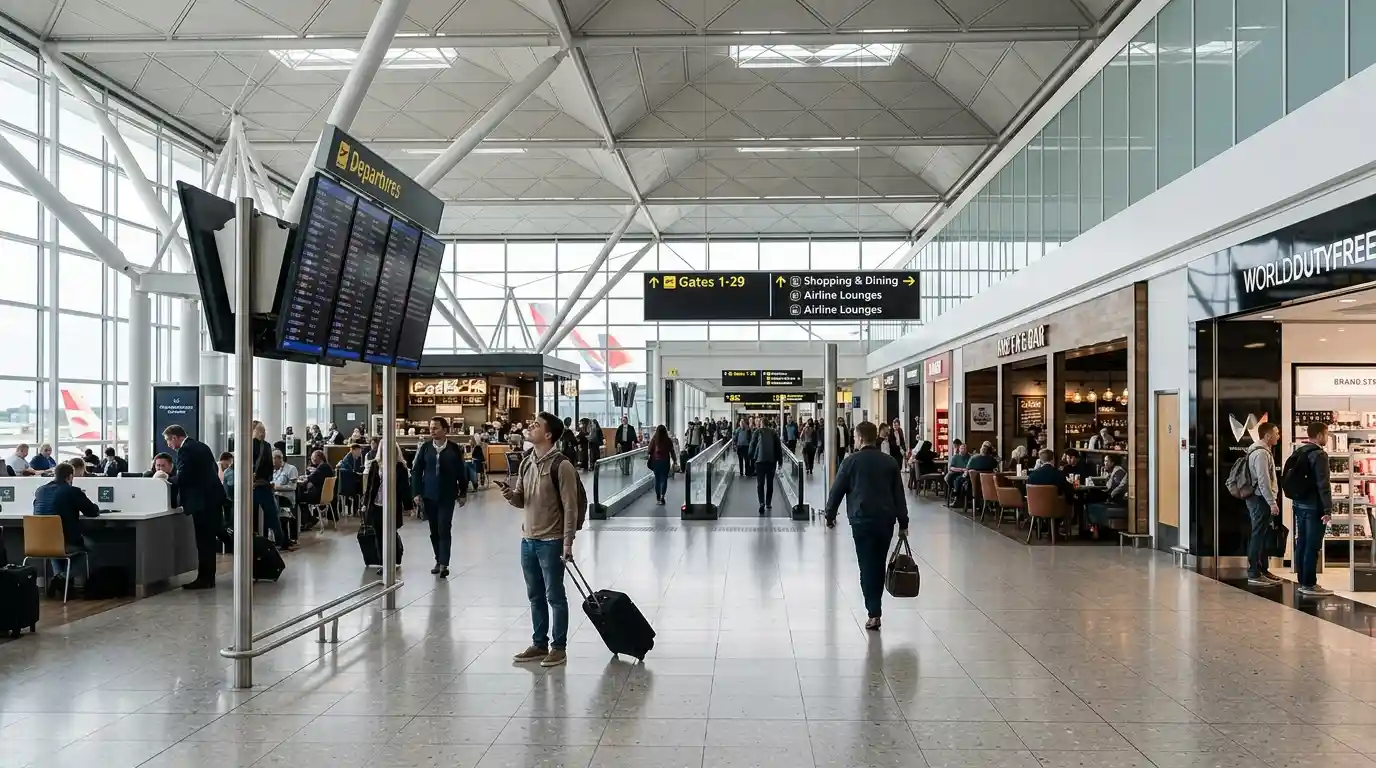
Repack fully before you move away from the belt — items left at the screening area are handed to lost property rather than held at the lane. Then check the screens immediately for your gate, because Stansted allocates gates late and your gate range — Gates 1–19, 20–39 or 40–59 — determines whether you have a four-minute walk or a twenty-minute one. Our departure lounge guide covers what to do once you are airside.
Security Rules and Restricted Items at Stansted
Read this section carefully if you have flown from Heathrow or Gatwick recently. The rules here are different in one critical respect — and the equipment looks identical to the airports that changed their rules.
Liquids, Aerosols and Gels — the Stansted Rule
Every liquid, gel and aerosol in your hand luggage must be in a container of 100ml or smaller. Containers larger than 100ml are not permitted through security even if only part full. Liquids under 100ml no longer need to be in a clear plastic bag and can stay in your hand luggage — but the 100ml container limit has not changed.
Here is why, and why it matters. The airport has confirmed that although all security lanes now have the latest scanning equipment fully installed and operating, the scanner supplier is awaiting government approval for its algorithm before the 100ml limit can be lifted. Heathrow, Gatwick, Birmingham and Edinburgh now allow containers up to two litres. Stansted, Manchester and Luton do not.
If you flew out of Heathrow last month with a full-size shampoo bottle in your hand luggage, do not assume the same applies here. The equipment looks the same; the rule is not.
Electronic Devices
- Laptops and tablets: stay in your bag — no need to remove at Stansted.
- Larger or unusual electronics: may still be pulled for a manual check even with the new scanners, if the image is unclear.
- Power banks and spare lithium batteries: must travel in the cabin — never in the hold bag. This is the opposite of what many travellers assume, and a power bank discovered in a checked bag will delay that bag or see it removed entirely.
Clothing, Footwear and Accessories
Remove coats and jackets before the scanner. Belts with substantial metal buckles need to come off. Staff may ask you to remove shoes, particularly boots and thick soles. Wearing simple footwear and minimal metal shortens your transit through the lane and reduces the chance of a second pass through the scanner.
Prohibited Items in the Cabin
Sharp items, tools over a certain length, flammables and anything resembling a weapon are prohibited in the cabin. Toy and replica guns — whether plastic or metal — are confiscated at security, and it is an offence to carry certain items into an aircraft cabin. Check the airport's full prohibited items list before packing anything you are unsure about.
Duty-Free Liquids Through Security
Liquids bought airside from Stansted's shops are not subject to the 100ml limit — which is why the airside shops sell full-size bottles. If you are connecting through another airport on your return, keep the sealed bag and the receipt, because transfer security at some airports may need to verify the purchase was made airside.
Medicines and Medical Equipment
Essential prescription medication may be carried in containers over 100ml through security, including liquid dietary foodstuffs and inhalers. Carry a prescription or a doctor's letter for any medication over 100ml. Declare medication at the lane rather than letting it be found in a search — telling an officer first avoids the item being treated as a prohibited liquid and speeds the process considerably.
Food and Drinks
Solid food passes through security without issue. Sauces, soups, yoghurt, jam and honey count as liquids and face the 100ml limit. Drinks opened before security cannot pass through, but you can take an empty bottle and fill it at a water point airside — most airports, including Stansted, provide them.
Families, Children and Accessibility at Stansted Security
Stansted has specific provisions for passengers with infants, families, reduced mobility and hidden disabilities. Here is what is available and how to use it — including the free fast lane that many families pay to avoid.
Travelling with Infants and Young Children
Passengers travelling with an infant under three are directed to the assistance lane at no charge. Take that lane rather than paying for Fast Track — the outcome is the same and the lane is free. Fold pushchairs before the scanner and expect them to be screened separately. Allow extra time for the pushchair to clear the belt before you collect it.
Baby Milk, Formula and Baby Food
Baby milk, formula and liquid baby food are exempt from the 100ml limit in quantities reasonable for your journey. You may be asked to taste the contents of each bottle or jar — this is standard procedure and not a suspicion. Bring what you need for the journey rather than a full holiday supply, which may attract more scrutiny at the lane.
Mobility Aids and Wheelchairs
Wheelchairs and walking aids go through security with you and are screened by hand where necessary. If you are travelling in a wheelchair but can stand, officers may ask you to stand briefly for the body scanner, and walking aids are available if needed. If you cannot stand, you can remain in your wheelchair and receive a hand search instead. A private search area is available on request.
Medical Equipment
Medical devices travel in the cabin and are screened separately. Bring supporting documentation for any device that cannot safely pass through a scanner. Tell staff before the device reaches the belt — not after — so they can arrange an alternative check method. This avoids the device being treated as an unidentified item and speeds your clearance considerably.
Hidden Disabilities and the Sunflower Lanyard
Stansted operates the Sunflower Lanyard scheme, which signals to security staff that a passenger may need extra time, patience or a quieter process without requiring an explanation or documentation. Wearing one is voluntary and requires nothing except collecting the lanyard at the airport. Staff are trained to recognise it. The assistance lane is available to Sunflower Lanyard wearers.
Assistance Dogs
Assistance dogs have their own security search process, separate from the standard passenger flow. Tell an officer before you reach the scanner so the correct process is followed. Your dog will not go through the body scanner. Keep the dog's documentation — vaccination records and certification — accessible alongside your own travel documents.
Understanding Fast Track Security at Stansted
Fast Track is a paid express lane — not a different security process, and not a route to the lounge. Here is what it is, what it costs and when it is actually worth buying.
What Fast Track Is
Security Fast Track is a paid queue for the main security checkpoint. It is the departures version — there is a separate Passport Control Fast Track for arrivals. Neither includes lounge entry. Fast Track and lounge access are bought separately at Stansted; buying one gives you no claim on the other. The screening rules in the Fast Track lane are identical to the standard lane — it is the queue you are paying to skip, not a different process.
Cost and Availability
- Security Fast Track: from £6.49 per person; open 04:00–20:00.
- Fast Track Plus: from £9.99 per person — routes you directly towards the gates without passing through the duty-free area.
- Booking: available up to 12 months in advance; every passenger needs their own pass, including children.
- Not included: lounge access — see our Stansted lounges guide for what that costs separately.
When Fast Track Is Worth It
Fast Track earns its keep at Stansted's early-morning peak — roughly 04:00 to 08:00 — when standard queues are longest and the departure wave is most concentrated. A midday or midweek departure can clear standard security in minutes, making the cheapest queue-skip simply timing your arrival correctly rather than paying for the lane.
When Fast Track Is Not Worth Buying
- You qualify for the free assistance lane: passengers travelling with an infant under three, or those needing special assistance, have access to a free lane. Do not pay for Fast Track if you already qualify.
- Your departure is midday or later on a weekday: standard lanes move quickly outside the morning peak and school holiday periods.
- You are buying it for the lounge: Fast Track does not include lounge access at Stansted. Check our lounges guide for the correct purchase.
Common Passenger Mistakes Before Departure
Eight mistakes that recur at Stansted — most of them avoidable before you leave home.
- Arriving too late. The single most expensive mistake. Bag drop deadlines are firm, and Stansted's morning peak means the queue you budgeted for can be twice as long as expected. Two hours for European flights is the floor, not a cushion — and it is time before bag drop closes, not before departure.
- Forgotten or invalid travel documents. Passports left at home, expired documents against the destination's requirement, and missing electronic authorisations all stop you at the desk. Check validity against your destination's rules, not your travel dates.
- Oversized cabin bag. Measured at the gate with handles and wheels included. Gate bag fees are substantially higher than the online rate. Measure at home before you pack.
- Carrying prohibited items. Penknives in day bags, tools left in a rucksack from a previous trip, lighters in jacket pockets. Empty and repack any bag you have used for something other than travel.
- Liquids for the wrong airport. The Stansted-specific trap. Travellers who recently flew from Heathrow or Gatwick assume the two-litre allowance applies here. It does not. Every container must be 100ml or smaller.
- Power bank in the hold bag. Power banks must be in the cabin. A power bank discovered in a checked bag will be removed by handlers, potentially delaying your luggage.
- Reading the airport guidance instead of the airline's. Baggage rules, check-in deadlines and boarding pass formats are set by the airline, not the airport. When the two differ, the airline wins — and the airport cannot help you if you relied on the wrong source.
- Dense packing that triggers a search. Stacked cables, overlapping electronics and clustered food items produce scanner images the equipment cannot read cleanly. Packing electronics loosely and food in a single accessible spot reduces the chance your bag is pulled.
Planning Your Journey to Stansted Airport
Get the timing right before the day and the airport process becomes straightforward. Get it wrong and the margin for error is almost none — especially on Stansted's early-morning waves.
How Much Time to Allow
Work backwards from your bag drop deadline rather than your departure time. Add two hours before departure for European and domestic flights, then add your journey time to the airport, then add a buffer for traffic and transit variability. For long-haul or charter departures, start with three hours rather than two. Stansted's early departures mean many passengers are travelling in complete darkness, with no train running — confirm your transport before the day rather than on it.
Peak Travel Periods
- Early mornings (04:00–08:00): the heaviest departure wave, every day. Security and bag drop queues are at their longest. A 6am flight warrants arrival at 04:00 or earlier.
- Friday and Sunday evenings: lighter on departures but heavier on the M11 and A120 approach roads.
- School holidays — July and August, Easter and Christmas: add at least 30 minutes to your normal allowance. Family traffic moves more slowly through bag drop and security, the assistance lane is busier, and check-in queues extend further.
- Summer overall: Stansted expects more than 6.5 million passengers across a peak summer season. Treat the whole period as peak, not just the school holiday weeks.
Early Morning vs Evening Departures
Early departures face the longest queues inside the airport but the clearest roads approaching it. Evening departures face shorter queues at check-in and security but significantly heavier traffic on the M11 approach. If you are being driven or driving yourself, that trade is real — account for it when choosing your departure window and confirming your transfer pickup time.
Confirming Your Transfer
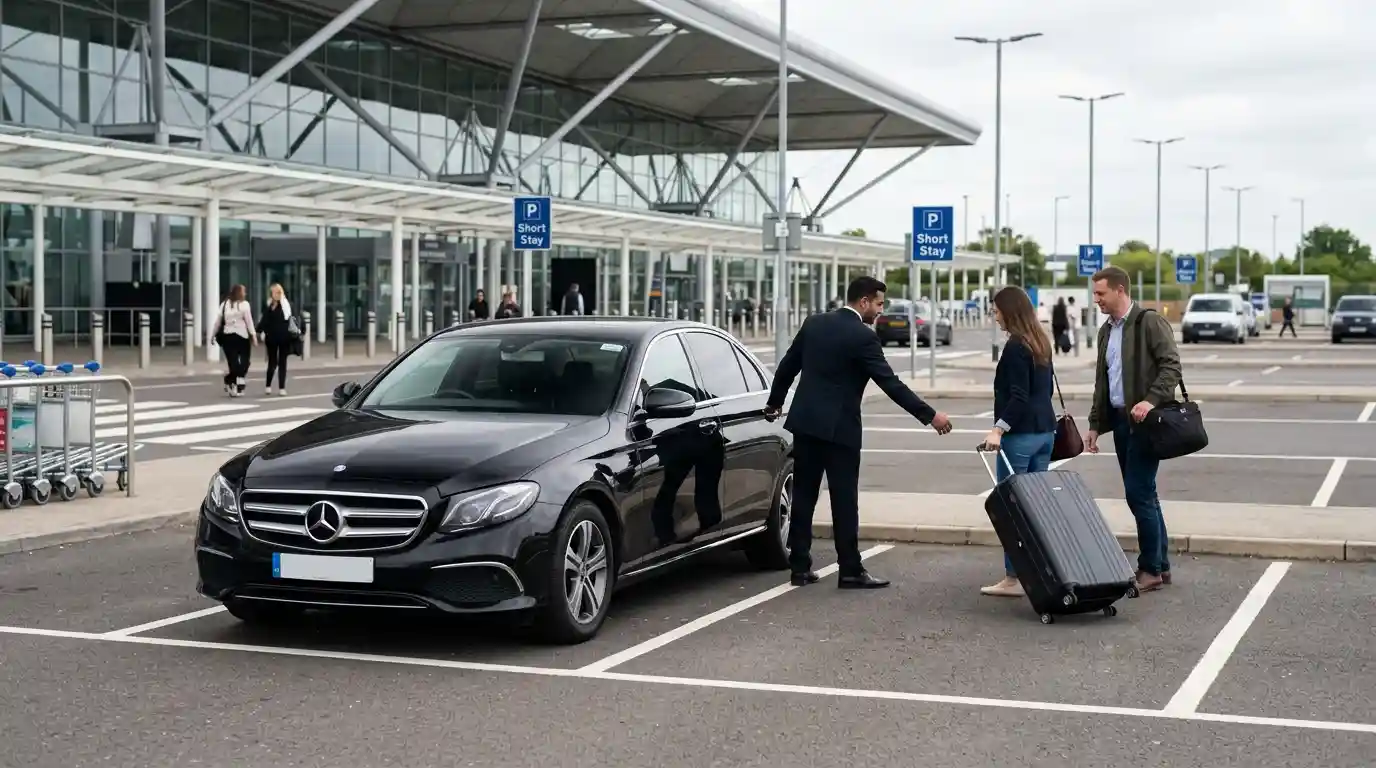
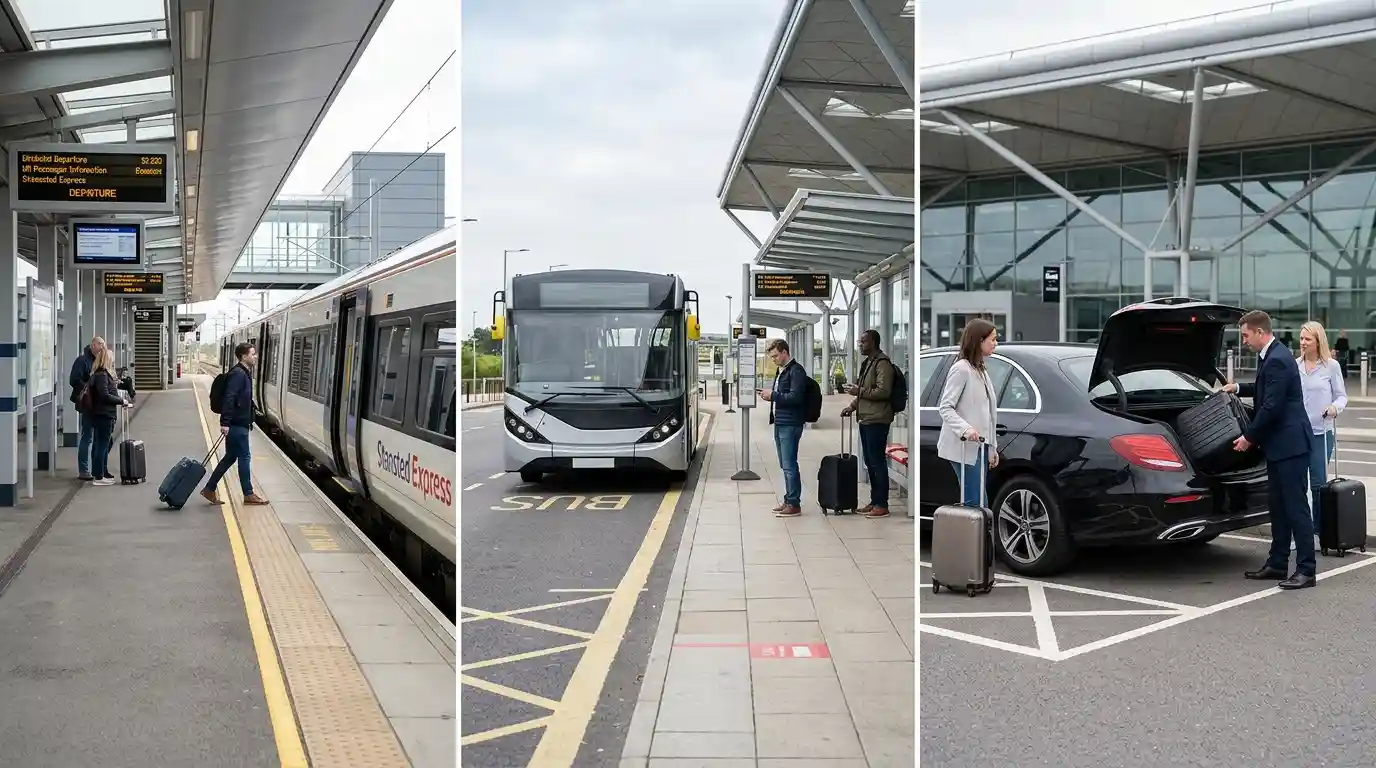
Stansted's early-morning departure pattern is heavily weighted to the hours before the first train from London — around 05:30 on weekdays. For any departure that requires you to be at bag drop before that time, there is no rail option at all, and the Stansted Express does not run through the night. A pre-booked transfer is not just more convenient for those slots — it is the only door-to-door option. We operate 24/7, including 03:00 and 04:00 pickups for first departures. Book via our booking page or call +44 20 3617 7825.
Tips for a Faster Check-in and Security Experience
Small preparation choices at home add up to meaningful time savings at the airport — particularly on a busy morning wave.
- Check in online as soon as it opens. You skip the check-in hall entirely with hand luggage only, and choose a better seat in the process.
- Organise your hand luggage in layers. Liquids near the top, electronics loose and not stacked, food in one accessible spot. An organised bag moves through a search in seconds; a jumbled one takes minutes.
- Hold documents in one hand from the moment you join the queue. Fumbling for a passport at the podium is the most common small delay at Stansted, and it compounds across a family of four.
- Wear simple footwear and minimal metal. Boots and belts with heavy buckles are the two items most likely to cost you a second pass through the scanner.
- Empty pockets into your bag, not a tray. Items left in trays get forgotten. Keys, coins and a phone in a tray are three separate things to retrieve — and one of them gets left behind at least once a morning.
- Charge your phone before security, not after. Charging points are more plentiful airside, but your boarding pass is on your phone. A dead phone at the scanner podium is a problem that takes time to fix in a queue.
- Check the screens for your gate range immediately after security. Your gate range — not the gate number — determines how far you walk. The difference between Satellite 1 and Satellite 3 is roughly 15 minutes. Know it before you head to the shops.
- Enable airline app notifications before you travel. Gate changes and delays reach you faster through the app than through the terminal screens. Switch notifications on at home, not at the gate.
The Stansted Departure Journey at a Glance
Every stage of the departure process in order — from home to the departure lounge.
| Stage |
What to do |
Notes |
| Before you leave home | Check in online, download boarding pass, weigh bags, move all liquids over 100ml to hold bag | This is where most problems are either prevented or created |
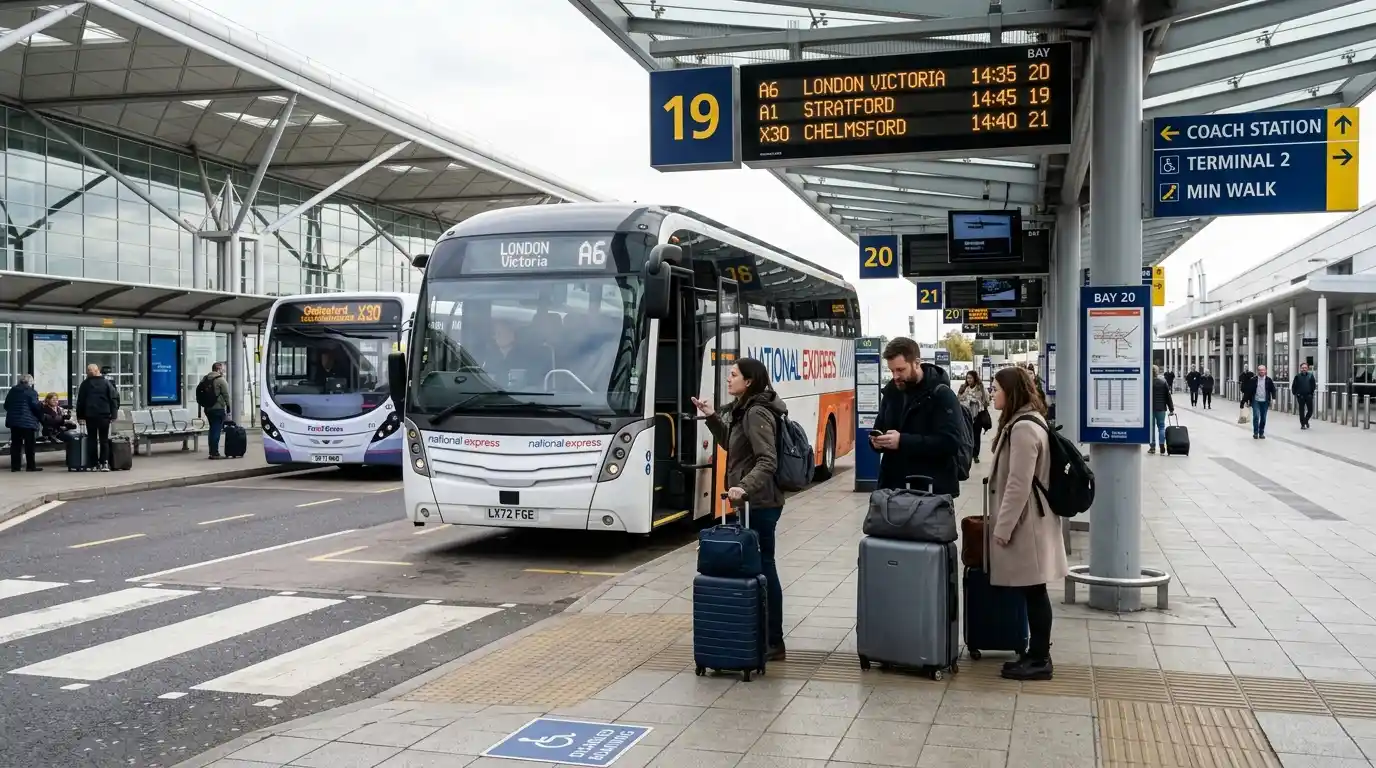
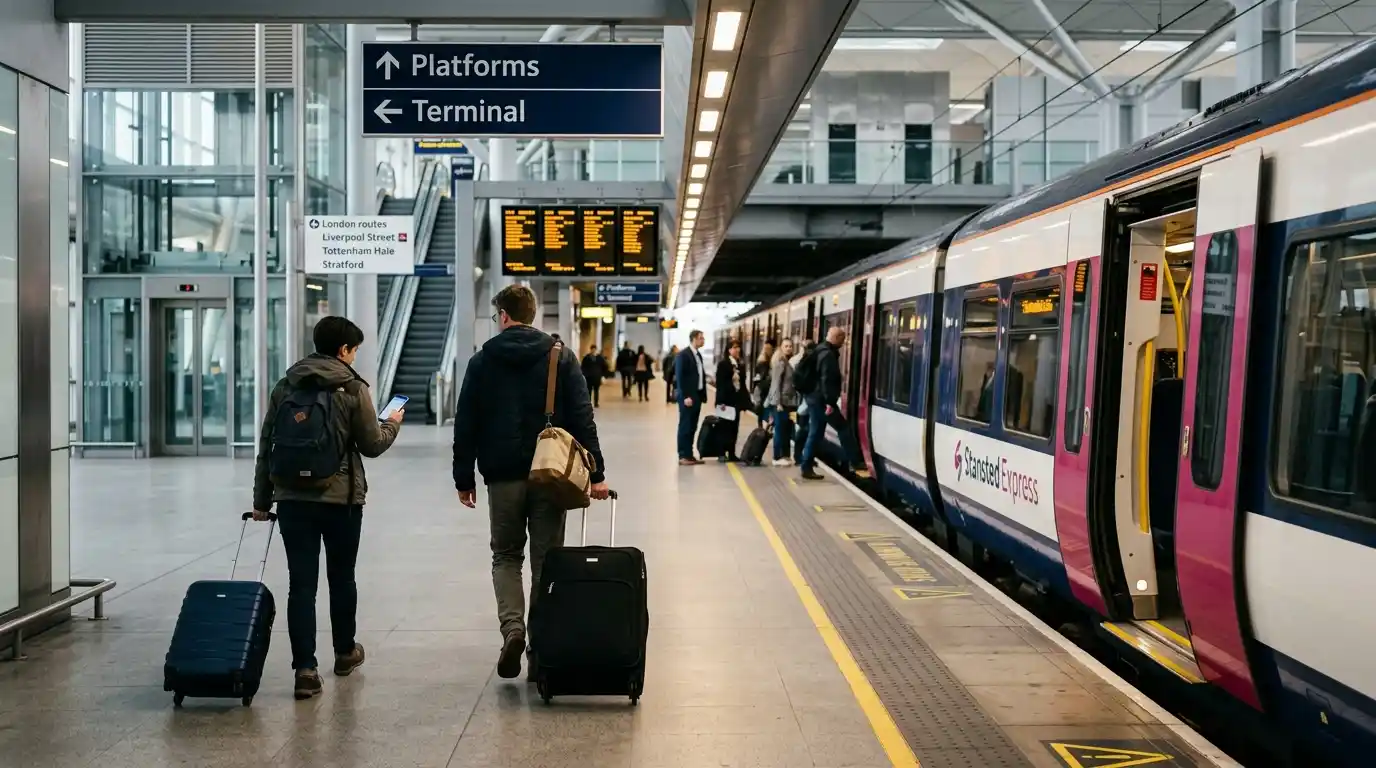
| Transport to Stansted | Confirm your transfer or train; allow journey time plus airport buffer | Pre-dawn departures have no train option — pre-book your transfer |
| Arrive at terminal | 2 hrs before European/domestic; 3 hrs for long-haul | Work backwards from bag drop deadline, not departure time |
| Check-in (if needed) | Kiosk for hold bags with online check-in; staffed desk for complex bookings | Hand luggage only and checked in online? Skip straight to security |
| Bag drop | Tagged bags to self-service belt; unusual items to staffed desk | Hard deadline: typically 40–60 min before departure |
| Document verification | Airline checks passport, visa and boarding pass | Name on booking must match passport exactly |
| Security screening | Boarding pass ready; coat and belt off; liquids ≤100ml in bag; laptop stays in bag | No clear plastic bag needed; 100ml limit per container still applies |
| Enter departure area | Check screens for gate range immediately | Gates 1–19, 20–39 or 40–59 — range determines your walk time |
| Gate | Head to satellite when gate is shown; gates close 20–30 min before departure | Satellite 3 (Gates 40–59) is 15–20 min from the departure lounge |
Related Stansted Airport Guides
Continue with the guide that covers your next step — before, during or after your flight.
The building, the satellites, the walking distances and the transport connections — the structural companion to this check-in guide, covering everything about the terminal itself before you reach security.
Stansted Airport Departure Lounge Guide
What is airside once you clear security — shops, restaurants, lounges, satellite layout and how long the walks to your gate actually take. The guide that picks up where this one ends.
Passport control, eGates, baggage reclaim and every onward transport option from the terminal — for the return leg or for anyone meeting an arrival.
Stansted Airport Airlines Guide
Which carriers fly from Stansted, which satellite each airline typically uses, and how to identify your gate range in advance so you know your airside walk before you arrive at the airport.
Stansted Airport Lounges Guide
Access rules, pricing, the gate restriction that catches people out, and whether Fast Track or a lounge is the better buy for your particular departure — with honest comparison of both.
The current £10 Express Set Down charge, the free pick-up alternative, and how a pre-booked transfer handles the forecourt without the clock-watching — the practical transport companion to this guide.
Frequently Asked Questions
Q: How early should I arrive at Stansted Airport?
A: Two hours before a European or domestic departure, three hours for long-haul or charter. Work backwards from your airline's bag drop deadline rather than the departure time — that deadline closes 40 to 60 minutes before the flight, and it is firm.
Q: Is the 100ml liquid rule still in place at Stansted?
A: Yes. Every container in your hand luggage must be 100ml or smaller. Stansted has next-generation scanners in every lane, but the larger two-litre allowance available at Heathrow, Gatwick, Birmingham and Edinburgh has not yet been approved here — government approval of the scanner algorithm is still pending.
Q: Do I still need a clear plastic bag for liquids at Stansted?
A: No. The airport confirms that liquids under 100ml no longer need to be in a plastic bag and can stay in your hand luggage. The 100ml limit per container still applies — that part has not changed.
Q: Do I need to take my laptop out at Stansted security?
A: No. Large electrical items including laptops stay in your hand luggage. The new scanners produce a three-dimensional image, so the bag can be read without being unpacked. Unusual or stacked electronics may still occasionally be pulled for a manual check.
Q: What time does bag drop close at Stansted?
A: Your airline sets it — typically 40 to 60 minutes before departure. Check your booking confirmation rather than the airport's general guidance, because deadlines vary between carriers and low-cost airlines tend to close earlier than traditional ones.
Q: How much is Fast Track at Stansted?
A: Security Fast Track starts from £6.49 per person, with a Plus version from £9.99 that bypasses the duty-free walk. The lane is open 04:00–20:00 and can be booked up to 12 months ahead. Every passenger needs their own pass, children included.
Q: Does Fast Track include lounge access at Stansted?
A: No. Fast Track and lounge entry are separate purchases at Stansted, and buying one gives you no claim on the other. See our lounges guide for what lounge access actually costs and how to buy it.
Q: Can I take medication through Stansted security?
A: Yes. Essential prescription medication may be carried in containers over 100ml, including liquid dietary foodstuffs and inhalers. Carry a prescription or doctor's letter and declare the medication at the lane rather than letting it be found in a search.
Q: What are the rules for baby milk and baby food?
A: Baby milk, formula and liquid baby food are exempt from the 100ml limit in quantities reasonable for your journey. You may be asked to taste the contents of each bottle or jar. Bring what you need for the trip rather than a full holiday's supply.
Q: Is there a free fast lane for families at Stansted?
A: Passengers travelling with an infant under three are directed to the assistance lane at no charge, as are passengers needing special assistance. If you qualify, there is no reason to pay for Fast Track — the lane is the same process and the result is the same.
Q: Can I take a power bank through Stansted security?
A: Yes, but only in your hand luggage. Power banks and spare lithium batteries must travel in the cabin and are not permitted in checked baggage — the opposite of what many travellers assume. A power bank found in a hold bag will be removed by handlers.
Q: What happens if my bag is searched at security?
A: An officer opens it and checks the item the scanner flagged. The new scanners are sensitive and searches are more common than they were — ordinary bottles, dense foods and stacked electronics all trigger them. A search is routine, not suspicion. Repack fully before leaving the belt area.
Get to Stansted on Time — Pre-Booked Transfers, 24/7
Almost everything that goes wrong at Stansted departures traces back to two things: arriving later than the bag drop deadline allows, and packing liquids for the wrong airport. This guide covers the second. Getting you there in time for the first is what we do.
Stansted's early-morning departure pattern means many passengers need to arrive before the first train from London — around 05:30 on weekdays. For a 04:00 or 04:30 bag drop, there is no rail option at all. A pre-booked transfer collects from your exact address, timed to your bag drop deadline, and delivers to the terminal forecourt with time to spare.
- ✔ Fixed fare agreed at booking — no meter, no surge, confirmed before you travel
- ✔ Door-to-door from any UK address to the Stansted terminal forecourt
- ✔ 24/7 operation — including 03:00 and 04:00 pickups for first departures
- ✔ Full vehicle range: Saloon, Estate, MPV5–8, Executive and Minibus for groups
- ✔ Flight tracking on every job — we monitor your inbound flight on return legs too
👉 Book your transfer in under two minutes — book online or call +44 20 3617 7825. See also our Stansted Terminal Guide and Stansted Arrivals Guide for the full picture at both ends of your journey.
Last reviewed August 2026 · Stansted Airport Taxi editorial team. Sources: London Stansted Airport