Landing at Stansted is simpler than at most London airports, because there is only one terminal to arrive into. The only genuine variable is where your aircraft parks. That determines whether you walk directly into a satellite via an air bridge, or take steps and a short bus ride from a remote stand — adding roughly ten minutes. After that, the route through border control, baggage and customs is the same for everyone, and it is shorter than at any multi-terminal airport.
This guide covers every stage from touchdown to leaving the terminal — eGates, passport control, baggage reclaim, customs, the arrivals hall and all your onward travel options. From Stansted Airport Taxi, a TfL-licensed private-hire operator running 24/7 transfers from the airport, with meet & greet in the arrivals hall and flight tracking on every job.
Stansted Arrivals: The Short Version
The key facts for the whole arrivals process in one place — times, rules and connections.
| Item |
What you need to know |
| Terminals | One — every flight arrives here |
| Air bridge vs remote stand | Remote stand adds ~10 minutes — build it into meeting arrangements |
| eGates | Age 8 and over (from 8 July 2026), minimum height 120cm, accompanied by an adult |
| Immigration to bags | Under 50 metres from the immigration exit to the first reclaim belt |
| Bags typically arrive | 10–20 minutes after you reach the hall (longer from remote stands) |
| UK ETA | £20, valid two years — required for eligible visa-free nationals, applied for online before travel |
| Total international processing | 30–45 minutes touchdown to arrivals hall (hold bags); 15–25 minutes hand luggage only |
| Meeting point | Arrivals hall, northern end of the terminal — open to anyone, no ticket needed |
| Rail to London | Station directly beneath the terminal — Liverpool Street ~48 min, from £9.90 |
| Free waiting for vehicles | Mid Stay car park — one hour free, free shuttle to terminal |
The one thing to tell whoever is collecting you. Allow 30 to 45 minutes from the published landing time before expecting to see your passenger at the arrivals doors — more if the flight arrives at a remote stand. "Just landed" and "walking out now" are different by that full margin for an international passenger with hold bags.
What Happens When Your Flight Arrives at Stansted?
The arrivals process starts before the aircraft door opens. Here is what determines your route from the runway to the terminal building.
Aircraft Stand — Air Bridge or Remote
Your aircraft parks either at a satellite gate with an air bridge, or at a remote stand where you leave by steps and board a bus to the terminal. Stansted has around 52 gates but only a minority carry air bridges, so a remote stand is common rather than unlucky. Remote stands add roughly ten minutes to the whole journey — account for this in any meeting arrangement rather than using the published landing time as your meeting trigger.
Taxiing and Disembarkation
Stansted works a single runway, so taxiing is usually brief. Stand allocation happens in advance, which keeps the taxi phase short even at busy periods. Disembarkation follows the usual pattern: forward rows first from a single door, or front and rear simultaneously where a second set of steps is used. Low-cost carriers at Stansted often use both doors, which speeds things noticeably.
From the Aircraft Door
Follow "Arrivals" from the moment you are off the aircraft. Depending on which satellite your gate is in, you either ride the transit system (Satellites 1 and 2) or walk a covered walkway (Satellite 3). Both routes lead to the same immigration hall — you cannot take the wrong one as long as you follow the signs. Arrivals routes are physically separated from departing passengers throughout, so there is no decision to make between the aircraft door and border control.
Satellite Routes to the Terminal
- Satellites 1 and 2 (Gates 1–39): connect to the terminal by the transit system, which runs on a separate arrivals platform from the departures one. Quick and covered.
- Satellite 3 (Gates 40–59): connects by walkway — the same 15-minute route that departures use, in reverse. No transit option. Factor this into timing if you are waiting for someone from a Gate 40-something flight.
- Remote stands: bus to terminal entry at ground level, then follow arrivals signs. The 2025 arrivals building upgrade improved the walkways and signage from this point onward.
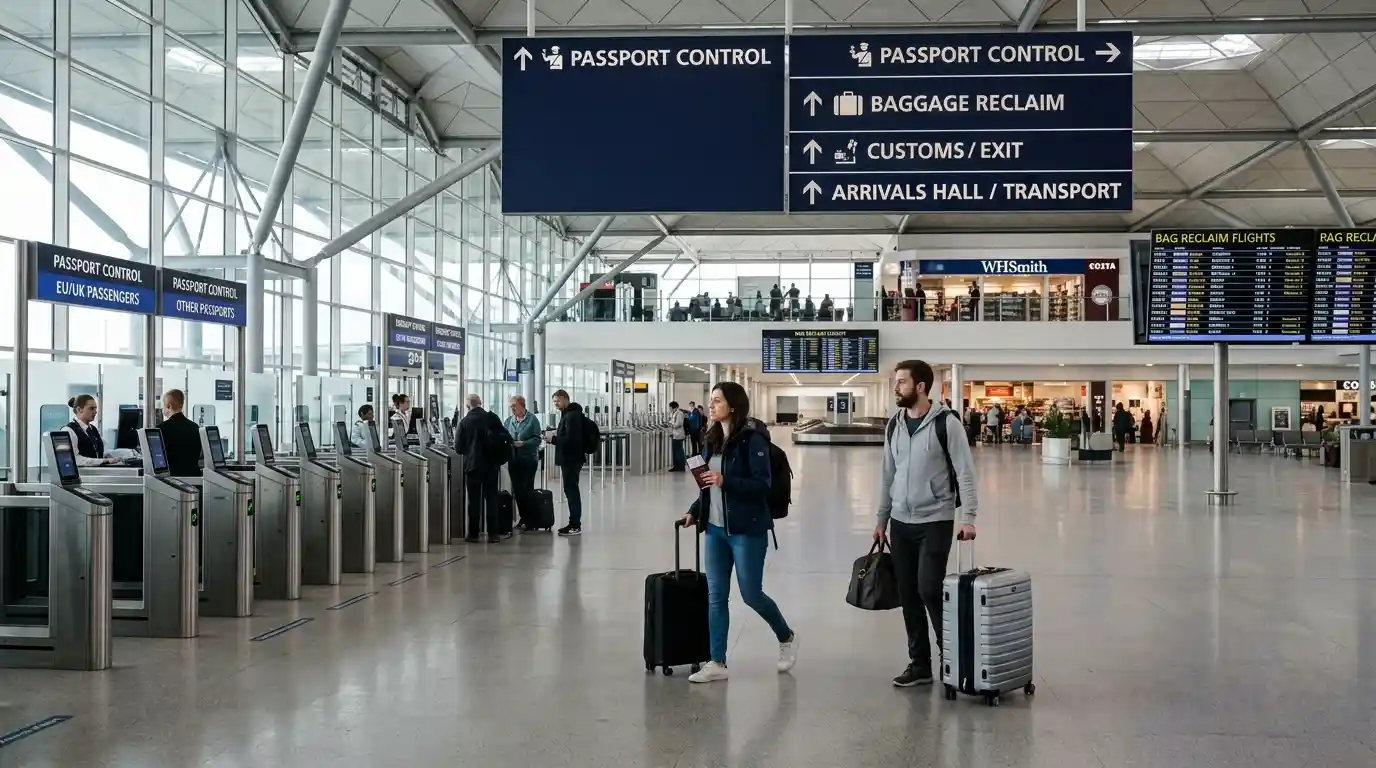
Passport Control at Stansted Airport
UK Border Force runs passport control — not the airport and not your airline. This is the stage that determines your right to enter the United Kingdom, and it is the same process regardless of which airline brought you here.
The Three Processing Routes
- eGates: for eligible biometric passport holders aged 8 and over (120cm minimum height, accompanied by an adult for under-18s). Automated facial recognition — no officer conversation required.
- Staffed desks: for everyone else, including children below the eGate threshold, non-eligible nationalities, damaged passports, and anyone whose entry requires a conversation or secondary check.
- Passport Control Fast Track: a paid lane that shortens the queue but not the check itself. Available separately from Security Fast Track.
What the Check Confirms
The check confirms three things: that the document is genuine, that it belongs to you, and that you are permitted to enter. Officers use scanners to verify that passports, visas and other official documents are genuine. Where any of the three needs more examination, you are directed to a secondary area — this is a routine outcome rather than an indication of a problem with your documents.
Preparing Your Documents
Open your passport at the photo page and remove any cover before you reach the gate or desk. Have it out of your bag well before you join the queue. Families should have every passport ready together rather than searching one at a time — a family searching bags at the front of an eGate line holds up everyone behind them, including themselves.
Queue Length
Queue length depends almost entirely on how many flights landed in the same window rather than the time of day. After a bank of simultaneous arrivals, expect a wait even at an otherwise quiet hour. At genuinely quiet periods you can walk straight through to the eGate in under a minute. The eGates handle the bulk of the volume when running normally.
Using Stansted Airport ePassport Gates
eGates are the fastest way through border control for eligible passengers — and from July 2026, more families qualify than before.
What eGates Do
eGates read the chip in a biometric passport and match it against a live photograph taken at the gate. They use facial recognition to speed up your border crossing, so you do not need to speak with a Border Force officer. The whole process takes under a minute when it works, and the gate opens automatically once the match succeeds.
Who Can Use the eGates
You can use the eGates if you are aged 8 or older and at least 120cm (3ft 11in) tall, with 8 to 17 year olds accompanied by an adult. Eligible nationalities include UK and EU states, plus nationals of Australia, Canada, Iceland, Japan, Liechtenstein, New Zealand, Norway, Singapore, South Korea, Switzerland and the USA. Your passport must carry the biometric chip symbol on the cover.
Recent Change — Minimum Age Now 8
From 8 July 2026 the minimum eGate age dropped from 10 to 8, provided the child is at least 120cm tall and is accompanied by an adult. If you last travelled with young children before that date, the queue arrangement you remember may no longer apply — children who previously needed a staffed desk may now use the eGate alongside you.
How the Process Works
- Place your passport photo page face down on the reader.
- Look straight at the camera when the gate prompts you.
- The gate opens once the facial match succeeds.
- Families should go through one at a time in sequence — agree the order before you reach the front.
Common eGate Failures
Passport covers left on, worn or damaged chips, glasses and hats left on, and looking away from the camera account for most rejections. If the gate rejects you, an officer directs you to a staffed desk. Rejection is a technical outcome, not a judgement on your documents or your right to enter. Remove your passport cover, take off hats and — if the gate requests it — glasses, and stand still facing the camera.
When a Staffed Desk Is Required
Use the staffed desk if you do not meet the eGate criteria, your passport chip is damaged, you are an unaccompanied minor, or your entry requires a conversation — for example, if you are visiting on a visa or if your entry conditions need to be confirmed. Desk checks are a short, direct exchange rather than an ordeal.
Immigration Process for International Arrivals
Immigration and passport control are the same stage at Stansted. Once you clear the eGate or the desk, you are through. There is no separate immigration hall.
International Arrivals
International arrivals pass through UK Border Force before reaching baggage reclaim. The routing is automatic — signage from your satellite directs you straight there, and there is no alternative path out of the arrivals route. Officers may ask about the purpose and length of your visit, where you are staying, and your onward plans. Answer directly; having an address and a return booking accessible shortens the exchange considerably.
UK Electronic Travel Authorisation (ETA)
Visitors from certain visa-free countries need a UK Electronic Travel Authorisation. The ETA costs £20, lasts two years, and is applied for online before you travel. Your airline checks it at departure, which means an ETA problem stops you before you reach the UK rather than at the Stansted border. Apply well in advance of your travel date — last-minute applications carry timing risk. Check the current UK government guidance for whether your nationality requires one.
Domestic Arrivals
Domestic arrivals skip border control entirely. If you have flown from within the UK, your route runs from the aircraft satellite to baggage reclaim and out, without an immigration stage. Signage separates the two flows from the satellite onwards. Domestic passengers typically reach the baggage belt sooner than international passengers, because they have not queued at the border first — bag delivery time itself is the same.
International vs Domestic — Processing Time
The international route adds approximately 20 to 30 minutes compared with the domestic route, almost entirely due to border control. Both routes end in the same arrivals hall, using the same baggage reclaim and the same exit.
Collecting Your Baggage at Stansted
Stansted's reclaim hall is one of the closest to the immigration exit of any UK airport. That proximity is useful — but settle any baggage problem before you leave it, because customs runs one way only.
Finding Your Carousel
Check the screens for your flight number and carousel number before you leave border control. The walk from the immigration exit to the first baggage reclaim belts is under 50 metres, so the reclaim hall is immediately ahead of you — but checking the screen before you step in saves a search through a crowded space. A flight with no belt yet allocated simply means the bags are still being unloaded; wait for the allocation rather than guessing.
How Long Bags Take
Bags typically start arriving 10 to 20 minutes after you reach the hall. Remote-stand arrivals take longer, because baggage handling from a parked aircraft takes more time than from a gate. The 2025 arrivals building upgrade included new baggage systems intended to reduce the gap. If you are waiting and your fellow passengers from the same flight are collecting their bags, your bag is on the same belt.
Oversized Baggage
Skis, golf bags, bicycles, pushchairs and larger instruments arrive at a separate oversized belt rather than the standard carousel. It is signed within the reclaim hall. If your bag has not appeared on the carousel and it was an oversized item, check the oversized belt before reporting it missing — this accounts for many apparent delays.
Missing or Delayed Baggage
Report a missing bag before you leave the reclaim hall. The baggage desk sits within the hall, and reporting there is significantly easier than doing it after you have cleared customs. Bring your bag tag receipt and your boarding pass. Once you walk through customs, the reclaim hall is behind a one-way exit and you cannot return to it.
Leaving the Baggage Hall
Once you have all your bags and have resolved any issues, you pass through customs and into the arrivals hall. Settle everything in the reclaim hall first — once you are through customs, that option is closed.
Customs After Baggage Collection
Customs is a formality for most passengers — a short walk through the green channel. But the rules are real and the penalties for the wrong channel are significant.
Green and Red Channels
- Green channel: for passengers with nothing to declare — goods within their allowance, nothing restricted or prohibited. Most passengers use this.
- Red channel: for passengers carrying goods above their allowance or restricted items, or for passengers who are unsure. Declaring voluntarily is always better than being stopped in the green channel.
Duty-Free Allowances
Allowances cover alcohol, tobacco and general goods, and they depend on where you have travelled from. Limits change, so check the current UK government guidance rather than relying on what applied the last time you flew. Do not assume allowances are the same as on a previous trip — they have changed more than once in recent years.
Restricted and Prohibited Goods
Certain foods, plants, animal products, weapons and counterfeit goods are restricted or banned regardless of quantity. Meat and dairy products from outside the UK are the items that most often catch out returning travellers, particularly those bringing gifts or food from family abroad. If you are unsure about an item, check before you fly rather than at the border.
Customs Inspections
Officers may stop any passenger for a check — this does not imply wrongdoing. An officer may ask what you have been doing, where you have travelled and what you are carrying. Answer plainly and accurately. Inspections are quick when the answers are straightforward and the bags match the account.
Leaving the Customs Area
The customs exit leads directly into the arrivals hall. Step clear of the exit doors before stopping to look around or regroup — the exit congests quickly when passengers pause in the doorway, particularly after a bank of flights arrives together.
Stansted Airport Arrivals Hall
You emerge into the northern end of the main terminal concourse — open to anyone, no ticket required. Here is what is here and how everything connects.
Layout and What Is Here
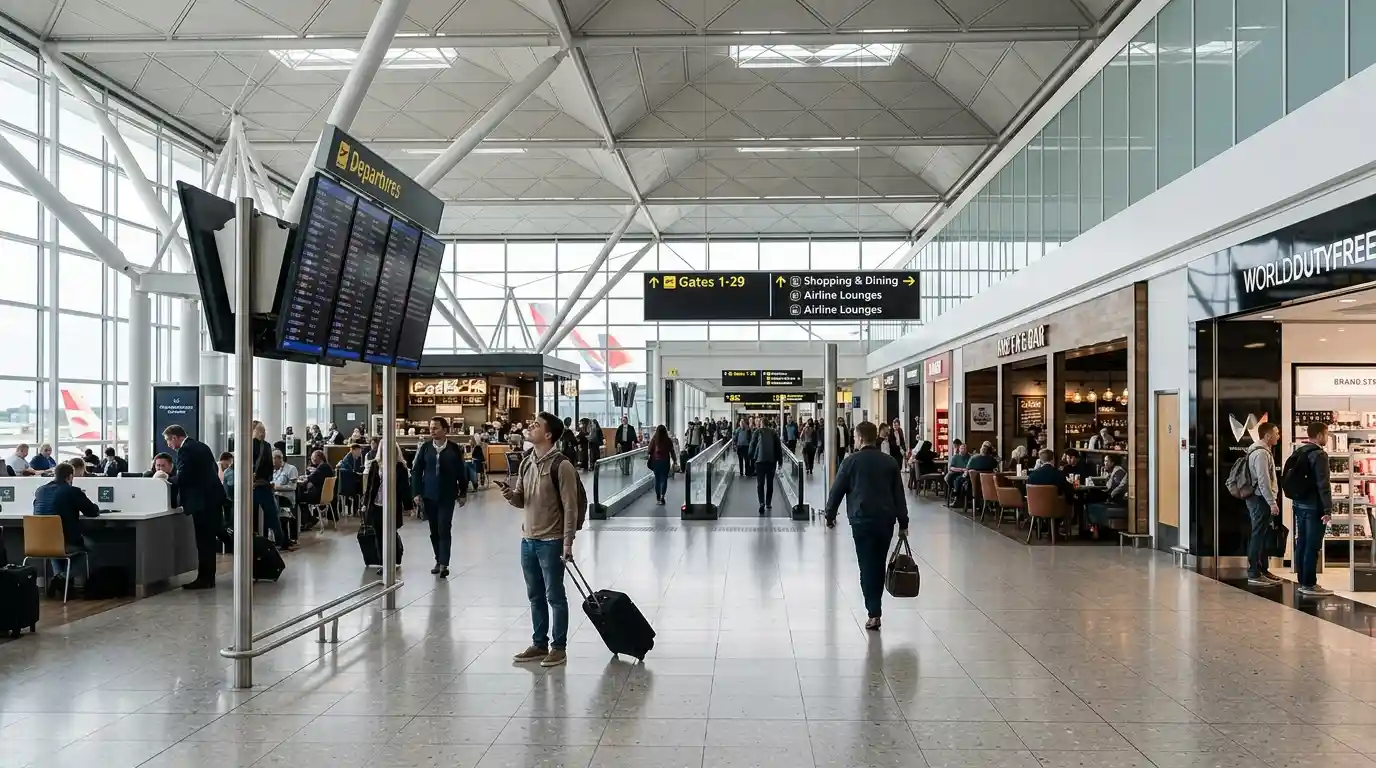
The arrivals hall occupies the northern end of the main terminal concourse. It holds seating, information screens, cafés, car hire desks, and access to every transport connection. Because Stansted has one terminal, every arriving passenger on every flight emerges through the same set of doors into the same hall.
Visitor Access
The arrivals hall is open landside space. You do not need a boarding pass or a ticket to enter. Anyone meeting a passenger can wait inside the building rather than in the car park or on the forecourt — this costs nothing and is considerably more comfortable, especially for long waits or late-night arrivals.
Flight Information Screens
Arrival screens in the hall show landing times and status. Landing time is not the same as the time your passenger walks out of the doors — allow 30 to 45 minutes after touchdown for an international arrival with hold baggage, and 15 to 25 minutes for hand luggage only. Remote stands add around ten minutes to either figure. Use the flight number and status on the screen, not the published schedule.
Transport Connections from the Hall
All transport connections run from or near the arrivals hall: escalators down to the railway station, signposted walk across the forecourt to coaches and buses, and the taxi rank and private hire collection areas directly outside. All are within a few minutes of the arrivals doors and all are signed from inside the hall.
Meeting Friends and Family at Stansted Airport
One terminal, one exit — meeting at Stansted is simpler than at any multi-terminal London airport. Here is how to make it work without confusion.
The Only Exit Everyone Uses
The customs exit doors are the natural meeting point, and the only set of doors every arriving passenger passes through. Because there is one terminal and one arrivals hall, there is no risk of waiting at the wrong building. Agree a specific spot within sight of the exit — a particular café or seating cluster — rather than "the doors", which congest after a bank of flights.
Timing Your Arrival as a Greeeter
Track the flight number rather than the scheduled time, then add 30 to 45 minutes from touchdown for an international passenger with hold bags — or 15 to 25 minutes for hand luggage only. A remote stand adds ten minutes to both. Arriving at the terminal the moment the plane lands means waiting 40 minutes; arriving 35 minutes after touchdown is usually the right call.
Waiting Inside the Hall — Free
Waiting inside the arrivals hall costs nothing and there is no time limit. The landside cafés adjacent to the hall are usually a better waiting spot than the seating directly outside the exit doors, because they are less congested and easier to hold a specific position in. The hall fills quickly after a bank of simultaneous arrivals and empties just as quickly.
Waiting by Vehicle — Free Option
The Mid Stay car park offers an hour without charge and runs a free shuttle bus to the terminal. This is the practical free option for drivers waiting for a passenger with an uncertain landing time. The forecourt, by contrast, is camera-enforced and charged from the moment of entry — it is not a waiting area, it is a pick-up point timed to the exact moment your passenger walks out.
Identification in a Crowd
Agree what you are both wearing, or use a visible marker. In a hall receiving several flights at once, a specific description plus a landmark beats a phone call. Keep phones charged, because travel drains batteries and your passenger may have been on a long-haul flight with limited charging. A printed or written name sign works when phone signal is unreliable.
Pre-Booked Name-Board Collection
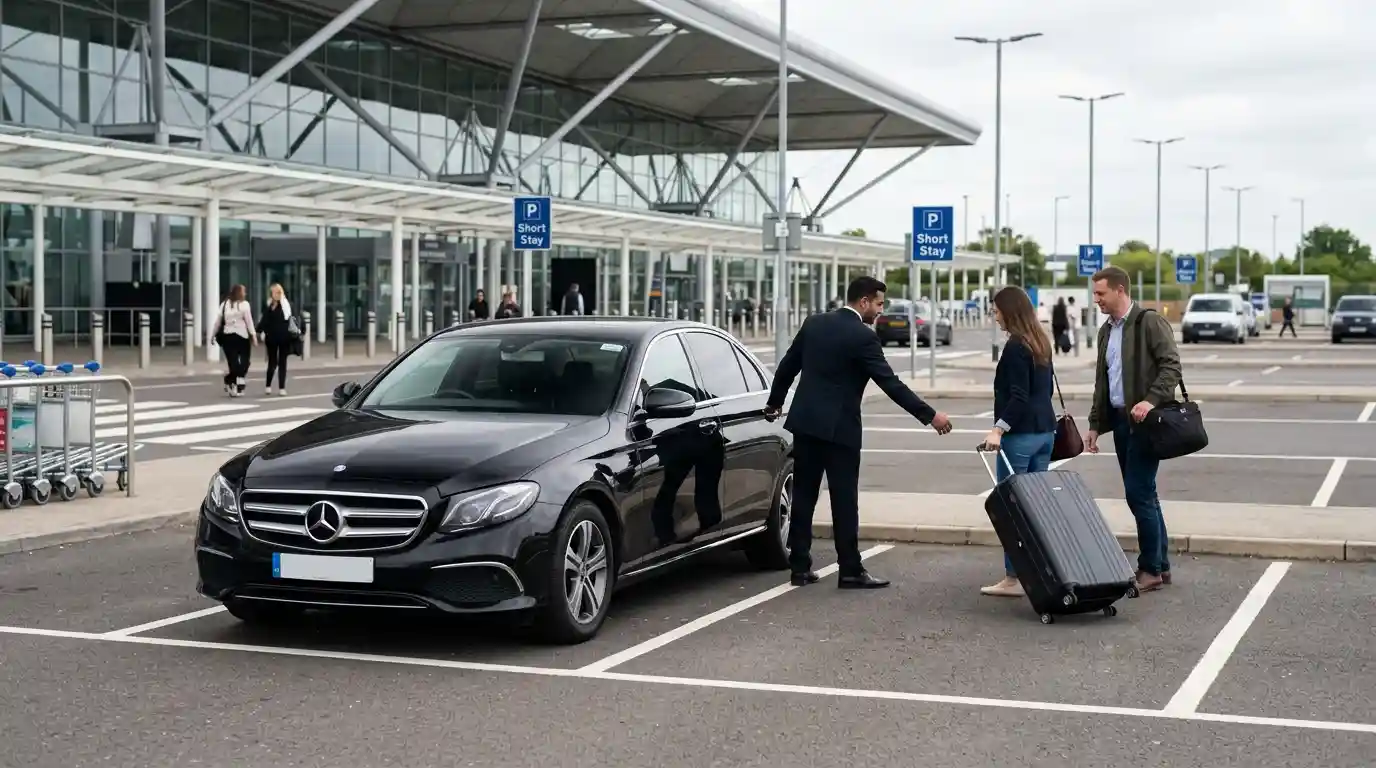
Our drivers meet arriving passengers inside the arrivals hall with a name board, so your passenger walks straight to a driver who knows their name, flight and destination without a phone call or a search through a crowd. Flight tracking means we adjust automatically for early landings or late arrivals — your driver is there when your passenger actually walks out, not when the schedule said they would.
Leaving Stansted Airport — Your Onward Travel Options
Every transport option leaves from or near the arrivals hall. Here is the honest comparison — times, fares and what each one does not cover.
| Option |
Journey time |
Typical fare |
Availability |
Best for / notes |
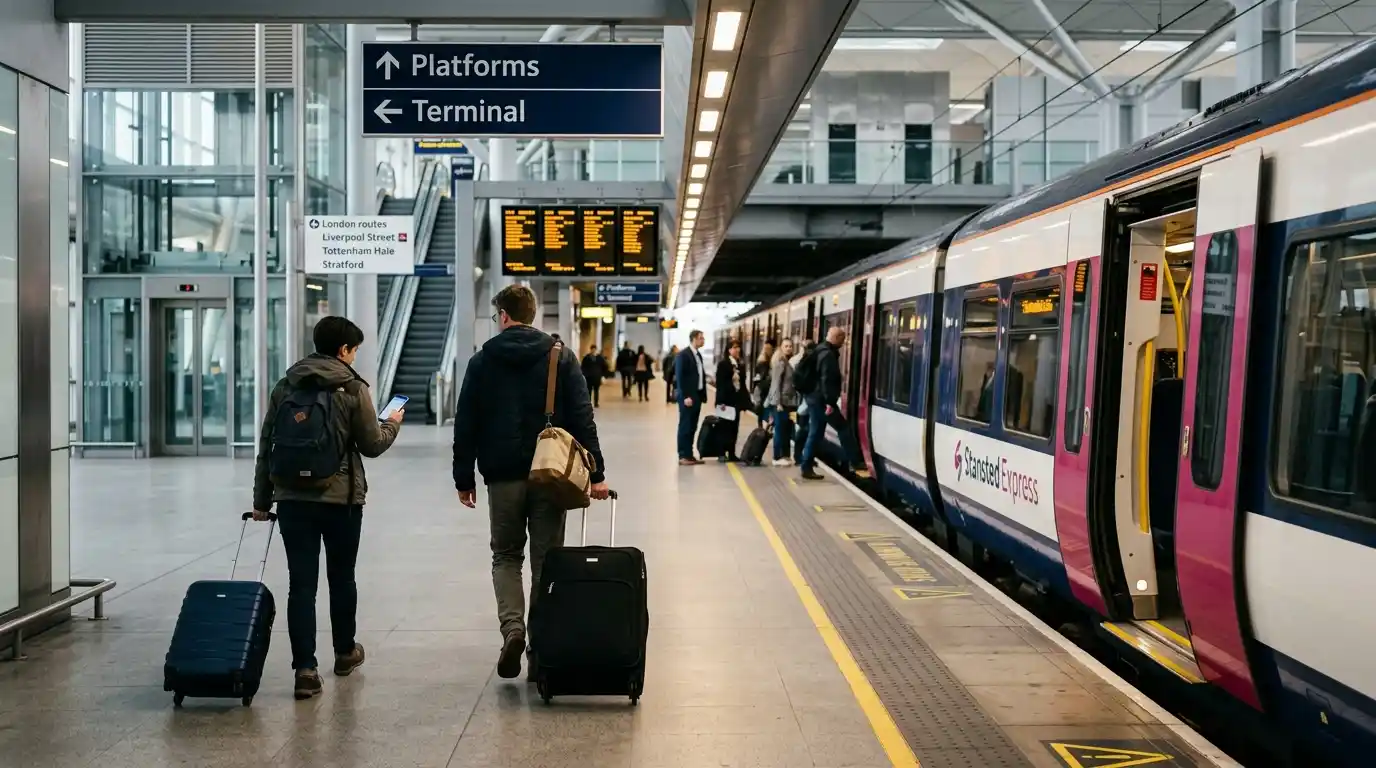
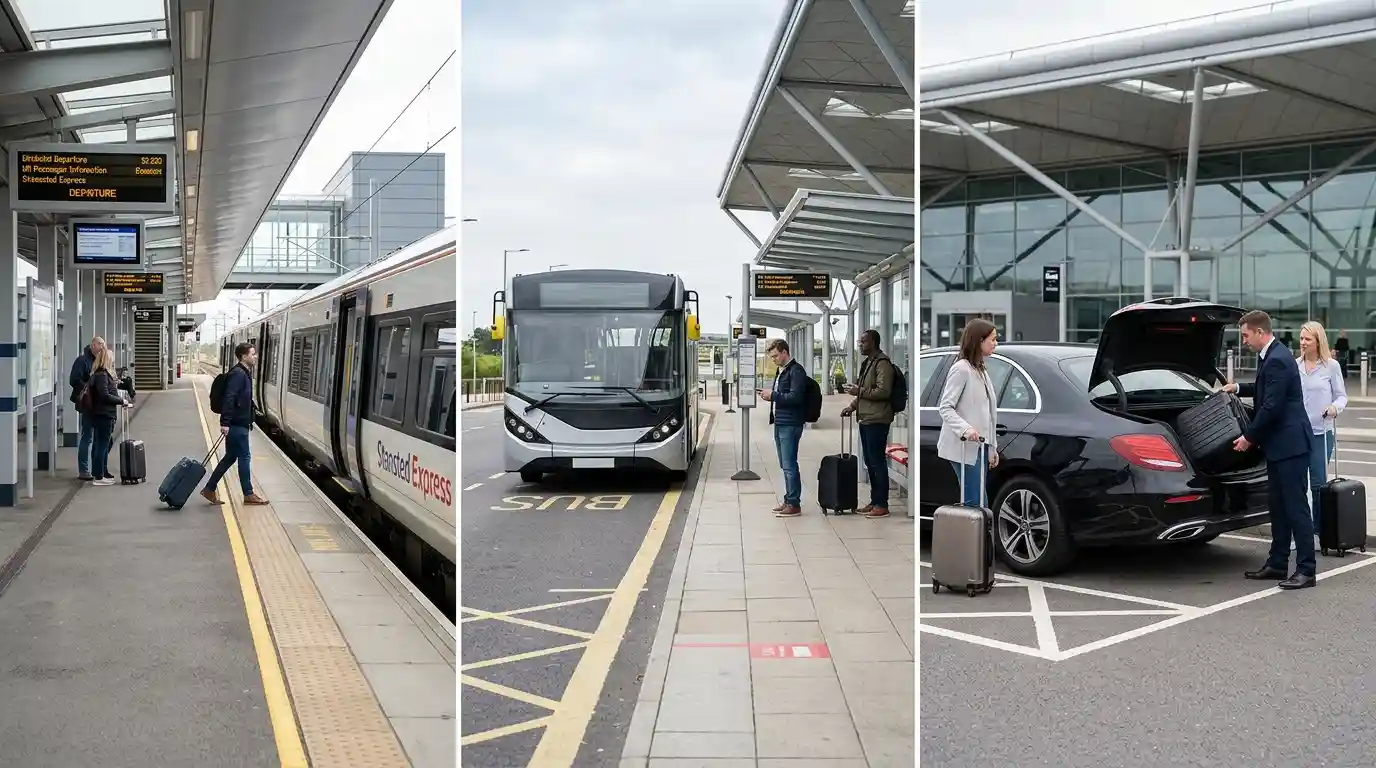
| Stansted Express (rail) | Liverpool Street ~48 min; Tottenham Hale ~36 min; Stratford ~60 min | From £9.90 advance; contactless pay-as-you-go also available | Not 24 hours — check timetable | Fastest to central London in service hours; station directly below terminal |
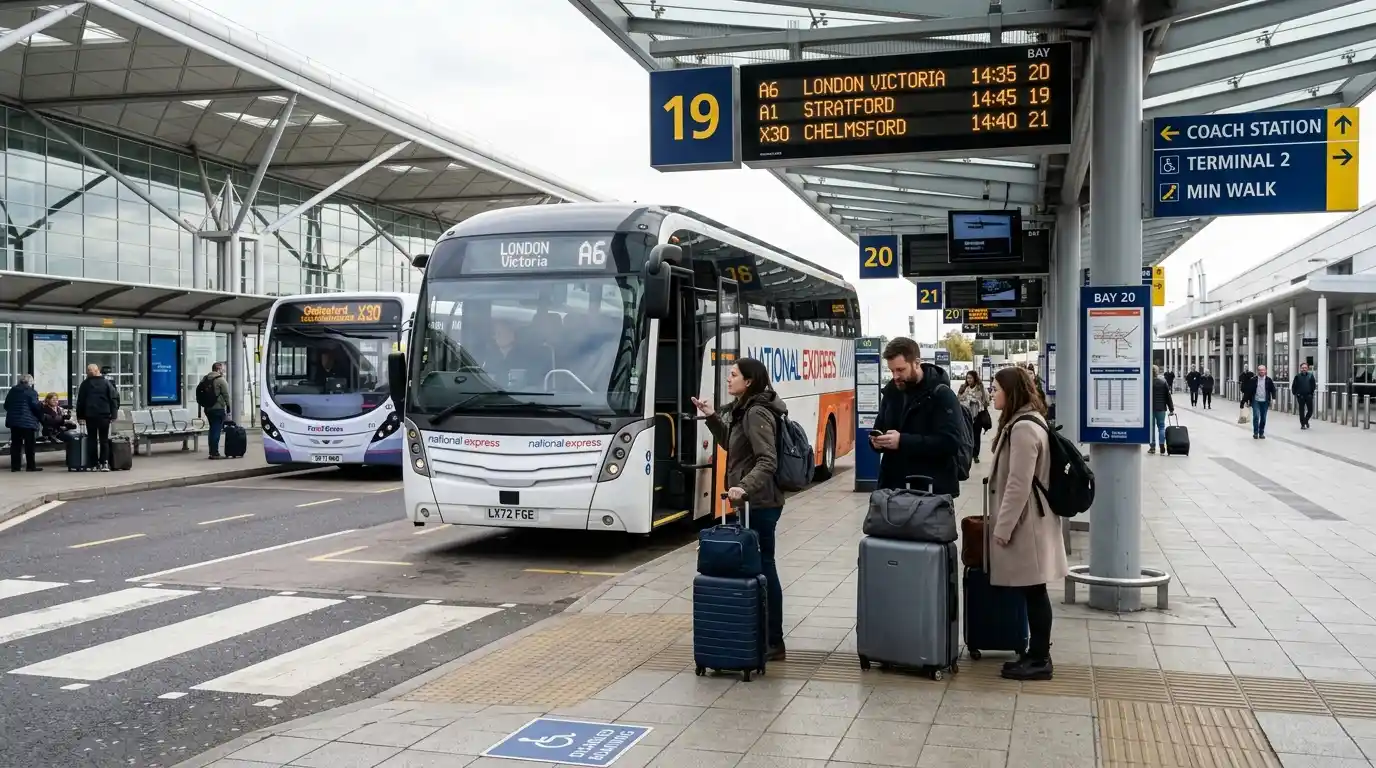
| National Express (coach) | ~50 min fastest; Liverpool Street ~1h 10; Victoria ~1h 45 — traffic-dependent | From ~£7 booked ahead to a central stop | 24 hours, 200+ services daily | Cheapest London option; only overnight choice; slower and traffic-exposed |
| Local/regional buses | Varies by route | Local fares | Daytime, route-dependent | Bishop's Stortford, Harlow, Cambridge and surrounding towns |
| Pre-booked private hire | Door-to-door — varies by destination | Fixed fare confirmed at booking | 24 hours | Best for luggage, groups, late arrivals, or destinations train/coach does not reach |
| On-site rank (contracted PHV) | Door-to-door | Operator rate — not metered | During operating hours | No hackney carriage rank at Stansted; pre-booking removes rank queue |
| Mid Stay car park (own vehicle) | Shuttle every 10 min, 7–10 min trip | 1 hour free; charged beyond that | 24 hours | Free wait option for people being collected; free shuttle to terminal |
How to Choose
- Rail in service hours, travelling light: the Stansted Express is the fastest and most predictable option for central London destinations — station directly below the terminal, no traffic exposure. From £9.90 booked ahead; contactless pay-as-you-go available.
- Coach overnight or on a tight budget: National Express runs 24 hours and is the cheapest way into London. It is also the only public option after the last train, making it the default for night-flight arrivals not using a pre-booked car.
- Pre-booked private hire for everything else: bags, groups, a 4am landing, or a destination the train and coach do not reach. Fixed fare agreed before you travel, driver with a name board in the arrivals hall, flight tracking so late landings are handled without a phone call.
No Black Cab Rank
Stansted has no hackney carriage rank. The on-site rank operates under a contracted private hire arrangement rather than a public cab stand, with fares set by that operator. Pre-booking with a licensed operator — at an agreed fixed fare — removes the rank queue and gives you a price before you travel rather than at the end of the journey.
Accessibility for Arriving Passengers
The entire arrivals route is step-free, from the aircraft door to the transport connections outside. Here is what that means in practice at each stage.
Arriving and the Arrivals Route
Every arrival route is step-free, from the aircraft door through border control and baggage to the arrivals hall. Arrange assistance with your airline at least 48 hours before departure so staff meet you at the aircraft door — not at the terminal — and accompany you through every stage. Buggies and wheelchair support are available on the arrivals route as well as departures.
Lifts and Level Access
Lifts serve every level change on the arrivals route, including the descent to the railway station below the terminal. Ramps cover the smaller transitions on the concourse and forecourt. No part of the standard arrivals journey requires stairs — but the Satellite 3 walkway is long, and if distance rather than steps is the constraint, request assistance rather than assuming the walk is manageable.
Baggage Reclaim and Customs
The reclaim hall is level throughout and belts are approachable from a seated position, though busy belts crowd quickly after a large arrival. Assistance staff can collect bags on your behalf if you have arranged support in advance. The customs exit and the arrivals hall are level and step-free throughout.
Accessible Transport Connections
Stansted Express services are accessible, with lift access to the platforms directly beneath the terminal. Coaches vary by vehicle, so check with the operator in advance of travel if you need step-free access. Pre-booked private hire can supply wheelchair-accessible vehicles when requested at the time of booking rather than on arrival — call us on +44 20 3617 7825 to discuss your requirements before you travel.
International vs Domestic Arrivals at Stansted
One building handles both — but the routes through it are meaningfully different. Here is the comparison.
| Stage |
International arrivals |
Domestic arrivals |
| Satellite to terminal | Transit (S1/S2) or walkway (S3) | Transit (S1/S2) or walkway (S3) — same route |
| Border control | UK Border Force — eGate or staffed desk | Not required — skip directly to baggage |
| UK ETA | Required for eligible visa-free nationalities | Not applicable |
| Baggage reclaim | After border control — same hall | Direct — usually reaches the belt sooner |
| Customs | Green or red channel | Not required — no border crossed |
| Arrivals hall | Same exit, northern end of terminal | Same exit, northern end of terminal |
| Total extra time vs domestic | Approximately 20–30 minutes | Baseline |
Common Arrival Mistakes and Useful Tips
Six mistakes that recur at Stansted arrivals — most preventable with one decision made earlier in the process.
- Using the scheduled landing time as the meeting trigger. Scheduled landing time is not the same as "walking out of the doors". Allow 30 to 45 minutes from touchdown for an international arrival with hold bags. Track the flight, add processing time, then head to the terminal.
- Leaving the baggage hall before the bag arrives or before reporting a missing one. The customs exit is one-way. Passengers who leave to greet someone before their bag appears, or who forget to report a missing bag before clearing customs, cannot go back. Settle baggage completely before you exit.
- Not checking the carousel number before leaving border control. Check the screen for your flight number and carousel before stepping into the reclaim hall. Walking in and then searching for your flight on a busy screen wastes the minutes your bags may need to arrive.
- Passport cover left on at the eGate. The single most common cause of eGate rejection. Remove the cover before you join the queue, not at the reader. A rejected gate sends you to a desk queue, adding time you cannot recover before the connecting transport.
- Meeting at "arrivals" without a specific spot. The arrivals hall is large and receives several flights at once. Agreeing "arrivals" as a meeting point leads to two people searching opposite ends of the same building. Agree a named landmark in advance, before the flight, not by text message after landing.
- Not accounting for Satellite 3 on the arrivals side. The 15-minute walkway from Satellite 3 applies inbound as well as outbound. A Gate 40-something arrival adds that walk to the processing time — update whoever is collecting you before you land rather than after you emerge.
Your Arrival Journey at a Glance
The complete arrivals sequence in order — from the runway to the transport connection.
| Stage |
What happens |
Time to allow |
| Aircraft arrival | Land on single runway, taxi to satellite gate (air bridge) or remote stand (steps + bus) | Remote stand adds ~10 min |
| Disembarkation | Exit aircraft — low-cost carriers often use front and rear doors simultaneously | 5–15 min depending on position and aircraft size |
| Satellite to terminal | Transit system (S1/S2) or covered walkway (S3) | S1/S2: a few minutes; S3: ~15 min |
| Border control | eGate (eligible passengers) or staffed desk — international arrivals only | Under 1 min at eGate when clear; variable with queue |
| Baggage reclaim | Under 50 m from immigration exit — check screen for carousel before entering | 10–20 min for bags to arrive; longer from remote stands |
| Customs | Green channel (nothing to declare) or red channel — international arrivals only | Seconds to a few minutes; longer if stopped for a check |
| Arrivals hall | Northern end of terminal — seating, screens, cafés, transport connections | Immediate from customs exit |
| Onward travel | Rail (below), coach (forecourt), private hire (forecourt), car park shuttle | Rail: every ~15 min in service hours; coach: continuous; private hire: pre-arranged |
Related Stansted Airport Guides
Continue with whichever guide covers your next step — or the return leg.
The building, the satellites, all walking distances and every transport connection — the structural companion to this arrivals guide, covering the terminal in full from the architecture to the forecourt charges.
Everything you need for your return departure — how early to arrive, the 2026 liquid rules, bag drop deadlines, Fast Track and what has changed at Stansted security compared with other UK airports.
Stansted Airport Departure Lounge Guide
What is airside once you clear security on your outbound flight — shops, restaurants, satellite layout and how long each gate walk actually takes in practice.
Stansted Airport Airlines Guide
Which carriers fly from Stansted, which satellite each airline typically uses, and how to find your gate range in advance — so you know your walk before you arrive at the airport.
Stansted Airport Lounges Guide
Access rules, lounge pricing, the gate restriction that decides eligibility, and an honest comparison of whether the lounge or Fast Track is the better buy for your departure.
The current £10 Express Set Down charge, the free pick-up alternative at Mid Stay, and how pre-booked private hire handles the forecourt for arriving and departing passengers.
Frequently Asked Questions
Q: How long does it take to get through Stansted arrivals?
A: Allow 30 to 45 minutes from touchdown to walking out, for an international arrival with hold baggage. Hand luggage only cuts that to 15 to 25 minutes. A remote stand adds around ten minutes to either figure.
Q: Can my child use the eGates at Stansted?
A: Yes, from age 8, provided they are at least 120cm tall and accompanied by an adult. The minimum age dropped from 10 on 8 July 2026. If you last flew with young children before that date, the arrangement you remember may no longer apply. Unaccompanied minors must use a staffed desk.
Q: Which nationalities can use the Stansted eGates?
A: UK and EU passport holders, plus nationals of Australia, Canada, Iceland, Japan, Liechtenstein, New Zealand, Norway, Singapore, South Korea, Switzerland and the USA. Your passport must carry the biometric chip symbol on the cover.
Q: Do I need a UK ETA to arrive at Stansted?
A: If you are a visitor from a visa-free country covered by the scheme, yes. It costs £20, lasts two years, and must be obtained online before you travel. Your airline checks it at departure, so an ETA problem stops you before you reach the UK rather than at the Stansted border.
Q: Where is baggage reclaim at Stansted?
A: Immediately beyond the immigration hall — under 50 metres from the exit. Check the screens for your carousel number before you leave border control rather than after, to save searching through a crowded hall.
Q: How long do bags take at Stansted?
A: Typically 10 to 20 minutes after you reach the reclaim hall, and longer if your aircraft parked at a remote stand. Oversized items such as skis and pushchairs arrive at a separate belt within the same hall — check there if your bag has not appeared on the carousel.
Q: Where do I meet someone arriving at Stansted?
A: In the arrivals hall at the northern end of the terminal, open to anyone without a ticket. Agree a specific landmark within sight of the customs exit doors before the flight rather than by text after landing — the doors themselves congest when several flights arrive together.
Q: Is there a free place to wait for an arriving passenger?
A: Yes. Waiting inside the arrivals hall is free. For vehicles, the Mid Stay car park gives an hour without charge and runs a free shuttle to the terminal every 10 minutes — unlike the forecourt, which is camera-enforced and charged from entry.
Q: How do I get from Stansted to London after landing?
A: The Stansted Express runs from the station beneath the terminal to Liverpool Street in about 48 minutes, from £9.90 booked ahead, but not around the clock. National Express coaches run 24 hours from the forecourt from around £7. Pre-booked private hire covers the hours and destinations neither serves.
Q: Is there a black cab rank at Stansted?
A: No. Stansted has no hackney carriage rank. The on-site rank operates under a contracted private hire arrangement with fares set by that operator. Pre-booking with a licensed private hire operator gives you an agreed fixed fare before you travel.
Q: Is Stansted arrivals accessible?
A: Yes — step-free throughout, with lifts at every level change including down to the railway station. Arrange assistance with your airline at least 48 hours before departure so staff meet you at the aircraft door and accompany you through every stage.
Q: What is the difference between domestic and international arrivals at Stansted?
A: Domestic arrivals skip border control and customs entirely, going straight from the satellite to baggage reclaim. International arrivals pass through both. The international route typically adds 20 to 30 minutes compared with the domestic route.
Pre-Booked Transfers From Stansted — Any Hour, Any Destination
Arriving at Stansted is a short, linear process with one variable at the start and one decision at the end. The variable — your stand — you cannot control. The decision — how you leave — you can settle before you fly.
The train is quick and predictable but stops overnight. The coach is the cheapest option and the only one that runs all night without pre-booking. A pre-booked car costs more and earns it back when you have bags, a group, a late-night landing, or a destination that neither the train nor the coach reaches directly. We operate 24/7, with a driver holding a name board in the arrivals hall and flight tracking that accounts for every early landing and every long-haul delay.
- ✔ Fixed fare confirmed at booking — no meter, no rank queue, no surge
- ✔ Meet & greet in the arrivals hall with name board — no phone call needed when you land
- ✔ Flight tracking and 45–60 minutes free waiting from touchdown
- ✔ 24/7 operation — covering 4am landings and red-eye arrivals
- ✔ Full vehicle range: Saloon, Estate, MPV5–8, Executive and Minibus for groups
- ✔ Wheelchair-accessible vehicles available — request at booking
👉 Book your transfer in under two minutes — book online or call +44 20 3617 7825. See also our Stansted Terminal Guide and Stansted Check-in & Security Guide for the full picture at both ends of your journey.
Last reviewed August 2026 · Stansted Airport Taxi editorial team. Sources: London Stansted Airport, UK Home Office, Stansted Express, National Express, Manchester Airports Group. Next review: February 2027.