Traffic around Stansted can be affected by airport demand, congestion on the M11 and A120, incidents, roadworks, weather and temporary restrictions. Conditions change quickly, so the only figure that matters on your travel day is the live one. This page explains what can disrupt your journey and where to check it — not which route to take or how long the journey normally lasts, which are covered on separate pages.
Three things are worth fixing in mind before you read further: congestion and incidents are different problems requiring different responses; live traffic, typical patterns and planned roadworks are three separate kinds of information; and the overnight window is the specific trap here, because roads look clear on a live map when they are actually under a planned closure. Pre-booked transfers at any hour available from Stansted Airport Taxi, a TfL-licensed private-hire operator. Sources: National Highways, Essex Highways, London Stansted Airport. Reviewed August 2026.
How This Page Fits with the Other Stansted Guides
Traffic conditions and route choice are two separate questions. This page covers the first. The others cover what follows from it.
⚙ Quick Answer: What Should I Know About Traffic to Stansted?
The M11 is the primary corridor and has limited parallel capacity — disruption here is felt more sharply than at airports with several approach routes. The A120 is where every approach converges, so congestion there affects all directions at once. Junction 8 is the recognised pressure point where airport, local and service-station traffic all meet.
The overnight trap: planned motorway maintenance runs roughly 21:00 to 05:00 on the M11 near the airport — exactly when Stansted's pre-dawn departure traffic is active. A live traffic app will show an empty road; the road may be under closure. Check planned roadworks separately, not just live conditions.
Congestion vs incident: ordinary congestion clears on a broadly predictable curve and leaving earlier beats rerouting. An incident has no known duration — that is when a route change is worth making and when the Stansted Express train becomes a genuine alternative.
Quick Answers
When is traffic around Stansted busiest?
Weekdays 07:00–09:00 and 17:00–19:00 on the road network. Friday evenings are worst. Terminal-area traffic peaks separately — during the 04:00–06:00 departure wave — when the motorway is at its quietest. The two rhythms do not align.
Why are overnight closures a particular risk at Stansted?
Motorway maintenance is scheduled overnight because traffic is lightest — but that is exactly when Stansted's pre-dawn departure wave runs. National Highways has run closures on the M11 northbound between Junctions 7 and 8, roughly 21:00 to 05:00. Live traffic will show an empty road, not a closed one. Check planned works separately.
What makes M11 disruption worse than other motorways?
Very limited parallel capacity. When the M11 has a problem, there is nowhere convenient for the traffic to go. An incident that would cause modest delay elsewhere creates disproportionate disruption here because alternatives are scarce.
What is the difference between traffic and road conditions?
Traffic refers to vehicle flow and congestion. Road conditions is broader — covering roadworks, closures, weather effects, surface conditions and temporary restrictions. A clear road can still be in poor condition. A live traffic app addresses the first; a roadworks calendar addresses the second.
Does traffic affect Stansted taxi journeys?
Yes — taxis and pre-booked transfers use the same roads as everyone else. A driver who tracks your flight and knows the corridor can adjust departure time and approach, which helps at the margins. No operator can drive around a closed motorway. Congestion affects transfer reliability exactly as it affects your own driving.
Is traffic information the same as journey-time information?
No. Traffic information explains road conditions, congestion and disruption — that is this page. Journey-time information explains how long a trip typically takes under those conditions. Our journey times guide covers the second; this page covers the first.
The Road Network Around Stansted Airport
Stansted's road access is unusually concentrated — which makes the network easy to describe and disruption easy to feel.
The M11 — Primary Corridor, Limited Alternatives
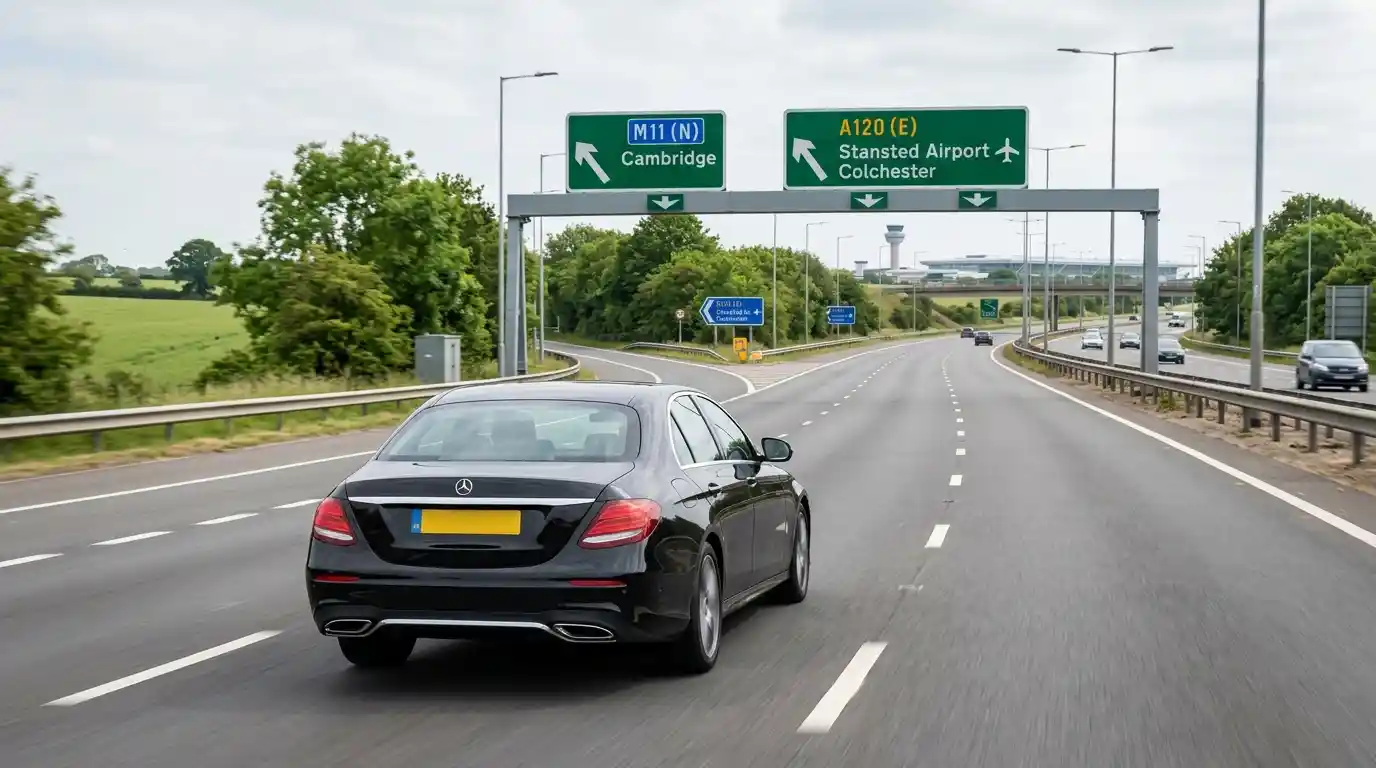
The M11 runs north to south along the airport's eastern side, carrying the majority of road traffic to Stansted. It connects London and the south to Cambridge and the north. Its traffic significance is simple: there is very little parallel capacity. When the M11 has a problem — whether a lane closure, an incident or overnight maintenance — there is nowhere convenient for diverted traffic to go. This makes disruption here feel sharper and last longer than the same event on a wider motorway with parallel alternatives. At peak, the stretch between Junctions 8 and 9 is the known pressure point, and the area around Junction 7 at Harlow has a history as an accident location.
The A120 — Where Every Route Converges
The A120 runs east to west across the M11 and every road journey to Stansted finishes on it, regardless of starting point. That makes it a single point of dependency: congestion here cannot be avoided by choosing a different approach. When the A120 is slow near the airport, all approaches slow together. Normal conditions on the dual-carriageway section are generally clear outside peak periods, with congestion concentrated at the junction approaches and the roundabouts distributing traffic into the airport complex. An incident on the A120 close to the airport is more disruptive than its scale suggests, because diversion options are limited and the traffic has nowhere else it needs to be.
Key Junctions and Approach Roads
M11 Junctions 8 and 8a connect the motorway to the A120 and both are signposted for the airport. Junction 8 is the recognised constraint — it handles passenger vehicles, taxis, coaches and freight simultaneously, and an improvement scheme has been progressing to increase its capacity. The Priory Wood Roundabout and Bassingbourn Roundabout distribute traffic between the terminal and car parks. The final approach roads — Thremhall Avenue, Round Coppice Road, Bassingbourn Road and Coopers End Road — carry traffic from the A120 into the terminal area, car parks and car rental village. Traffic slows naturally on these roads as drivers make destination decisions, and more when those decisions are made late.
Regional Connections and Where Problems Start
The M25 at Junction 27 connects the south, west and Midlands to the M11. The A11, A14, A10, A12 and A131 feed the wider region into the Stansted corridor. Conditions on these determine whether a problem ever reaches the airport at all — an incident on the A12 or A14 pushes traffic onto alternatives, and some of those alternatives are the roads you were planning to use. The M25, in particular, is the least predictable section of any Stansted journey from the south or west, contributing more to journey time variability than the Stansted-specific roads do.
Where Does Traffic Build Up Around Stansted Airport?
A traffic problem affecting your airport journey can begin in four different places — and they behave differently, requiring different responses.
| Zone |
Where it is |
Typical cause |
Response |
| Approach roads | M11, M25, regional A-roads — well before the airport | Congestion, incidents, roadworks on approach corridors | Leave earlier, consider rerouting (see best routes guide) |
| Airport access roads | A120 junction approaches, M11 Junction 8 | Junction capacity, local and airport traffic combining | Allow margin; no detour available once on the A120 |
| Terminal-area traffic | Forecourt, car park entrances, shuttle stops | Departure waves — peaks at 04:00–06:00, when the motorway is clear | Know your destination before reaching the A120 split |
| Regional knock-on | Alternative roads when A12, A14 or M25 are blocked | Incidents on feeder roads divert traffic onto Stansted corridor | Check feeder-road conditions before assuming your route is clear |
Why the distinction matters. A problem on the approach roads may be avoidable by rerouting before you join them. A problem in the terminal area is not — you drive into it, which is why knowing your destination and departure time matters more than route choice for the last two miles. The most common lost time accumulates on approach roads, often an hour or more before the airport itself is visible.
M11 Traffic and Conditions Near Stansted
The M11 is the single most consequential road for Stansted journeys — and the one where disruption is felt most asymmetrically.
- Typical peak congestion. Weekdays 07:00 to 09:00 and 17:00 to 19:00. The stretch between Junctions 8 and 9 is known for heavy traffic. Congestion is directional — morning flow is towards London, evening flow outward — so the same stretch behaves differently depending on your direction and the time.
- Accidents and breakdowns. The M11's limited parallel capacity makes incidents disproportionately disruptive. A lane closure that would cause modest delay on a wider motorway can produce substantial delay here because diverted traffic has few realistic alternatives. Unlike congestion, an incident has no predictable clearing curve — its duration depends on the emergency response and recovery.
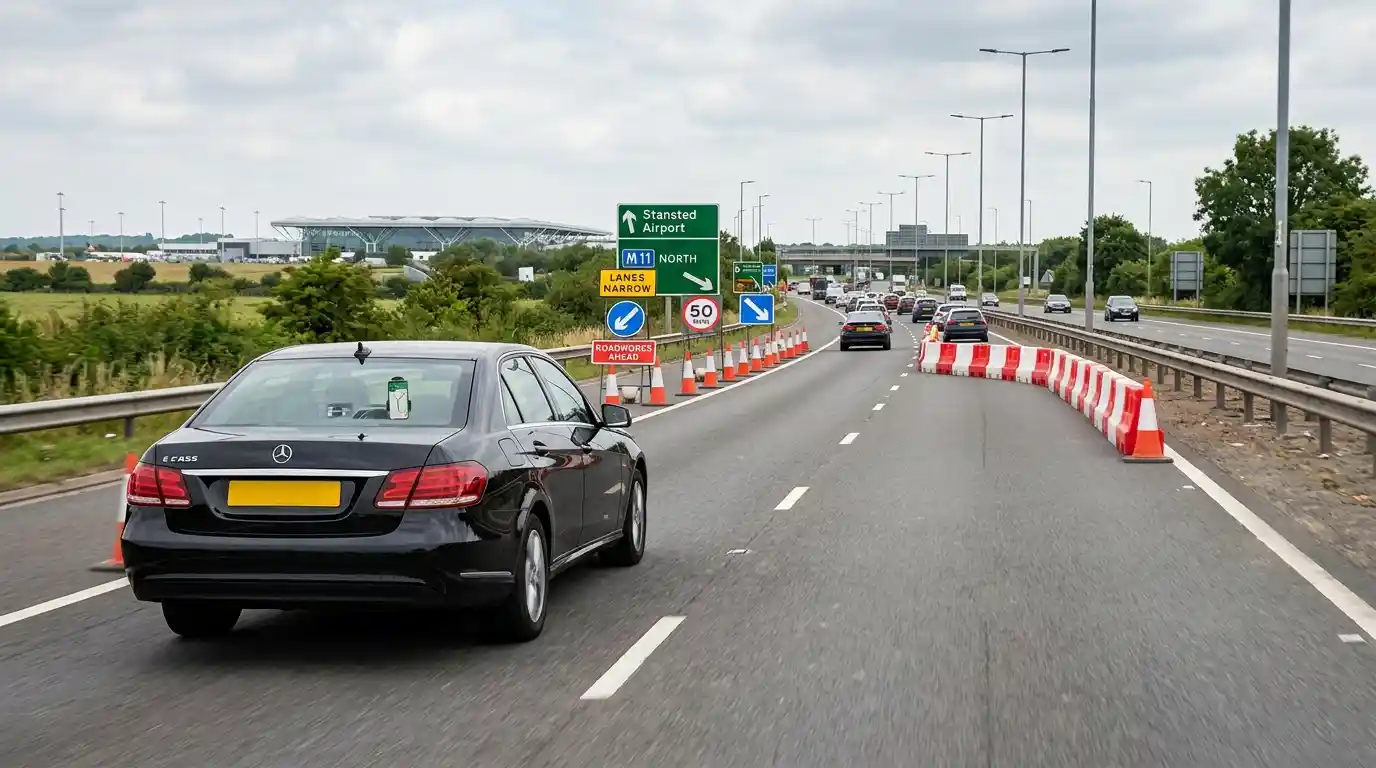
- Roadworks and lane restrictions. National Highways has run maintenance programmes on the M11, including work between Junctions 6 and 14 and safety improvements between Junctions 7 and 8 — the stretch immediately serving the airport. Lane restrictions reduce capacity without closing the road; full closures remove the route entirely.
- Overnight closures — the specific Stansted trap. Full closures are usually planned and usually overnight, because traffic volumes are lowest then. National Highways has run overnight closures on the M11 northbound between Junctions 7 and 8, working roughly 21:00 to 05:00. That window overlaps exactly with Stansted's pre-dawn departure traffic. A live traffic map will show the road as empty, because the closure has diverted everything — not because the road is clear. Check planned works separately before any overnight journey.
- Weather impacts. Exposed motorway sections are affected by fog, high winds, heavy rain and ice more than sheltered roads. Reduced speeds propagate quickly because the M11 runs near capacity at peak. Fog is a particular issue on the open Essex and Cambridgeshire countryside the M11 crosses, especially in autumn mornings — the same hours as the departure wave.
- What M11 disruption means in practice. It affects the reliability of a Stansted journey more than the typical duration. A normal M11 day produces a predictable trip; a disrupted one produces an unpredictable one, and there is limited scope to route around it. If disruption means reconsidering your route, the decision belongs on our best routes guide.
A120 Traffic and Stansted Airport Access
The M11 is where most delay happens. The A120 is where all traffic converges. These are different kinds of significance.
- Why the A120 matters differently from the M11. Because every route ends here, congestion on the A120 cannot be avoided by choosing a different approach — there is no alternative final road. An incident on the A120 near the airport is therefore more disruptive than its scale suggests: the traffic has nowhere else it needs to go, and the diversion options are limited.
- Normal conditions. The A120 is a dual carriageway at the airport section and generally flows well outside peak periods. Its problems are concentrated at junction approaches and airport roundabouts rather than distributed along the route.
- Congestion points. The junction approaches, particularly around M11 Junction 8, and the Priory Wood and Bassingbourn Roundabouts distributing traffic into the airport complex. Airport entrances and car park access can congest independently during school and seasonal holiday peaks.
- Roadworks. Work on the A120 or its junction with the M11 affects every approach simultaneously. Lighting upgrades and junction improvement works have both been carried out in this area. These are the one category of A120 disruption you can know about in advance — check the planned works calendar for your travel date.
- The final approach. The A120 splits into separate signed destinations before the terminal — terminal, Express Set Down, Mid Stay, Short Stay, Long Stay, car rental village. Traffic naturally slows as drivers make decisions, and more when they make them late. Knowing your destination before you reach this point removes unnecessary delay and stress at the end of a long journey.
What Causes Traffic Delays Around Stansted?
"Traffic" describes an effect rather than a cause. Here are the causes, structured so they can be checked and planned against.
| Category |
Specific causes |
Predictable? |
Where to check |
| Airport demand | Departure waves, pick-up/drop-off peaks, taxi movements, 200+ daily coach services, holiday uplift | Partially — follows flight schedule | Flight schedules, seasonal patterns |
| Road-network congestion | Commuter demand on M11 and M25, independent of airport | Yes — follows time-of-day patterns | Live traffic; historical patterns |
| Accidents and incidents | Collisions, breakdowns, debris, emergency response | No — sudden and open-ended | Live incident feeds |
| Roadworks | Lane restrictions, junction works, full closures — planned | Yes — published in advance | National Highways planned works; Essex Highways |
| Weather | Fog, heavy rain, ice, snow, high winds | Partially — forecast but not precise | Met Office; road weather alerts |
| Events and other causes | Regional events, sporting fixtures, abnormal loads, emergency restrictions | Partially — some are scheduled | Event calendars; live road alerts |
The compounding problem. These causes do not queue politely. A wet Friday evening in August during roadworks combines four categories, and the combined effect is worse than any one alone. Checking only live traffic on such a day misses the roadworks element; checking only the roadworks calendar misses the weather. For an important journey, check all categories separately.
When Is Traffic Around Stansted Usually Heavier?
Typical patterns — useful for planning, not a prediction of your specific travel day.
| Time / Period |
Road-network condition |
Terminal-area condition |
Practical implication |
| Weekday 07:00–09:00 | Busiest — M11 peak, commuter flow | Moderate — not the departure peak | Dominant risk is network congestion; leave earlier |
| Weekday 10:00–15:00 | Off-peak — most consistent window | Lower | Best regular window for this corridor |
| Weekday 17:00–19:00 | Busy — evening peak, worst on Friday | Lower | Direction of flow matters — against-flow journeys run better |
| Overnight 00:00–06:00 | Quietest — free-running | Highest — 04:00–06:00 departure wave | Network clear but planned closures most likely; check works calendar |
| Weekends | Flatter — no commuter peak, broader leisure traffic | Variable | Saturday mornings and Sunday afternoons carry their own volume; M25 busy at weekends |
| School holidays | Baseline raised all day — midday window narrows | Elevated | The normally clear off-peak window becomes less reliable |
| Bank holidays | Friday before and Monday after are worst; others quiet | Variable | Specific bank holiday days vary; check rather than assume |
The pattern these reveal. The road-network peak and the terminal-area peak are misaligned — the motorway is busiest at 08:00 and quietest at 04:00, while the terminal is busiest at 04:00–06:00. This means a driver heading to Stansted for an early flight faces a clear motorway and a congested final approach, while a driver heading in at 08:00 faces a busy motorway and a clear terminal. Know which problem you are dealing with.
Use patterns to plan. Use live information to decide. Historical patterns describe what usually happens. A quiet Tuesday midday can be disrupted by a single incident. A Friday evening can run clear. The pattern is the prior; the live condition is the fact.
How Do Roadworks Affect Stansted Airport Journeys?
Roadworks are the most predictable form of disruption — and therefore the most avoidable, if you check before you travel rather than discovering them on the night.
- What roadworks do to your journey. Lane closures reduce capacity and slow traffic even when the road remains open. Junction works alter access routes and can close specific slip roads. Temporary speed restrictions lower the road's throughput. Full closures impose a diversion with a longer route and its own congestion.
- The overnight trap — the specific Stansted problem. Motorway maintenance is scheduled overnight because road traffic volumes are lowest then. National Highways has run overnight closures on the M11 northbound between Junctions 7 and 8, working roughly 21:00 to 05:00. That window coincides exactly with Stansted's pre-dawn departure traffic. A driver leaving at 03:00 for a 06:00 flight is travelling during the maintenance window, on a road that a live traffic app will show as empty — because the closure has diverted everything, not because the road is open and clear. Check planned works separately, not just live conditions, before any overnight journey.
- Junction 8 improvement scheme. The M11 Junction 8 improvement scheme, progressed by Essex Highways, aims to increase off-slip capacity onto the junction. Junction works affect access rather than through-traffic, which means they hit airport journeys harder than they hit the motorway generally — the improvement is designed specifically for the airport approach.
- A120 and approach road works. Lighting upgrades, surface works and junction improvements on the A120 and its connecting roads affect every approach simultaneously. These are published in advance and checkable before your travel date.
- Where to check planned works. National Highways publishes its programme at nationalhighways.co.uk. Essex Highways publishes local works. Both are updated as programmes change. Check the specific date you are travelling, not just the general area.
Accidents and Major Road Incidents: Why They Are Different from Congestion
Not all disruption is equal. Treating an incident like ordinary congestion is how people miss flights.
| Type |
What it means for your journey |
Clears predictably? |
Response |
| Ordinary congestion | Slower, predictable — volume exceeding capacity | Yes — clears on a broadly predictable curve | Leave earlier; rerouting usually does not help |
| Minor incident | Breakdown, debris — short local delay | Mostly — usually clears within 30–60 minutes | Monitor; allow margin |
| Lane closure | Significant delay; capacity reduced to remaining lanes | Partially — depends on recovery speed | Monitor live and consider alternatives if the closure is on the M11 |
| Major incident | Serious collision, emergency response — substantial and open-ended | No — duration unknown | Treat as a reason to consider another mode or very substantial extra time |
| Full closure | Route unavailable; diversion imposed | No — reopens when the road is cleared | Follow official diversion; consider rail if time allows |
| Diversion active | Traffic routed to alternatives; those alternatives slow down | Resolves when primary road reopens | Check whether the alternative you planned to use is now itself affected |
The M11 multiplier. An incident on the M11 is more disruptive than the same incident elsewhere, because the alternatives are limited. A full closure between Junctions 7 and 8 removes the primary airport access route with no equivalent substitute — which is why this corridor's reliability is more weather-sensitive and incident-sensitive than most. Congestion is a delay. A major incident is an unknown. Plan differently for each.
Weather and Events: The Less Predictable Causes
Weather affects reliability more than duration. Events are the least predictable cause because they are not on any traffic map until they happen.
- Fog. The M11 corridor runs through open Essex and Cambridgeshire countryside and is prone to fog, particularly in autumn and early morning — which coincides directly with the airport's departure wave. Reduced visibility lowers speeds, which compounds quickly on a road running near capacity at peak.
- Heavy rain and flooding. Reduces speeds, increases stopping distances and raises incident likelihood. Standing water on exposed sections is a recurring winter problem. Reduced speeds spread backward quickly on the M11.
- Snow and ice. Less frequent but more disruptive. Overnight ice affects pre-dawn journeys — the ones Stansted generates in the highest volume. Gritting coverage on approach roads varies; the motorway is prioritised over minor roads.
- High winds. Affect high-sided vehicles most, and the M11's exposed sections carry substantial freight traffic. Restrictions on high-sided vehicles create congestion for all traffic by reducing effective lane capacity.
- The practical point about weather. Weather rarely closes a road outright, but it consistently widens the range of possible journey times. In poor conditions, plan against the upper end of any estimate rather than the middle.
- Events. Regional events, sporting fixtures, festivals and large gatherings generate traffic on roads that feed the Stansted corridor. An event near Cambridge, Chelmsford or the M25 can push traffic onto the M11 without anything happening on the M11 itself. Emergency service activity, planned protests and abnormal load movements also cause temporary restrictions. These rarely appear in typical traffic patterns — they are a live-information problem, not a planning-pattern problem. Check event calendars and road alerts for dates where you know regional activity is concentrated.
Where Can I Check Live Traffic Near Stansted Airport?
Three different kinds of information — and confusing them is the most common mistake on this subject. Each answers a different question.
| Information type |
What it shows |
What it cannot show |
Use it for |
| Live conditions | Current incidents, congestion, active closures — right now | Planned closures starting tonight; tomorrow's roadworks | Deciding whether to leave now and by which road |
| Typical traffic patterns | What usually happens at a given time and day, based on historical data | Today's specific incident; tonight's planned closure | Planning a journey days or weeks ahead |
| Planned roadworks and disruptions | Scheduled closures, lane restrictions, junction works — published in advance | An accident that happened ten minutes ago; live congestion | Checking whether your travel date carries a known problem — especially overnight |
Check all three for an important journey. A live traffic app will not warn you about a closure scheduled for tonight. A roadworks calendar will not tell you about an accident that happened ten minutes ago. Typical patterns will tell you neither. The specific blind spot for Stansted is the overnight closure — live traffic shows an empty road; the planned works calendar shows the closure. Only the second tells you the truth.
Useful sources. For live conditions and planned works: National Highways (nationalhighways.co.uk) covers the M11. Essex Highways covers local roads including the Junction 8 improvement. Live traffic layers in major navigation apps (Google Maps, Waze, Apple Maps) provide current incident and congestion data. Traffic England covers national incidents.
How to Check Traffic Before Leaving for Stansted
A short sequence that takes a few minutes and answers all three questions.
- The night before: check planned roadworks. Look up your travel date on the National Highways planned works page and the Essex Highways site. This is the check that cannot be done live on the morning — it answers "is there a scheduled closure I will drive into" rather than "is the road busy right now".
- The night before: check for major events. If your travel date falls near a significant regional event, event traffic can affect the corridor without anything showing on a road-network map until the day itself.
- The morning of travel: check live incidents. Use your navigation app with live traffic enabled. Look specifically at the M11 between Junctions 7 and 9, the A120 approach, and any motorway your route uses before the M11.
- The morning of travel: check live congestion on your specific route. Not the region in general — your specific roads. A congestion hotspot twenty miles from your route is not your problem; a slow stretch three miles in is.
- Check the weather. Particularly for fog (the M11 corridor in autumn mornings), ice (overnight in winter), and high winds (freight restrictions).
- Confirm your departure time against what you have found and adjust if needed. Then re-check immediately before leaving, because conditions move — a clear road at 05:00 may not be clear at 05:30 if an incident has just occurred.
The key timing principle. Checking the night before tells you about roadworks. Checking as you leave tells you about incidents. Both are necessary; the second does not replace the first. They answer different questions.
What Should I Do If Traffic Is Bad on My Travel Day?
The response depends on which kind of problem it is — and getting that diagnosis right first is the step most people skip.
- Step 1: Establish what kind of problem it is. Ordinary congestion and a major incident require different responses. Confirm using live information rather than a passenger's report or a social media post — drivers who divert on a rumour frequently arrive later than those who stayed on the original route.
- If it is ordinary congestion: leave earlier if you still can, and accept the journey will sit at the upper end of its range. Rerouting around ordinary congestion on the M11 corridor frequently arrives later than staying put, because the alternatives are slower roads.
- If it is an incident or active closure: this is when a route change is worth considering. Confirm it with live information, then consult our best routes guide for the realistic alternatives from your starting point.
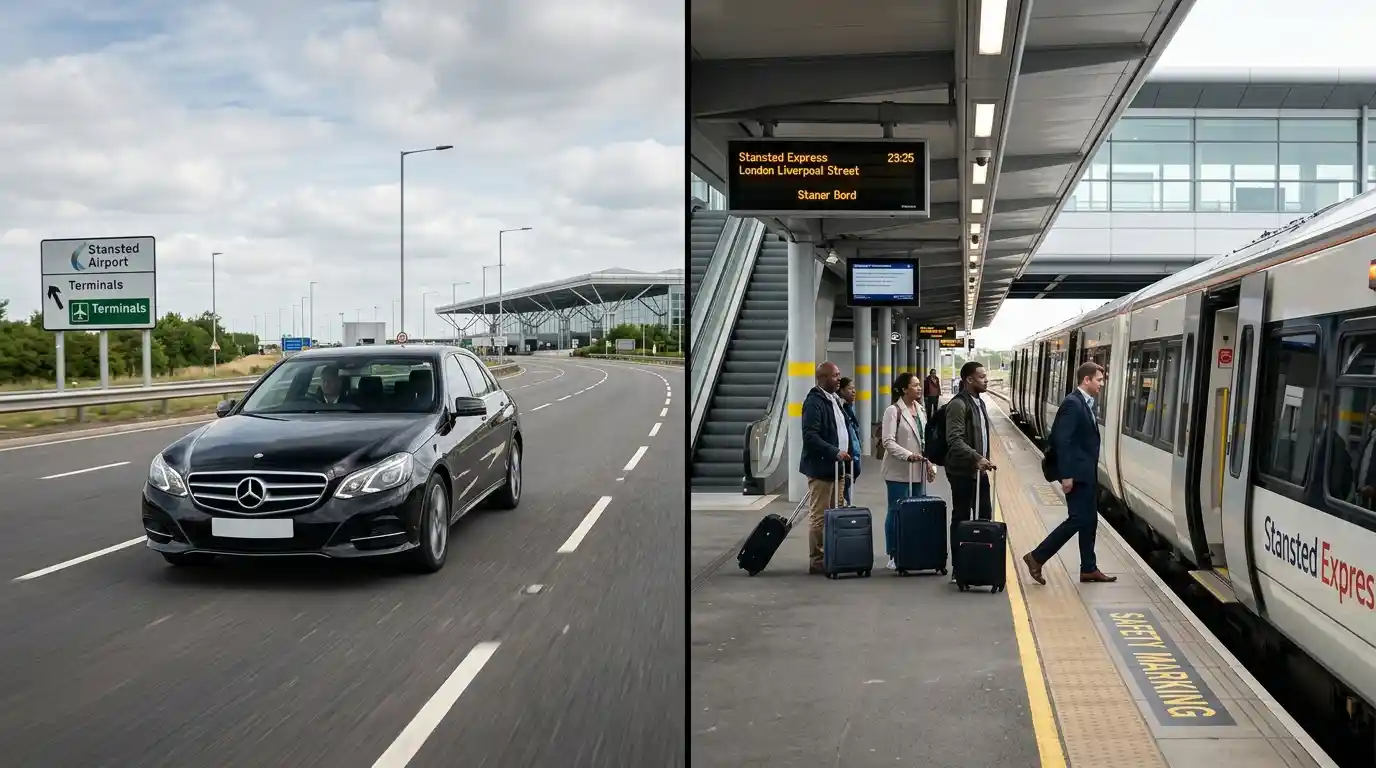
- If the disruption is severe: the question shifts from which road to take to whether road is the right mode. The Stansted Express station sits beneath the terminal and is entirely unaffected by road conditions — see our rail services guide. For a genuinely blocked motorway with a flight to catch, the train is not a consolation prize: it is the faster answer.
- If you are already en route: let your navigation recalculate rather than sticking to the original plan. Do not divert on rumour — confirm the problem first, then let the navigation respond. Re-check before making any manual change.
Traffic for Airport Pick-Up and Drop-Off
Terminal-area traffic follows the flight schedule rather than the commuter one — which means it peaks at hours when the wider road network is clear.
- Drop-off. Vehicle movements around the forecourt rise sharply during departure waves — at Stansted, primarily the 04:00 to 06:00 window. Access to the Express Set Down zone can slow even when the M11 and A120 are completely clear, because the volume is generated by the flight schedule rather than by commuter demand.
- Pick-up. Less predictable, because it follows arrival banks and passengers clear the terminal at varying speeds. Waiting time is the variable, not driving time — which is why the pick-up charge is structured around time in the zone rather than a flat fee.
- Car park access. Entrances and shuttle stops experience their own peaks around departure and arrival banks. Airport entrances specifically can congest during school and seasonal holiday periods, creating local congestion independent of the wider network.
- Temporary traffic management. The airport complex can impose temporary restrictions on internal roads at short notice, altering the approach to specific car parks or facilities. These are not visible on road-network traffic maps.
For the procedures, charges and where to go: our drop-off charges guide, pick-up charges guide and parking guide cover each in full. This section covers the traffic implications only.
Stansted Traffic and Road Conditions — Quick Reference
A single-view summary of every condition type, its potential effect and where to check it.
| Condition |
Potential effect |
Predictable? |
What to check |
| Normal traffic flow | Standard road conditions — baseline journey time | Yes | Time of day and patterns |
| Peak congestion | Slower but predictable; recovers | Yes — by time of day | Live traffic; departure time adjustment |
| Roadworks | Lane restrictions, delays, full closures | Yes — published in advance | National Highways; Essex Highways planned works |
| Accident / incident | Sudden, open-ended delay; disproportionate on M11 | No | Live incident feeds |
| Full road closure | Route unavailable; diversion added | Planned: yes. Emergency: no | Official diversion information; live road alerts |
| Severe weather | Wider range of journey times; higher incident likelihood | Partially | Met Office; road weather alerts |
| Holiday demand | Baseline raised all day; midday window narrows | Partially — by period | Current conditions rather than typical patterns |
| Major event | Local or regional disruption on feeder roads | Scheduled events: yes | Event calendars; regional road alerts |
Related Stansted Airport Guides
The decisions that follow naturally from understanding the traffic picture.
Frequently Asked Questions
Q: Is the M11 usually busy near Stansted Airport?
A: Conditions vary significantly. Typical peaks are 07:00 to 09:00 and 17:00 to 19:00 on weekdays, with the stretch between Junctions 8 and 9 known for heavy traffic. The M11's limited parallel capacity makes disruption felt more than at most airports. Check current conditions before travelling rather than relying on the pattern alone.
Q: What causes traffic around Stansted Airport?
A: Airport demand, commuter traffic, accidents, breakdowns, roadworks, lane restrictions, planned closures, weather, major regional events and seasonal holiday demand. These frequently combine — a wet Friday evening in August during roadworks stacks four causes simultaneously, and the combined effect is worse than any one alone.
Q: Can roadworks affect the journey to Stansted?
A: Yes, and they are the most predictable disruption — which makes them the most avoidable. Lane closures, junction works and full closures all affect access. Overnight M11 closures near the airport are the specific trap: they coincide with the pre-dawn departure wave and will not appear on a live traffic map. Check the planned works calendar separately before any overnight journey.
Q: What happens if there is an accident on the M11?
A: Delays are disproportionate to the incident size, because the M11 has very limited alternative capacity. Unlike congestion, an accident has no predictable clearing time — its duration depends on the emergency response and recovery. Treat it as an unknown rather than a delay, and consider whether the Stansted Express is a faster alternative if time allows.
Q: Where can I check live traffic for Stansted Airport?
A: National Highways traffic information covers the M11. Live traffic layers in navigation apps (Google Maps, Waze, Apple Maps) cover current incidents and congestion. Essex Highways covers local works. For an important journey, check all three types — live conditions, typical patterns and planned roadworks — because each answers a different question and none replaces the others.
Q: Should I check traffic before driving to Stansted?
A: Yes, and check twice: the night before for planned roadworks and scheduled events, and again as you leave for live incidents and current congestion. The night-before check and the morning check answer different questions, and the second does not make the first unnecessary.
Q: Does traffic affect Stansted taxi and transfer journeys?
A: Yes — taxis and pre-booked transfers use the same road network and face the same closures as any driver. A professional driver who tracks your flight and knows the corridor can adjust departure timing and approach, which helps at the margins. No operator can drive around a closed motorway. Congestion affects transfer reliability exactly as it affects your own driving — any operator suggesting otherwise is overselling.
Q: What should I do if there is heavy traffic on the way to Stansted?
A: First, establish whether it is ordinary congestion or a major incident — they require different responses. Congestion clears on a predictable curve; leaving earlier beats rerouting. An incident is open-ended; that is when a route change is worth making, or when the Stansted Express becomes the faster answer. Confirm with live information before acting.
Would You Rather Not Manage the Traffic at All?
Traffic is the largest variable in any road journey to Stansted, and the M11's limited parallel capacity means disruption here is felt more sharply than at most airports. Three things stand out from this page: congestion and incidents require different responses; live traffic, planned roadworks and typical patterns are three separate checks; and the overnight window is the specific trap, where a clear road on a live map may be under a planned closure. Stansted Airport Taxi is a TfL-licensed private-hire operator running pre-booked transfers at any hour. Congestion affects our drivers as it affects every road user — we plan for it with departure-time adjustment and route knowledge rather than pretending the physics are different. Your fixed fare is confirmed at booking regardless of what conditions are on the day.
- ✔ Fixed fare confirmed at booking — no surge pricing when traffic is worst
- ✔ Flight tracking and 45–60 min free waiting on arrivals — delays handled without extra charge
- ✔ 24/7 including pre-dawn pickups during the overnight window when road closures are most likely
- ✔ Saloon, Estate, MPV5–8 and Executive vehicles — door to terminal, luggage handled
👉 Get your fixed-fare quote in under two minutes — book online or call +44 20 3617 7825.
See also our Best Routes Guide, Distance Guide, and Rail Services Guide.
Last reviewed August 2026 · Next review November 2026 — roadworks programmes and junction schemes change · Sources: National Highways (M11 Junction 6–14 maintenance); Essex Highways (M11 Junction 8 improvement scheme); London Stansted Airport · Stansted Airport Taxi editorial team.