Everything that matters airside at Stansted comes down to three numbers: 1–19, 20–39, and 40–59. Those are the gate ranges, they sit in three separate satellite buildings, and the gap between the nearest and the furthest is roughly fifteen to twenty minutes of walking. Find your range on the screens the moment you clear security. Everything else — food, shopping, charging — can wait until you know where you are going.
This guide covers the whole airside picture: how the lounge is laid out, when gates are called, how far each satellite is, and what to do at every stage from leaving the security belt to stepping onto the aircraft. From Stansted Airport Taxi, a TfL-licensed private-hire operator running pre-booked transfers to Stansted around the clock — including the hours before the first train.
Stansted Departure Lounge at a Glance
If you only read one section, read this. The key facts about Stansted's airside — the honest quick answer for passengers and planners alike.
| What |
Detail |
| Gate ranges | 1–19 (Satellite 1), 20–39 (Satellite 2), 40–59 (Satellite 3), plus 90–93 remote stands |
| Nearest satellite | Gates 1–19 — a few minutes by transit from the main lounge |
| Furthest satellite | Gates 40–59 — roughly 15–20 minutes on foot from the main lounge |
| When gates are announced | 30–50 minutes before departure — later than most UK airports, this is normal |
| Shops and food | Concentrated in the main lounge; satellites have comparatively little |
| Walk to Satellite 3 | Roughly 1.0–1.2 km from the central lounge |
| Peak hours | Approx 04:00–08:00 — seating is genuinely tight; midday is calmer |
| Remote stand boarding | Common at Stansted; add ~10 minutes and expect weather |
The one rule that covers everything. Take your boarding time, subtract your walking time, subtract ten minutes of buffer — that is when you leave your seat. For Gates 1–19 it is a relaxed stroll. For Gates 40–59 it is the calculation that separates a comfortable board from a sprint. Everything else in this guide builds on that single discipline.
⚙ Quick Answer: How Does the Stansted Departure Lounge Work?
After security you enter a single large lounge containing almost all shops, restaurants and seating. Gates sit in three satellite buildings — check a screen for your gate range (1–19, 20–39, or 40–59) before you do anything else. Gates are announced 30–50 minutes before departure. Satellite 3 (Gates 40–59) is a 15–20 minute walk, so leave earlier than you think you need to. The satellites themselves have limited facilities — eat, charge and use facilities in the main lounge first.
Quick Answers
When are Stansted gates announced?
Typically 30–50 minutes before departure — later than most UK airports, but this is standard at Stansted due to dynamic allocation across three satellites.
How far is the walk to Gate 50?
Satellite 3 (Gates 40–59) is roughly 15–20 minutes from the main lounge. Security to the far end of the satellite is closer to 20 minutes at a steady pace.
Is there food near the boarding gates?
Very little. Almost all shops, cafés and restaurants are in the main lounge. Eat and buy drinks there before heading to your satellite.
What does 'Wait in Lounge' mean?
It means a gate has not yet been allocated — it is the default status before the 30–50 minute window, not an indication of a delay.
Can my gate change after it is announced?
Yes. At Stansted a gate change can move you between satellites, adding up to 15 minutes to your walk. Recheck the gate range, not just the number.
What is the difference between boarding time and departure time?
Boarding starts 30–40 minutes before departure and the gate closes before the aircraft moves. Always plan against boarding time — confusing the two causes most missed flights.
What Is the Stansted Airport Departure Lounge?
The departure lounge is the airside space between security and the gates. Understanding how it is structured — and why — shapes every decision you make once you are through screening.
The Lounge Itself
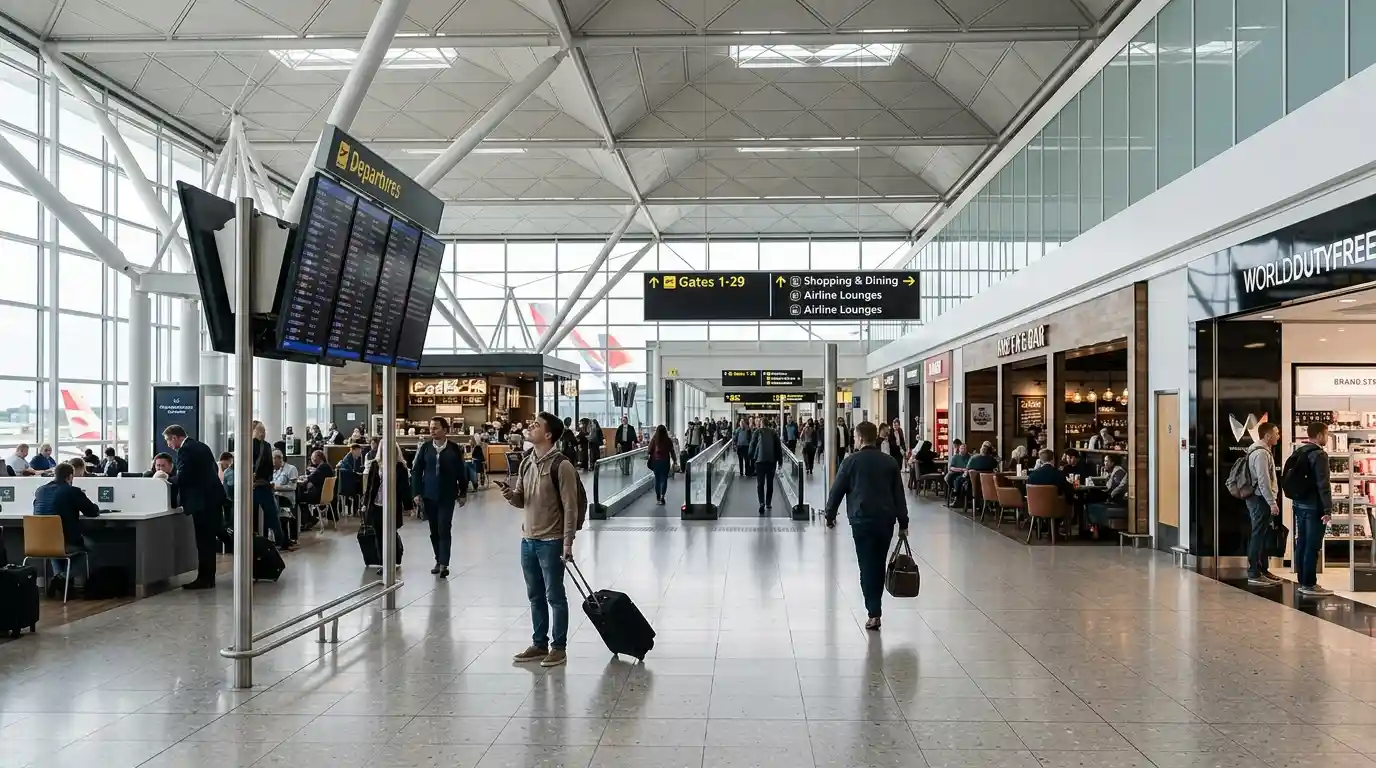
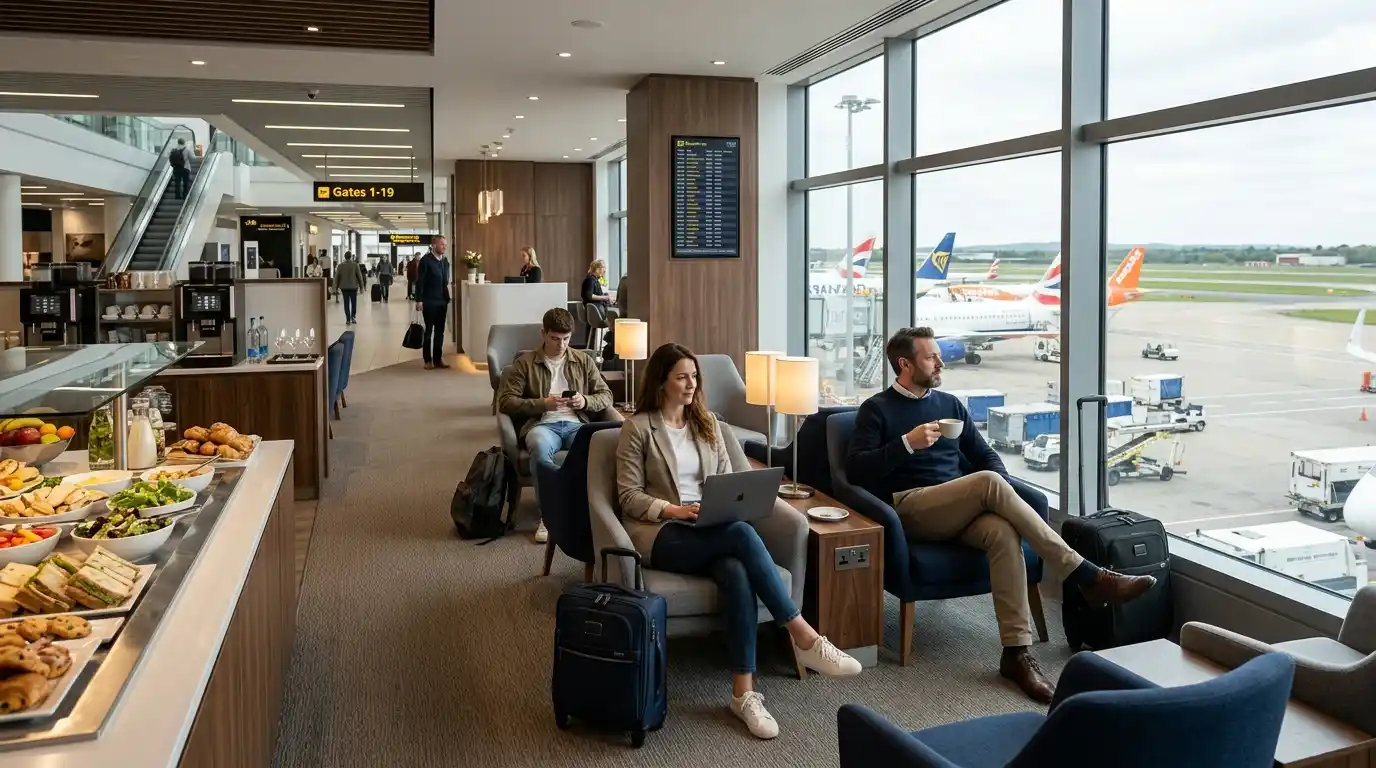
At Stansted the departure lounge is one large room rather than a series of piers. It holds almost all the airport's shops and restaurants, most of its seating, and the routes out to three satellite buildings. The satellites hold the gates and comparatively little else. That imbalance is the single most useful thing to know about waiting at Stansted — because it means walking to your gate early has a real cost in comfort and convenience.
Its Purpose in the Journey
The lounge exists to hold passengers between two fixed points: the moment they clear screening and the moment their gate opens. Because Stansted allocates gates late, the lounge also absorbs the uncertainty — you wait here until you know where you are going. It is the fourth of five stages in the journey (check-in, bag drop, security, departure lounge, gate) and it is the only stage with no queue and no fixed deadline, which is why people misjudge how much time they have left.
Airside vs Landside
Landside is everything before security, open to anyone. Airside is everything after, and only departing passengers with a boarding pass enter. The two never reconnect: once you are airside you cannot return to the check-in hall without leaving the airport. People seeing you off stay landside — say goodbye before the security queue, not after it. If you are travelling with a non-flying companion, the security lane is the point of separation.
Operating Rhythm Through the Day
Stansted's traffic is weighted heavily towards early morning. From roughly 04:00 to 08:00 the lounge is at its busiest and seating is genuinely tight — arriving at 05:30 for a 07:00 departure means competing for seats with a large proportion of the day's passengers. Midday and mid-afternoon are noticeably calmer and a much easier experience. Evenings build again, though less sharply than the morning peak.
Entering the Airside Departure Area
From the security belt to the open lounge floor — what actually happens and what to do first.
- Repack at the belt before moving. Trays get separated from bags quickly at peak, and the space immediately past the scanners is the worst place in the airport to reorganise a rucksack. Pull everything together before you move off — laptops back in bags, belts on, jackets zipped.
- Walk through the duty-free area. The exit from security routes you deliberately through the retail zone into the main lounge. Keep moving if you do not want to stop — the route continues straight through and you are not obliged to browse. This is by design rather than an accident of layout.
- Find a screen before you find a seat. The better instinct after security is to locate a flight information display and check your gate. If no gate is showing yet, note your flight's status — it will most likely say Wait in Lounge — and check again in ten minutes. Sitting down first is how people miss gate announcements.
- Three things in order. Check the screen for your gate range. Work out roughly how long the walk is (see the gate walking times table below). Then decide where to wait, based on that walk rather than on where the nearest seat happens to be.
- Fill a water bottle, charge your phone, eat. Do all of this in the main lounge rather than assuming there will be options at the gate. Then keep your boarding pass and passport accessible — in a pocket, not at the bottom of a bag.
Understanding the Airside Passenger Journey
How passengers move through the lounge and out to the satellites — and why following people rather than signs works badly at Stansted.
- Everyone exits security into the same lounge. From there the crowd disperses three ways — towards Satellite 1, Satellite 2 or Satellite 3. The people around you are not necessarily going where you are going. Following the crowd is a common mistake at Stansted because the split is invisible until you reach the satellite routes.
- Signs airside point to gate ranges, not gate numbers. Follow "Gates 1–19", "Gates 20–39" or "Gates 40–59" rather than hunting for your specific number. Gate numbers are only relevant once you are inside the correct satellite.
- Check the screens on a rhythm. Roughly every ten minutes is enough. Your airline's app will usually flag a gate change faster than the terminal screens, so enable notifications before you travel. There is no need to watch constantly — the screens change when allocation changes and not before.
- Work backwards from boarding time. Note your boarding time, subtract your walking time, subtract ten minutes of buffer. What is left is genuinely free time. Treating departure time as the deadline — rather than boarding time — is how people end up running for Gates 40–59 after a leisurely hour in the lounge.
- Prepare for boarding about 20 minutes before you leave. Repack anything you have opened, put documents in a pocket and finish drinks. Boarding is easier when you are not reorganising a bag in a queue.
Flight Information & Departure Boards
Reading the FIDS screens correctly is the difference between informed waiting and a panic. Here is exactly what the boards show and how to use them.
| Screen Status |
What It Means |
What To Do |
| Wait in Lounge | Gate not yet allocated — normal until 30–50 min before departure | Stay in the main lounge and recheck every 10 minutes |
| Go to Gate | Gate allocated — head there now at walking pace | Calculate walk time, subtract buffer, depart accordingly |
| Boarding | Gate is open and passengers are boarding | If not at the gate, move promptly — do not finish a meal |
| Final Call | Boarding closing shortly | If in the main lounge with a Satellite 3 gate: move immediately |
| Gate Closing | Last passengers being processed | You may already be too late — speak to airline staff |
| Departed | Aircraft has left | Speak to airline desk about rebooking options |
Four fields matter on every screen: your flight number, the status, the gate, and the boarding time where shown. Sorting visually by departure time (the boards are chronological) is faster than hunting for your flight number. Destination alone is unreliable at Stansted — several airlines may fly the same city within an hour.
Boarding time vs departure time. These are different, and confusing them causes most missed flights. Boarding typically starts 30 to 40 minutes before departure and the gate closes well before the aircraft moves. Always plan against boarding time. A delayed departure does not always mean a delayed boarding — airlines often absorb schedule slippage, so keep watching the boarding field rather than the departure field.
Gate changes after allocation. Gates can change once announced, and at Stansted a change can move you between satellites — adding up to fifteen minutes to your walk. This is the reason to stay within reach of a screen rather than settling at a gate the moment it appears. When a change happens, recalculate your walk time before you move, not after.
Boarding Gates: Satellites, Walking Times & Remote Stands
Stansted's three satellites and their walking times are the geography that controls your day. Knowing these numbers before your gate appears means you are never surprised.
| Satellite |
Gate Range |
Route |
Walking Time from Main Lounge |
| Satellite 1 | Gates 1–19 | Transit (automated) | ~4 minutes by transit |
| Satellite 2 | Gates 20–39 | Transit (automated) | ~7 min by transit / ~10 min on foot |
| Satellite 3 | Gates 40–59 | Pedestrian walkway (~1.0–1.2 km) | ~15 min (up to 20 from security to far end) |
| Remote stands | Gates 90–93 | Separate building below main terminal | Add ~10 min + bus to aircraft |
- Satellite 1 (Gates 1–19) and Satellite 2 (Gates 20–39) are both served by the transit system — the automated people-mover running beneath the terminal. You can wait in the main lounge until closer to boarding and transit quickly. The practical difference between the two is small.
- Satellite 3 (Gates 40–59) is connected by a pedestrian walkway rather than the transit, and it is the one that changes your waiting strategy. If your gate is in the 40s or 50s, leaving the main lounge on a tight margin does not work — the walkway is long and the satellite itself has limited food and seating. Move earlier.
- Remote stands (Gates 90–93) sit in a separate building below the main terminal. Boarding is by bus to the aircraft, which adds around ten minutes and means climbing steps outside in whatever weather is happening. Low-cost carriers use remote stands frequently at Stansted, so this is common rather than exceptional.
- Why gates are announced late. Gate allocation responds to aircraft arrival times, stand availability and turnaround progress across three satellites. Stansted allocates late precisely because allocating early would mean changing more often — the dynamic system reduces total gate changes even though it shortens the notice window.
- Priority boarding. Priority boards you earlier and usually bundles a larger cabin-bag allowance. Its practical value is overhead locker space on a full aircraft, not the few minutes saved at the desk. The gate and its closing time are identical for all passengers — priority changes the sequence, not the deadline.
The Boarding Process Step by Step
From the gate room to your seat — what happens at each stage and what to have ready.
- Boarding announcements. Stansted uses gate announcements relatively sparingly. The screens are your primary source of information; announcements confirm what they already show. If you are relying on hearing your flight called rather than watching the boards, you are taking an unnecessary risk in a noisy lounge.
- Boarding groups. Most airlines board in sequences — groups printed on your boarding pass reflecting fare type, seat location or a priority purchase. Wait for yours rather than joining the first queue you see. Queuing before your group is called does not get you on sooner; it blocks the desk and slows everyone including you.
- Boarding pass verification. Staff check your pass against your identity before scanning. Digital passes are accepted throughout. Keep the screen bright and the barcode unobscured — dim screens and cracked glass slow the scanners and cause unnecessary holds at a busy gate.
- Passport checks. For international flights, staff check your passport at the gate. This is the airline's check — carriers hold liability for passengers refused entry at the destination. Have it in hand from the moment you leave your seat, not buried in a bag you then have to open at the desk.
- Jet bridge vs remote stand. Beyond the gate desk you either walk down an air bridge directly to the aircraft door, or board a bus to a remote stand. Only a minority of Stansted's gates have an air bridge, so treat it as a bonus. For bus boarding, have your bag manageable in one hand, expect standing-room on a full bus, and factor in the weather visible through the window.
- Gate closure. The gate closes 20 to 30 minutes before departure. Once closed it does not reopen — staff finalise the passenger count and the aircraft prepares to push back. If you are not at the gate when it closes, your options are determined entirely by your fare conditions with the airline, not by the airport.
Waiting in the Departure Lounge: Strategy by Gate Range
Where and how you wait depends entirely on which satellite your gate is in. Here is the practical strategy for each range.
Gates 1–19: Wait Comfortably, Leave Casually
Satellite 1 is a few minutes by transit. You can wait in the main lounge until close to your boarding time, use all the main lounge facilities, and walk to the transit when you are ready. Being at the gate an hour early buys you nothing except a harder seat and fewer food options. Leave roughly fifteen minutes before boarding starts — that includes transit time and ten minutes of buffer.
Gates 20–39: Similar Strategy, Slightly Earlier
Satellite 2 is seven minutes by transit or around ten on foot. The same main-lounge-first strategy applies. Leave a little earlier than for Satellite 1 — around twenty minutes before boarding — to keep the same comfortable buffer. The lounge facilities are still the right place to eat, charge and use toilets before you go.
Gates 40–59: Move Earlier, Eat Before You Go
Satellite 3 is where the strategy changes. The pedestrian walkway is roughly 1.0–1.2 km, and the walk from security to the far end of the satellite takes up to twenty minutes. Wait in the main lounge as long as your calculation allows, but eat, drink, charge and use the toilets before you set off — there is comparatively little in Satellite 3 and what there is will be busy. Leave at boarding time minus twenty-five to thirty minutes, not when boarding is announced.
Remote Stands (90–93): Expect the Unexpected
Remote stands involve a bus journey across the apron. Follow gate staff instructions, have your bag manageable in one hand, and expect a standing bus with other passengers doing the same. Buses run to a timetable set by the aircraft turnaround, not by passenger preference — if you are late to the gate, the bus does not wait. Add a ten-minute buffer on top of your normal gate walking time.
Preparing to Board: Documents, Bags & Timing
The steps to take before you leave your seat — so the gate desk is smooth rather than a scramble.
- Final document check. Passport, boarding pass, and any visa or travel authorisation your destination requires. Check all three are accessible before you leave your seat — not when you reach the desk. International flights require both passport and boarding pass at the gate; have them together in the same pocket.
- Organise cabin baggage. One bag in hand, everything zipped, liquids and electronics settled from security. If you bought duty free, keep the sealed bag intact — you may need it and the receipt at a connecting airport. If your bag is close to the size limit, make sure it still closes cleanly; gate sizers are used and gate-check fees are steep.
- Boarding pass ready. Screen bright, barcode visible, or the printout unfolded. Add the pass to your phone's wallet app so it loads without a network signal — airside Wi-Fi at a busy gate is not something to depend on. A dead phone with the pass on it is one of the most avoidable causes of gate-desk delays.
- Charge before you leave the main lounge. Charging points are distributed through the main lounge seating clusters and less generously in the satellites. If your boarding pass is on your phone, charge before you set off rather than hoping for a free socket in the satellite.
- Repack after security, not at the gate. Repacking at the gate blocks the gate room, slows the desk and puts you under pressure when you should be relaxed. The security belt area — despite its busyness — is the right place to sort the bag properly, not the gate queue.
Common Departure Lounge Mistakes — and How to Avoid Them
The mistakes that actually cause missed flights and stressful departures at Stansted. All avoidable, all common.
| Mistake |
Why It Happens |
How to Avoid It |
| Ignoring flight information screens | Passengers settle in without checking, then discover a Gate 50-something with twelve minutes left | Check a screen before you sit — gate range first, seat second |
| Planning against departure time | Boarding time and departure time look similar — people mix them up | Always plan against boarding time; it is 30–40 min earlier than departure |
| Waiting too far from the gate | Distance is underestimated, especially for Satellite 3 | Know your walking time before the gate is called; calculate your leave time |
| Missing gate change announcements | Headphones in, screen not checked, notification missed | Check screens on a rhythm every 10 minutes; enable airline app notifications |
| Boarding pass on a dead phone | Charging left until the satellite; lounge socket not found in time | Charge in the main lounge before heading to any satellite |
| Queuing before your boarding group | Anxiety about overhead locker space; instinct to move early | Wait for your group — early queuing blocks the desk and slows everyone |
| Assuming the satellite has food | Expecting the same facilities as the main lounge | Eat, drink and use facilities in the main lounge before setting off |
Departure Lounge Timeline: Stage by Stage
The full sequence from security exit to aircraft door — what happens and what to do at each stage.
- Exit security. Repack at the belt. Move through the retail area into the main lounge. Do not stop to reorganise anything immediately past the scanners — keep moving to clear the flow.
- Enter the departure lounge. Find a screen before you find a seat. Note your flight's status and whether a gate has been allocated. If it shows Wait in Lounge, that is normal — check again in ten minutes.
- Monitor flight information. Check every ten minutes. Have your airline's app open with notifications on — it usually reports gate changes faster than the terminal screens. Enable notifications before you leave home, not airside.
- Wait for gate announcement. Expect the gate 30 to 50 minutes before departure. Use this time to eat, charge, buy what you need, and use the toilets — the main lounge is the place for all of this, not the satellite.
- Calculate your departure time. When the gate appears: boarding time minus walking time minus ten minutes. Write it on your phone if it helps. That figure is when you leave your seat.
- Walk to the boarding gate. Leave at your calculated time, not when boarding is announced. For Gates 40–59 in particular, waiting for the announcement and then walking means arriving late or arriving flustered.
- Boarding begins. Boarding starts 30 to 40 minutes before departure. Wait for your group, then have passport and boarding pass in hand at the desk. Do not join a queue until your group is called.
- Final call. The last announcement before gate closure. If you hear it and you are not at the gate — or you see it on a screen in the main lounge with a Satellite 3 gate — move immediately.
- Gate closes. 20 to 30 minutes before departure. Does not reopen. If you are not through the desk, speak to your airline about options under your fare conditions.
Related Stansted Airport Guides
Everything else you need for a Stansted departure, from the road in to the gate out.
Frequently Asked Questions
Q: What is the Stansted Airport departure lounge?
A: The airside space between security and the gates. It holds almost all the airport's shops, restaurants and seating, and the routes to three satellite buildings. Importantly, it is one large room rather than a series of piers — and the satellites where the gates sit have comparatively little in the way of facilities.
Q: Who can enter the departure lounge?
A: Only departing passengers who have cleared security. People seeing you off cannot come through — say goodbye before the security queue, not after it. Once airside you cannot return to the check-in hall without leaving the airport.
Q: What happens after security at Stansted?
A: You walk through the duty-free retail area into the main lounge. Check a flight information screen before doing anything else — your gate range tells you how much time you actually have. If no gate is showing yet, note the status and recheck in ten minutes.
Q: When is my boarding gate announced at Stansted?
A: Usually 30 to 50 minutes before departure — later than at many UK airports. Gate allocation is spread dynamically across three satellites, so late announcement is the standard here, not a sign of a problem. The screen will show Wait in Lounge until the gate appears.
Q: Can my boarding gate change at Stansted?
A: Yes. At Stansted a gate change can move you to a different satellite, adding up to fifteen minutes to your walk. When a change is announced, recalculate your walking time and leave-by time before you move — do not just head for the new number.
Q: How far is the walk to the gates at Stansted?
A: Gates 1–19 are about four minutes by transit. Gates 20–39 are around seven minutes by transit or ten on foot. Gates 40–59 are a walk of roughly fifteen minutes from the main lounge, and up to twenty from security to the far end of Satellite 3.
Q: What does 'Final Call' mean at Stansted?
A: Boarding is about to close. If you see Final Call on a screen and you are still in the main lounge with a Satellite 3 gate, you are unlikely to make it at walking pace. Move immediately rather than finishing what you are doing.
Q: What is remote stand boarding at Stansted?
A: Boarding by bus rather than air bridge. You walk outside, ride across the apron and climb steps to the aircraft. It adds around ten minutes, is standing-room on the bus, and is common at Stansted — particularly with low-cost carriers. Factor in the weather you can see outside.
Flying from Stansted? Book Your Pre-Booked Transfer
Stansted Airport Taxi is a TfL-licensed private-hire operator running 24/7 fixed-fare transfers to Stansted — including the early-morning and overnight slots outside train hours. Your fixed fare is calculated on distance and vehicle class, and confirmed at booking so there are no surprises at the other end.
- ✔ Fixed fare confirmed at booking — no meter, no surge, no matter the traffic or time
- ✔ 24/7 operation including pre-dawn pickups for early-morning Stansted departures
- ✔ Meet & greet with name board, flight tracking, and 45–60 min free waiting on arrivals
- ✔ Saloon, Estate, MPV5–8 and Executive vehicles — luggage help both ends
👉 Get your fixed-fare quote in under two minutes — book online or call +44 20 3617 7825.
See also our Stansted Arrivals Guide, Stansted Terminal Guide, and Check-in & Security Guide.
Last reviewed August 2026 · Next review February 2027 — earlier if satellite routes alter · Stansted Airport Taxi editorial team. Sources: London Stansted Airport, Manchester Airports Group, published terminal mapping.