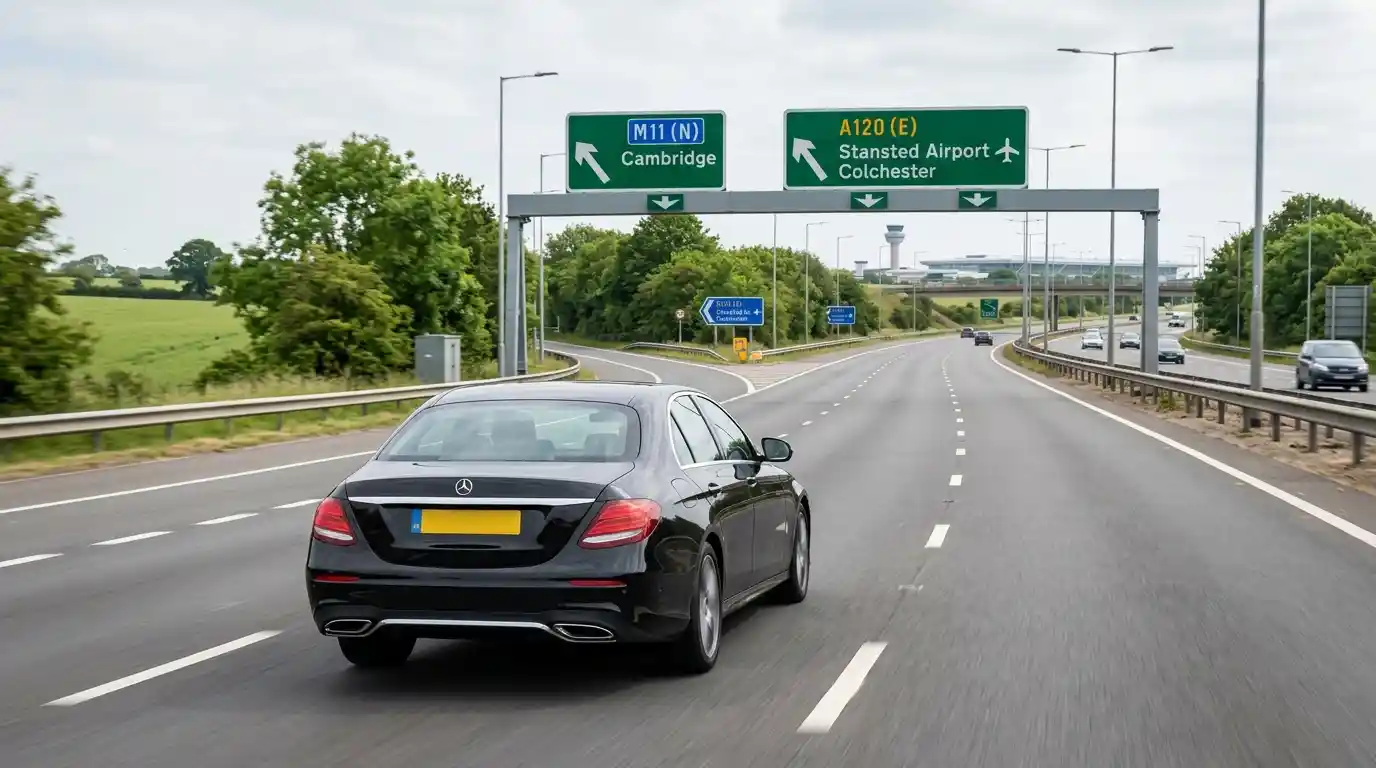
There is no single best route to Stansted Airport, because "best" means different things to different drivers. What every route does share is a common ending: whichever way you approach, you finish on the A120 and follow airport signage in. The variable is how you reach the A120 — and that depends on where you start, when you travel and what you value: shortest distance, shortest expected time, simplest driving, or the most predictable arrival.
This guide gives you the roads, the trade-offs and a decision framework you can work through — without turn-by-turn directions that belong in a sat-nav. If you would rather not drive it, Stansted Airport Taxi runs pre-booked transfers at any hour, with drivers who know which approach suits the conditions on the day. Sources: London Stansted Airport, National Highways, Essex Highways. Reviewed August 2026.
Route Choice at a Glance
The five route categories and when each applies — before the detail.
| Route consideration |
What it means |
When it matters |
| Main route | M11 to Junction 8 or 8a, then the A120 | Standard journeys from most directions — the default for almost every driver |
| Alternative route | A120 east or west, or a local approach | Congestion, closures or eastern origins (Colchester, Braintree) |
| Motorway-focused | M25 to M11, staying on major roads | Longer journeys from the south and west of London |
| A-road alternative | A120, A10, A11 or regional roads | Specific origins, or when the M11 is disrupted |
| Airport approach | A120 → Thremhall Avenue → Priory Wood Roundabout → terminal | The final two miles — common to all routes |
Sat-nav postcodes. The official airport postcode is CM24 1RW. For the terminal building specifically, some sat-navs route more precisely using CM24 1QW (Bassingbourn Road). For a specific car park, use that car park's own postcode rather than either of these.
⚙ Quick Answer: What Is the Best Route to Stansted Airport?
From most directions: M11 to Junction 8 or 8a, then the A120 into the airport. Every route ends on the A120 regardless of your approach — follow airport signage rather than a specific junction number, since published guides genuinely contradict each other on which junction suits which direction and the signs do not.
From Colchester, Braintree or eastern Essex: A120 westbound directly to the airport — the M11 is a detour from these origins, not an improvement.
From south or west London: M25 to Junction 27, then M11 northbound. The M25 is the least predictable section of any Stansted route, so leave earlier rather than planning around it.
The most important rule for an airport journey: predictability beats speed. A route that arrives consistently beats one that is usually quicker but occasionally fails badly. For a flight with a fixed departure time, the cost of arriving late is much higher than the benefit of arriving early.
Quick Answers
Which M11 junction do I use for Stansted Airport?
Both Junction 8 and Junction 8a connect to the A120 and both are signposted for the airport. Published guides contradict each other on which suits which direction — follow the airport signage rather than a junction number you remember. The signs begin well in advance and are unambiguous.
What postcode should I enter for Stansted Airport?
CM24 1RW for the airport generally. For the terminal building, CM24 1QW (Bassingbourn Road) routes more precisely on some sat-navs. For a specific car park, use that car park's own postcode. Check your device has selected the airport, not Stansted Mountfitchet village, before setting off.
Is the M11 the only road to Stansted?
No. The A120 runs east-west and reaches the airport directly. Eastern Essex origins (Colchester, Braintree, Great Dunmow) use the A120 westbound without touching the M11. The A120 is also a genuine alternative when the M11 is disrupted.
When is the M11 busiest near Stansted?
Weekdays 07:00–09:00 and 17:00–19:00, with the Junction 8–9 stretch the known pressure point. Friday evenings are the worst of the week. Off-peak from about 10:00 to 15:00 the direct route is almost always clear and right.
What should I do if the M11 is closed?
Confirm the closure with live traffic first — unnecessary diversions often arrive later than waiting. From the south, the A10 and A120 westbound provide an M11-free approach. From the east, the A120 already avoids it. From the north, A11 and local roads are slower alternatives.
What is the best route from east London to Stansted?
East London is the best-placed part of London for Stansted. The M11 is reachable without crossing the city, and the A12/A120 corridor provides an eastern alternative if the M11 is disrupted. Journeys from Stratford, Canary Wharf and the City are among the shortest and most predictable London routes.
What Makes a Route the "Best" Route to Stansted?
Five drivers on the same journey can reasonably want five different routes. Before comparing roads, it is worth being clear about what you are optimising for.
Shortest Distance vs Shortest Expected Time
These are rarely the same road. The shortest route by mileage usually means slower A-roads, more junctions and more towns. The fastest expected route usually means more motorway, even at the cost of extra miles — because twenty extra motorway miles frequently beat ten fewer A-road miles. Note the word "expected": a route that is fastest at 11:00 may not be fastest at 08:00. Both figures are planning inputs, not guarantees, and neither accounts for the conditions you will actually meet.
Simplest Driving vs Avoiding Congestion
Fewer complicated junctions, clearer road progression and less navigation matter more than people admit — particularly for an unfamiliar driver, a night journey, or anyone managing children in the car. A route with one motorway and one A-road is easier than a route with four changes, even if it takes five minutes longer. Avoiding congestion is a separate calculation: a longer route can arrive sooner when the normal route is heavily affected, but only if the extra distance costs less time than the congestion would. This is the only category where the right answer changes hour by hour.
Predictability vs Raw Speed
For an airport journey with a flight at the end, the route that arrives consistently is worth more than the one that is nominally quicker but occasionally terrible. Shortest and fastest are fixed numbers based on normal conditions. Predictability is a property of the whole route — how it behaves when conditions deteriorate, not just when they are good. A route whose worst case is acceptable beats a route whose best case is excellent. That is why, for airport journeys, predictability usually outranks speed as the primary criterion.
The Honest Position: "Best" Is a Decision, Not a Fact
The best route for a family with luggage and a tight flight, starting from west London on a Friday evening, is not the same as the best route for a solo business traveller from Cambridge on a Tuesday morning. Who is in the car, when the flight is, how much margin you have, how familiar you are with the roads, and what you are willing to trade all change the answer. This page gives you the roads and the trade-offs. The decision is yours — and that is the right place for it to sit.
The Main Road Routes to Stansted Airport
The road network around Stansted is simpler than most airports — almost everything funnels through two roads. Understanding those two roads explains most of the route decisions available to you.
- The M11 — the primary corridor. The M11 runs north to south along the airport's eastern side, carrying the majority of road traffic to Stansted. Southbound it heads towards Harlow and London, connecting onward to the M25 at Junction 27. Northbound it heads towards Saffron Walden and Cambridge, connecting to Norwich via the A11 and to the Midlands via the A14. Almost every road journey to Stansted uses at least part of it.
- The A120 — the airport's own road. Every route ends here. The A120 runs east to west across the M11 and the airport sits directly north of it. Westbound it heads towards Bishop's Stortford with onward connections to Hertford via the A10. Eastbound it heads towards Braintree, Colchester and Harwich with connections to Chelmsford and Ipswich. Eastern Essex origins can use it without touching the M11 at all.
- Junction 8 and Junction 8a — the junction question. The M11 meets the A120 at Junction 8 and Junction 8a. Both connect to the airport. Published guides genuinely contradict each other on which suits which direction of travel. The safe position: both junctions are signposted for the airport, the signage begins well in advance, and following it is more reliable than following a junction number you read somewhere. Let the signs — and your sat-nav — do the work.
- The final approach roads. From the junction, the route runs via Thremhall Avenue to the Priory Wood Roundabout, then into the airport complex. The A120 splits into signed destinations before the terminal. Car parks, set-down zones and the car rental village are all signposted from this point. Know your destination before you reach the split — the approach roads assume you do.
- The M25 — the connector for south and west. The M25 connects the south, west and Midlands to the M11 at Junction 27. It is the most variable section of any Stansted route and the one that contributes most to unpredictable journey times. Avoid it where a realistic alternative exists; allow for it where it is unavoidable.
How to Choose the Best Route to Stansted: A Five-Step Framework
A process you can work through before you leave — not while you are driving.
| Step |
What to do |
Why it matters |
| 1. Identify your starting point | Central/north London → M11 south. East London → M11 via A406 or A12/A120. South/west London → M25 to J27. Cambridge/north → M11 south. Colchester/east → A120 west | Starting point does more than anything else to determine the right route |
| 2. Check expected conditions | Live traffic, roadworks, planned closures, weather — before you leave, not while driving | The M11 has limited parallel alternatives; a problem there affects every option |
| 3. Compare your options | Distance, expected journey time, road type, junction complexity — and route reliability | The fastest option under normal conditions may not be the most reliable option on your day |
| 4. Consider who is in the car | Family with luggage and a tight schedule → simplest predictable route. Solo driver who knows the area → quickest option | The travellers, not just the road, determine what 'best' means |
| 5. Know your airport destination | Terminal / Express Set Down, Mid Stay, Short Stay, Long Stay, car rental village — all signposted separately from the A120 | The approach roads split before the terminal; reversing a decision means going around again |
Best Routes from London to Stansted Airport
The M11 is the backbone of every London route. What changes is how you reach it — and that depends almost entirely on which part of London you start from.
| London Origin |
Route Corridor |
Key Variable |
Notes |
| East London (Stratford, Canary Wharf, City) | M11 via A12/A406 — avoids crossing the city | Low — east London faces Stansted directly | Shortest and most predictable London approach |
| North-East London (Enfield, Walthamstow) | M11 via A406 North Circular | A406 congestion at peak | Very well placed; A406 is the key junction point |
| North London (Islington, Camden) | A406 to M11 northbound | A406 congestion | Good access; reliability varies by time of day |
| City of London | Eastern approach to M11 — shortest central London journey | City traffic at peak | On the Stansted-facing side; among the best-served central areas |
| Central London (King's Cross, Liverpool Street) | North or east out of the city to the M11 | Urban congestion at the start | Departure time affects more than route choice does |
| West-Central London (Paddington, Victoria) | M25 to J27, then M11 — or cross-city to reach the M11 | M25 unpredictability | Longest central London journey; route decision matters less than departure time |
| South London (Croydon, Brixton) | M25 anticlockwise to J27, then M11 north | M25 throughout | Long and exposed; Gatwick is closer for much of south London |
| West London (Heathrow, Slough) | M25 clockwise or anticlockwise to J27, then M11 | M25 throughout | Longest London journey; Heathrow is the natural airport for this area |
The pattern across London. East and north-east London origins are the best placed — shorter distance, no city crossing, and road distances that are genuinely competitive with the Stansted Express train on shorter journeys. West and south-west London origins are the most exposed — longer distances, M25 dependence, and routes that run against the grain of the road network. For much of west London, Heathrow is closer and faster than Stansted.
These are route corridors, not turn-by-turn directions. This page explains which roads connect where and why you might choose one over another. It does not replace live navigation on the day.
Routes from Major UK Destinations to Stansted
The corridors that matter, and the single route decision that shapes each of them.
| Origin Area |
Primary Route |
Alternative / M25-Free Option |
Key Point |
| Cambridge | M11 southbound direct | — | Simplest relationship: ~30 miles, one road, no decision to make |
| Colchester, Braintree, Great Dunmow | A120 westbound direct | — (A120 is already the best route) | Avoids M11 entirely; more direct than joining the motorway |
| Chelmsford and central Essex | A131 or A12 to A120 westbound | — | Regional A-road approach; no motorway needed |
| Ipswich and Suffolk | A12 south to A120 westbound | — | A120 as the entry point; straightforward approach |
| Oxford, Reading | M40 / M4 to M25, then M11 at J27 | — | M25 governs duration and variability — allow margin |
| Brighton, Southampton | M23 / M3 to M25, then M11 at J27 | — | Long M25 section; most variable of the named routes |
| Midlands (Birmingham, Coventry) | M6 / M1 to M25, then M11 at J27 | A14 to M11 northbound — avoids M25 | A14 alternative worth considering; removes most unpredictable section |
| Northern England (Leeds, Manchester) | M6 / M1 via M25 or A14 | A1(M) to A14 to M11 | At this range, Stansted-specific portion is a small fraction; earlier sections determine everything |
The Midlands A14 alternative is worth knowing. The A14 connects the M1/M6 corridor directly to the M11, bypassing the M25 entirely. For Midlands origins in particular, it offers a steadier route than the M25 junction when the motorway is busy — and on a Friday evening, it usually is.
Shortest Route vs Fastest Route vs Best Route
Three different things — and treating them as one is the most common route-planning mistake for airport journeys.
|
Shortest |
Fastest |
Best |
| Optimises for | Fewest miles | Expected minutes under normal conditions | Your specific circumstances |
| Typically uses | Direct roads, more A-roads, fewer motorway miles | Motorways, fewer junctions, higher average speed | Depends on origin, time of day, travellers and conditions |
| Fixed or variable? | Fixed — miles do not change | Varies substantially by time of day | Varies by traveller and day |
| Good for | Fuel, EV range management, understanding geography | Normal off-peak conditions on a familiar road | An airport journey with a flight at the end |
| Predictability | Low — slower roads fail more variably | Moderate — motorways fail faster when they fail | High — built in by design, not by luck |
Why the shortest route is often not the fastest. Shorter routes typically use slower roads with more junctions and more towns. Twenty extra motorway miles frequently beat ten fewer A-road miles, particularly outside urban areas where speed limits and traffic lights apply.
Why the fastest route is not always the best for an airport journey. The fastest route on a planning tool assumes normal conditions. A route that depends on one stretch behaving well — and fails badly when it does not — is a poor choice when your flight has a fixed departure time. For an airport journey, the cost of arriving late is much higher than the benefit of arriving ten minutes early. Predictability usually outranks speed.
When Should You Consider an Alternative Route to Stansted?
Six situations where the standard M11 approach is not the right answer — and what to consider instead.
- Severe M11 congestion or a closure. The motorway has limited parallel capacity, so a problem there is a genuine problem rather than a manageable delay. Confirm with live traffic information before diverting — unnecessary diversions frequently arrive later than waiting out congestion on the original route.
- An incident between Junctions 7 and 8. This is the stretch immediately serving the airport and a recognised high-traffic section. An incident here blocks the most direct approach and makes the A120 alternatives genuinely useful.
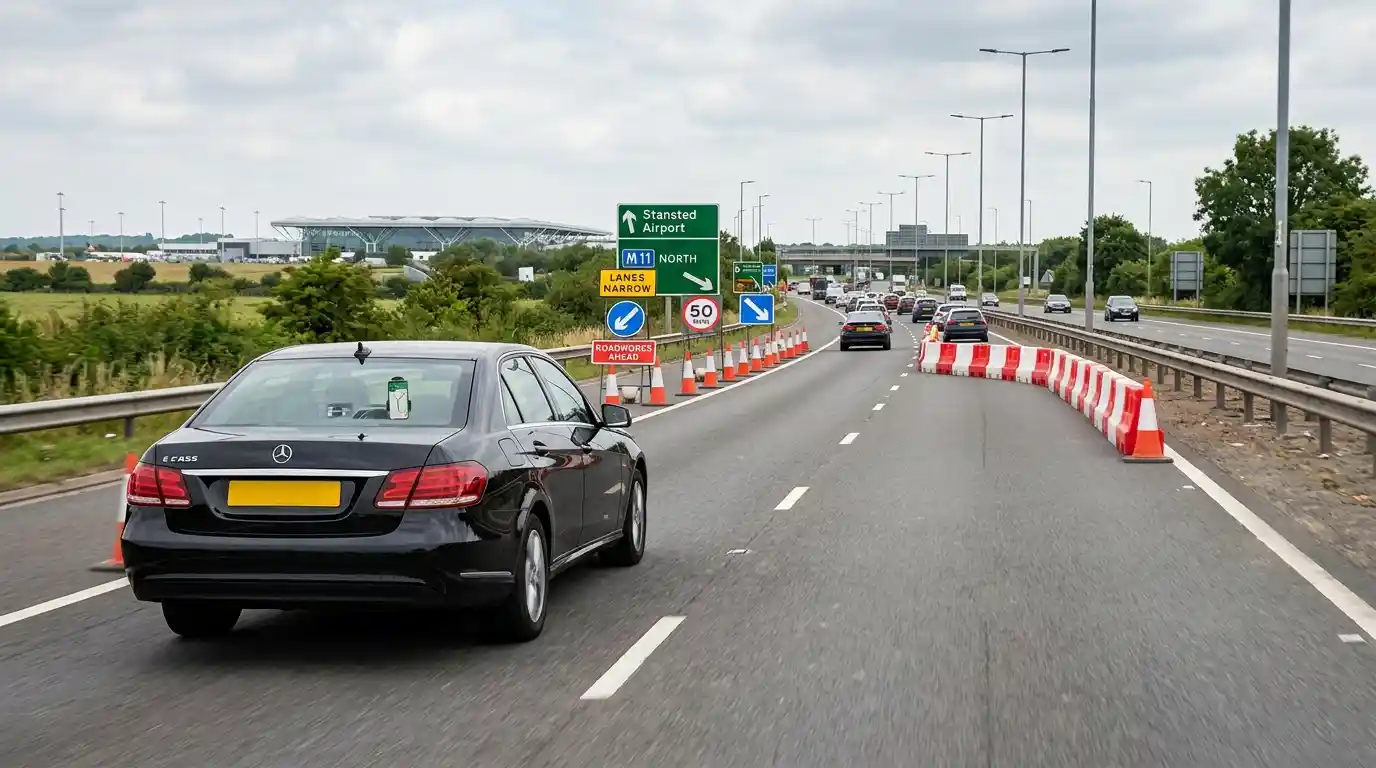
- Planned overnight roadworks. National Highways has run overnight closures on the M11 northbound between Junctions 7 and 8, adjacent to the airport junction. Check for planned works before assuming an empty overnight road — closures are scheduled precisely when traffic is lightest.
- Junction 8 congestion. The airport junction handles passenger cars, taxis, coaches and freight simultaneously and is a recognised pressure point. An improvement scheme is in progress, but congestion at the junction itself can add time independently of the motorway.
- An eastern origin. If you are coming from Colchester, Braintree or Great Dunmow, the A120 westbound is the natural approach and the M11 is not an improvement — it is a detour. These origins are well served without the motorway.
- Weather affecting the motorway. Fog and high winds affect exposed motorway sections more than sheltered A-roads. In severe weather, the A-road alternatives are sometimes more manageable, even if slower in normal conditions.
When an alternative route is available. From the south, the A10 and A120 westbound provide an M11-free approach. From the east, the A120 already avoids it. From the north, the A11 and B1383 offer local alternatives at slower speeds. From none of these is the alternative as fast as a clear M11 — they are hedges against disruption, not improvements in normal conditions.
Does the Best Route Change During the Day?
Yes — and on this corridor the change is substantial enough to affect the decision.
| Time window |
Typical M11 condition |
Route guidance |
Key caveat |
| 07:00–09:00 weekdays | Busiest — Junctions 8–9 known pressure point | Consider A-road alternatives if the M11 shows significant delay | Confirm congestion before diverting |
| 10:00–15:00 weekdays | Off-peak — typically clear | Direct M11 route is almost always right; alternatives offer nothing | — |
| 17:00–19:00 weekdays | Evening peak — worse on Fridays | Allow extra time; a route running against the flow may outperform | Friday evenings are worst of the week |
| Overnight (00:00–06:00) | Free-running | Direct M11 is the clear choice; alternatives lose their purpose | Planned roadworks are scheduled at these hours — check before assuming clear |
| Weekends | Flatter than weekdays — no commuter peak, broader leisure traffic | Direct route; Saturday mornings and Sunday afternoons carry their own congestion | M25 does not empty at weekends |
The practical rule. Check conditions before you leave rather than assuming yesterday's best route is today's. The M11 corridor is prone to sudden, significant delays that make live traffic data the single most useful input for any Stansted road journey.
Route Choice by Traveller Type
The best route is partly a question of who is in the car — not just which road is currently fastest.
Families with Children and Luggage
Favour simplicity and fewer junctions. A route with one motorway and one A-road is far easier to manage than one with several road changes — and the Birchanger Green services at Junction 8, immediately before the airport, are a useful stop if you need it. For the airport approach, know which car park or set-down area you want before you reach the A120 split, because the signage assumes you do and reversing a decision in a large vehicle means going around again. Book child seats in a pre-booked transfer and you remove the vehicle-sizing decision entirely.
Time-Sensitive Travellers
Prioritise route reliability over raw speed. Check live conditions before departure, have an alternative identified in advance, and leave earlier rather than planning a faster route — thirty minutes earlier removes more risk than any route change. The downside of arriving late at an airport is categorically different from the downside of arriving five minutes early; plan accordingly. A pre-booked transfer with a professional driver removes the in-journey decision load entirely, which for a tight flight is worth pricing.
Unfamiliar Drivers
Choose the route with the fewest decisions. The M11-to-A120 approach is well signposted, progresses logically and is hard to get wrong — which is worth more than a few minutes saved on a route that requires attention in the final miles. Follow the airport signs from the A120 junction rather than relying on a junction number half-remembered from a previous visit. Use sat-nav for the route and confirm the destination is the airport rather than Stansted Mountfitchet village before setting off.
Older Travellers and Passengers with Mobility Considerations
Prioritise a simple, predictable approach with a clear arrival. Avoid routes with complex junction sequences at the end of a long journey, when decision fatigue is highest. Arriving with time in hand matters more than arriving quickly — the airport accessibility provisions, parking and set-down arrangements all work better when you are not under time pressure. This is a route-planning note rather than an accessibility guarantee; the airport's own accessibility provisions are a separate matter and are covered on the official Stansted Airport website.
Route Planning for Early-Morning and Late-Night Flights
Stansted's schedule concentrates departures into the early morning — so a large share of road journeys happen at unusual hours, where the route decision is different.
- Why route choice changes outside commuting periods. Congestion largely disappears, so the shortest route and the fastest route converge. The direct M11 approach becomes the clear answer, and alternatives lose their purpose. Off-peak simplicity replaces the congestion-avoidance calculation.
- Check for planned roadworks regardless. Motorway maintenance is scheduled for the small hours precisely because traffic is light, and a 02:00 closure is more disruptive than 08:00 congestion — there is no traffic to divert, but there is also no warning from live traffic data. Check National Highways' planned works before an overnight journey rather than assuming an empty road is a clear one.
- Allow contingency for the unexpected. Overnight journeys need a smaller traffic buffer but the same closure buffer. A 30-minute margin covers most scenarios; a full motorway closure needs considerably more. Building the margin in at planning stage is less stressful than discovering the problem at 03:00.
- Confirm airport access for your specific facility. Airport approach roads and the terminal operate around the clock, but individual car parks, set-down areas and the car rental village have their own access hours. Confirm the facility you are heading for is accessible at your arrival time before assuming it is.
- Consider a pre-booked transfer for pre-dawn departures. A driver from Stansted Airport Taxi handles the route, the conditions and the parking or set-down — leaving you to focus on the flight. Fixed fares are confirmed at booking. At 04:00, the value of not making route decisions is higher, not lower.
How the Final Approach to Stansted Airport Works
Every route converges here. Know your destination before you reach the A120 split — the signage assumes you do.
| Destination |
Approach / Postcode |
Notes |
| Terminal / Express Set Down | CM24 1QW (Bassingbourn Road) | Closest to the terminal doors; pick-up and drop-off charge applies |
| Mid Stay (Free Set Down zone) | Via Bassingbourn Roundabout | One hour free with free shuttle; no forecourt charge |
| Short Stay car parks | Via Priory Wood Roundabout — Green, Orange and Blue zones | Parking tariff; suited to going inside the terminal |
| Long Stay car parks | Via Round Coppice Road | Best for multi-day stays; shuttle to terminal |
| Car Rental Village | Coopers End Road | Free shuttle from terminal forecourt if arriving on foot |
The transition sequence for every driver: regional road network → M11 or A120 → Thremhall Avenue → Priory Wood Roundabout → airport complex → your specific destination. Car parks are signposted from the A120 before you reach the terminal. The A120 splits into different signed destinations — if you miss the correct turn, the route around again adds several minutes at a point where most drivers have least time to spare.
For the full detail on drop-off, collection charges and car parks: our drop-off charges guide, pick-up charges guide and parking guide cover each in full.
What to Do When the Normal Route Is Disrupted
A decision framework for road closure, congestion, accidents and roadworks — the kinds of disruption that actually happen on this corridor.
- Step 1: Confirm the disruption is real. Use live traffic information — not a social media report, not a passenger's assumption. Drivers who divert on a rumour of congestion frequently arrive later than those who stayed on the original route. Confirm before you act.
- Step 2: Identify a realistic alternative. From the south, the A10 and A120 westbound provide an M11-free approach. From the east, the A120 already avoids the M11. From the north, the A11 and B1383 local roads offer slower alternatives. None of these is as fast as a clear M11 — they are hedges against disruption, not improvements.
- Step 3: Compare the extra distance against the delay. A 20-mile detour to save 15 minutes is rarely worth it. Work out whether the alternative actually gains you time, or whether it adds miles without reducing waiting time meaningfully.
- Step 4: Check the alternative reaches the airport approach properly. All roads lead to the A120, but not all reach it conveniently from every direction. Confirm your alternative terminates correctly before committing to it.
- Step 5: Reassess before departure. A diversion plan made an hour ago may no longer apply. Conditions change, and the diversion you identified may now itself be congested.
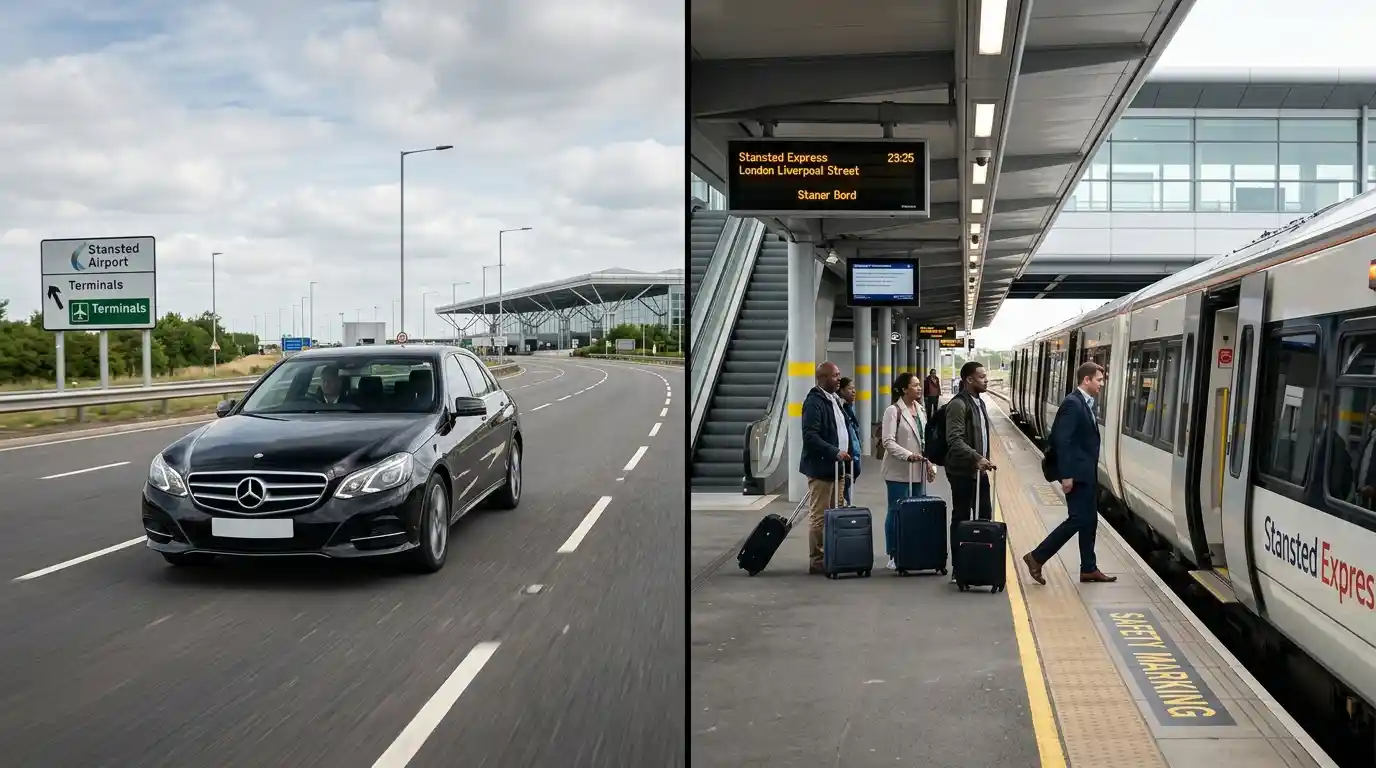
- If the disruption is severe: consider the rail alternative. The Stansted Express station sits beneath the terminal and is entirely unaffected by road conditions. If the road network is genuinely blocked and your timing allows, the train is a genuine option — covered in our rail services guide.
Using GPS and Navigation for Stansted Airport
Navigation tools are good at routes and poor at judgement. Both matter for an airport journey.
- Enter the exact destination. Use CM24 1RW for the airport generally, or CM24 1QW for the terminal building. For a specific car park, use that car park's own postcode. A sat-nav routing to CM24 1RW will get you to the airport complex; one routing to a car park postcode will take you to the right bay.
- Confirm the destination is the airport, not the village. "Stansted" on a navigation device can resolve to Stansted Mountfitchet, a few miles from the airport. Check the destination your device has selected before you pull away — this takes five seconds and occasionally saves an hour.
- Look at the proposed route before you drive it. A route planner optimising for time may choose a road you would not. Reviewing it takes thirty seconds and occasionally reveals an obvious problem — a long section on a known congestion pinch point, or a route that ignores an available motorway.
- Enable live traffic. Live traffic data is the single most useful feature for a Stansted journey. The M11 corridor is prone to sudden, significant delays that no static timetable captures. Without live data, a route planner is giving you yesterday's answer to today's question.
- Allow the device to recalculate. If conditions change mid-journey, let the navigation re-route rather than sticking to the original plan. A recalculation that costs you two minutes is always better than a blockage that costs you twenty.
- Do not follow blindly. Navigation gives you a route recommendation based on expected time. It does not know you have a flight, that you are unfamiliar with the area, that you have children in the car, or that you would rather arrive early on a simple road than on time via a complicated one. That judgement is yours. The tool optimises for minutes; you should be optimising for arriving in good order with margin to spare.
Related Stansted Airport Guides
The questions that follow naturally from planning a road journey to Stansted.
Frequently Asked Questions
Q: What is the best route to Stansted Airport?
A: There is no single universal answer. Most journeys use the M11 to Junction 8 or 8a, then the A120 into the airport. From Colchester or Braintree the A120 westbound is more direct and the M11 is unnecessary. From south or west London, the M25 to Junction 27 then M11 northbound. The right route depends on your origin, when you travel and live conditions.
Q: Which M11 junction should I use for Stansted Airport?
A: Both Junction 8 and Junction 8a connect to the A120 and both are signposted for the airport. Published guides genuinely contradict each other on which suits which direction. The safe answer: follow the airport signage rather than a remembered junction number — it begins well in advance and is unambiguous. Let your sat-nav and the signs do the work.
Q: What postcode should I use for Stansted Airport?
A: CM24 1RW for the airport generally. For the terminal building specifically, CM24 1QW (Bassingbourn Road) routes more precisely on some sat-navs. For a specific car park, use that car park's own postcode. Always confirm your device has selected the airport and not Stansted Mountfitchet village before setting off.
Q: Is the M11 the only road to Stansted Airport?
A: No. The A120 runs east-west and reaches the airport directly, so origins in Colchester, Braintree and eastern Essex can avoid the M11 entirely. The A120 is also a genuine alternative when the M11 is disrupted — from the south via the A10, and from the east it already avoids the motorway.
Q: When is the M11 busiest near Stansted Airport?
A: Weekdays 07:00 to 09:00 and 17:00 to 19:00, with the stretch between Junctions 8 and 9 the known pressure point. Friday evenings are the worst of the week. Off-peak from about 10:00 to 15:00 the direct M11 route is almost always clear and the right choice. Overnight the road runs freely but planned roadworks are scheduled for these hours — check before assuming.
Q: What should I do if the M11 is closed near Stansted?
A: Confirm the closure with live traffic information first — unnecessary diversions often arrive later. Then consider the A10 and A120 westbound from the south, or the A120 from the east if that is your origin. Compare the extra distance against the delay before committing. If the disruption is severe, the Stansted Express train is unaffected by road conditions and is a genuine alternative.
Q: Is the shortest route to Stansted always the fastest?
A: No. Shorter routes typically use slower A-roads with more junctions and towns. Twenty extra motorway miles frequently beat ten fewer A-road miles. For an airport journey, neither shortest nor fastest is the main criterion — the route with the most predictable duration is the right one, because arriving late is categorically more costly than arriving early.
Q: How does the final approach to Stansted Airport work?
A: From the M11 junction you join the A120, then follow Thremhall Avenue and the Priory Wood Roundabout into the airport complex. Car parks are signposted from the A120 before the terminal — know whether you want the terminal, Express Set Down, Mid Stay, Short Stay or Long Stay before you reach the split, because reversing a wrong turn adds several minutes at the worst possible moment.
Would You Rather Not Drive It?
Every road route to Stansted ends the same way: on the A120, following airport signage into the complex. Three things decide your route in practice — where you start, when you travel, and what you are optimising for. For an airport journey, predictability usually beats speed. A route you can drive without thinking, on roads that behave consistently, with margin built in, is worth more than one that is nominally quicker but occasionally terrible. And whichever you take, follow the airport signage at the end rather than a junction number you half-remember. If you would rather not drive it at all, Stansted Airport Taxi is a TfL-licensed private-hire operator running pre-booked fixed-fare transfers at any hour, with drivers who know which approach suits the conditions on the day.
- ✔ Fixed fare confirmed at booking — calculated on actual road distance, not a rounded estimate
- ✔ 24/7 operation including pre-dawn pickups and late-night arrivals when rail has stopped
- ✔ Meet & greet in arrivals with a name board, flight tracking and 45–60 min free waiting
- ✔ Saloon, Estate, MPV5–8 and Executive vehicles — door to terminal, luggage handled
👉 Get your fixed-fare quote in under two minutes — book online or call +44 20 3617 7825.
See also our Distance Guide, Parking Guide, and Rail Services Guide.
Last reviewed August 2026 · Next review February 2027 — route conditions change with roadworks and junction improvements · Sources: London Stansted Airport (getting here by car); National Highways (M11 Junction 6–14 maintenance); Essex Highways (M11 Junction 8 improvement scheme) · Stansted Airport Taxi editorial team.