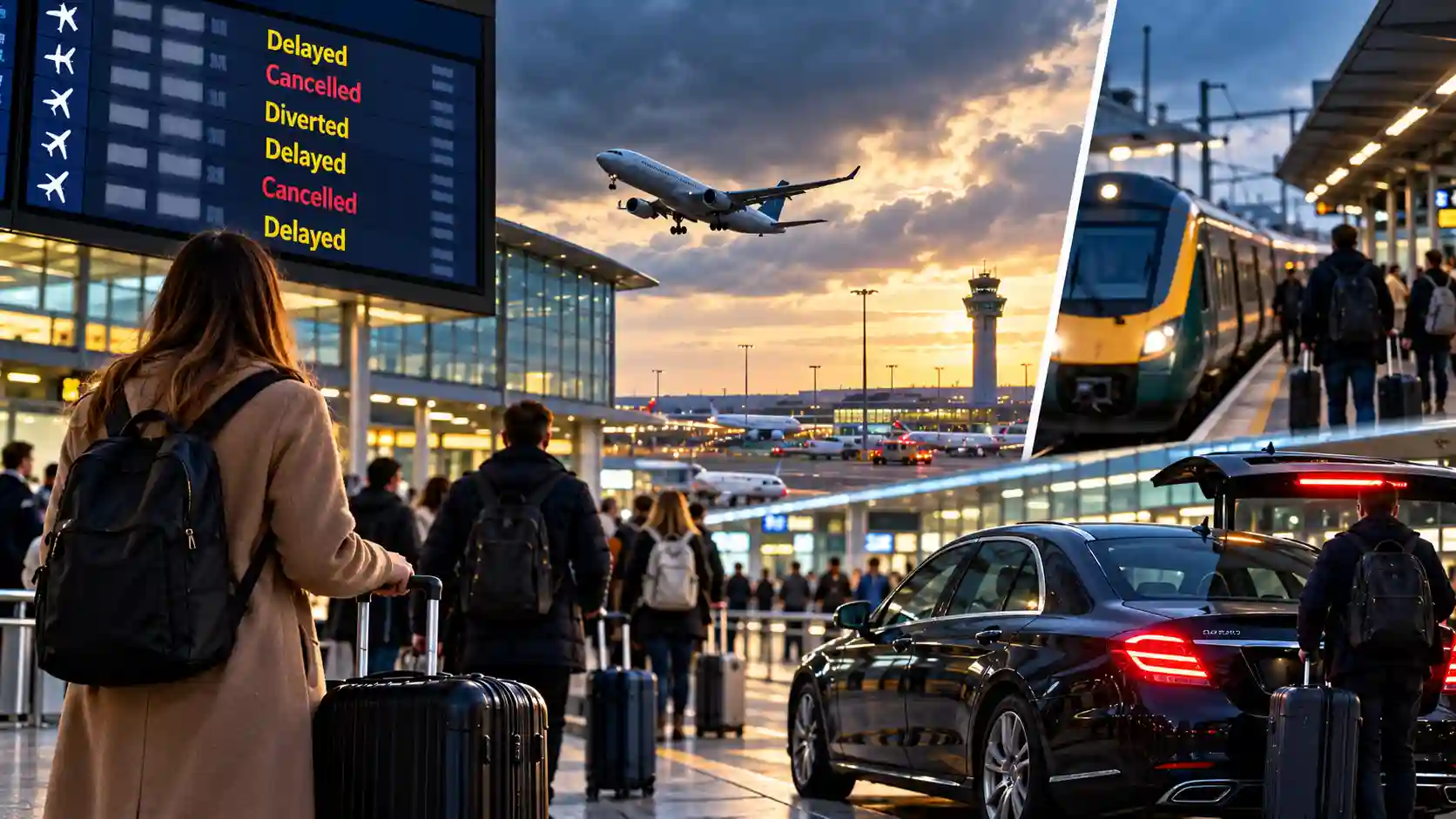
When disruption hits a UK airport, the effects don't stay in the terminal. A cancelled flight in Edinburgh sets off a chain: passengers stranded at the gate, aircraft repositioned overnight, crew who've exceeded their duty hours, and a family with a pre-booked taxi waiting at the arrivals door for a flight that landed 600 miles away in Oslo. The storm that grounds flights at Leeds Bradford is often the same storm that knocks out overhead electrical cables on the rail line — so the train alternative isn't available either.
Understanding how these disruptions cascade — and what your practical options are when they do — is the difference between a journey that recovers quickly and one that drags on for twelve hours longer than it needed to.
Author: Stansted Airport Taxi Editorial Team | Licence: Uttlesford PHV | Companies House: 13506378. Published 27 October 2026 | Last checked: 27 October 2026.
⚙ Quick Answer: UK Airport Travel Disruptions
When a storm, power failure or rail outage disrupts a UK airport, the effects reach far beyond the terminal: flights are diverted, trains stop running and pre-booked transfers end up waiting at the wrong airport.
Check flight status with your airline first, confirm the actual arrival airport, then update your onward transfer straight away. Under UK Reg 261/2004 your airline must still provide care and assistance during weather disruption, even though fixed compensation is unlikely to apply.
A pre-booked Stansted Airport Taxi is door to door, with a fixed fare confirmed at booking. Flight monitoring adjusts for delays automatically; a diversion or a new flight number needs a direct call.
Why Do Airport Travel Disruptions Happen Across the UK?
UK airports are exposed to a wider range of disruption causes than passengers often realise before they're caught in one. They rarely travel alone.
Severe weather is the most common trigger for large-scale disruption. Storms bring high crosswinds that make landing approaches dangerous, gusts that ground aircraft at exposed airports, and rain that reduces visibility and makes runways slippery. In October 2026, Storms Austen and Boelo struck on consecutive days — Storm Austen on 23 October, Storm Boelo arriving on 24 October — producing amber wind warnings across Scotland and northern England, Met Office-recorded gusts of up to 76mph at coastal stations, and flood warnings covering parts of England and Wales. The result was disruption across the aviation and rail networks simultaneously.
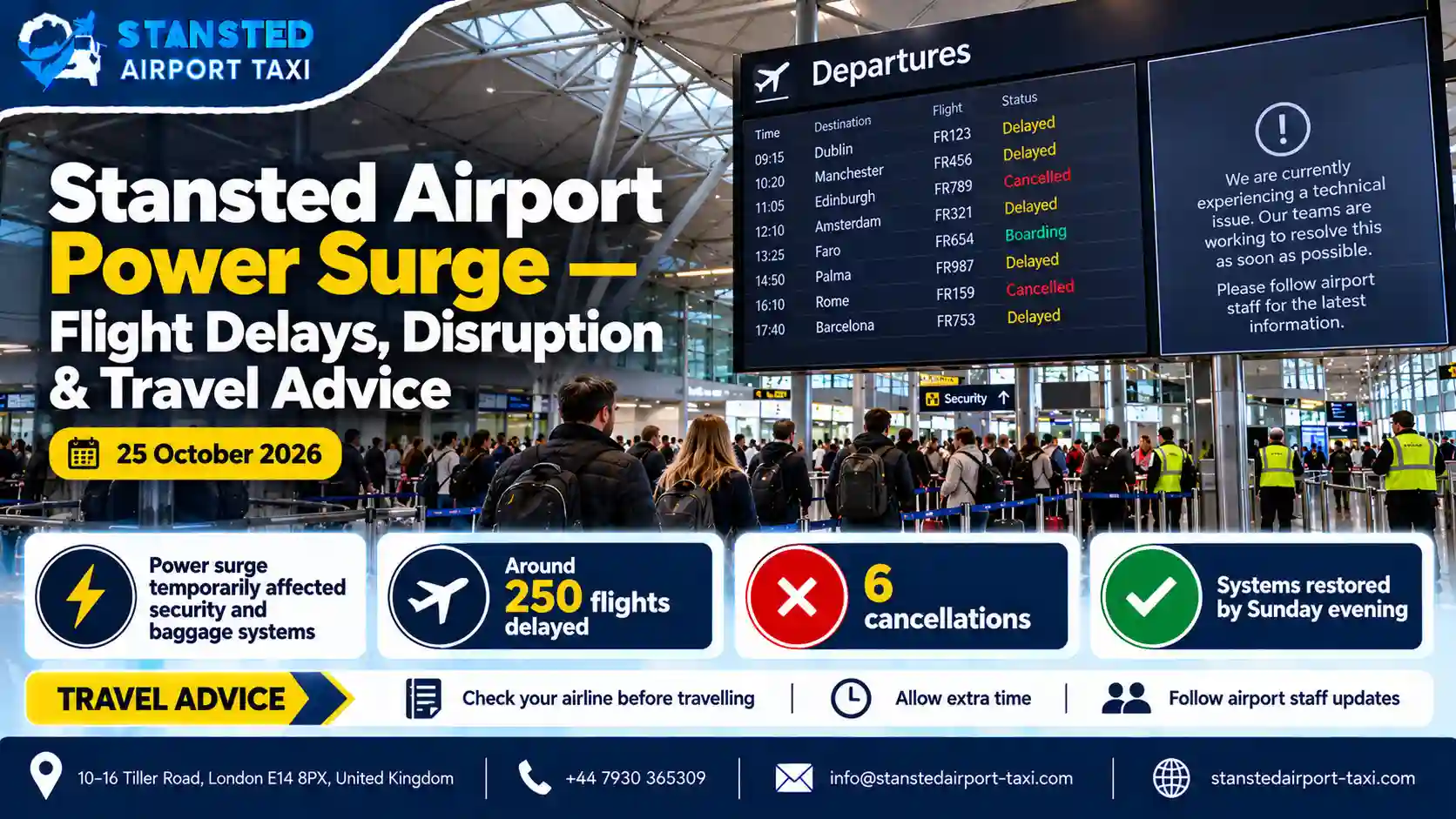
Infrastructure and equipment failures are a separate cause that can occur independently of weather. A power surge at an airport — as happened at London Stansted on 25 October 2026 — can knock out security screening, baggage handling, and terminal systems without any storm involved. These failures are often harder for passengers to anticipate because there's no weather forecast to check in advance.
Railway damage frequently accompanies storm events and creates a specific problem for airport passengers: the same weather that causes flight disruption also disrupts the rail links passengers would normally use as a backup. When a tree falls on an overhead line near Stansted Mountfitchet, the Stansted Express and the airport may both be affected by the same storm at the same time.
Air Traffic Control (ATC) restrictions impose route and runway capacity limits that affect departure slots across multiple airports simultaneously. The UK's NATS averaged 7.8 seconds of ATC-attributable delay per flight in 2025 — modest compared with France (114 seconds per flight) or Germany (53 seconds) — but a major ATC event can propagate delays across the network within hours.
Knock-on effects from disruption elsewhere account for a large portion of what passengers experience as their own delay. According to Eurocontrol's 2024 data for European aviation, reactionary (knock-on) delay accounts for approximately 46% of total average delay per flight — the largest single category. When a morning departure is delayed, the aircraft that was supposed to return to the same airport for an afternoon service hasn't arrived yet. The passengers on that afternoon flight didn't cause any delay. But they're waiting.
Industrial action and staffing disruptions at airports, airlines or ground handlers are a separate category with their own regulatory treatment — passengers have stronger compensation rights in these cases than in weather events.
How Do Flight Delays and Diversions Affect Passengers?
A delayed flight is frustrating. A diverted flight is a different problem entirely — because your journey has ended somewhere you didn't plan to be.
What a diversion actually looks like
During Storm Boelo on 24–25 October 2026, a Ryanair flight from Faro to Edinburgh made its approach in strong winds, aborted the landing, circled the airport, and ultimately diverted to Oslo, Norway — approximately 600 miles from Edinburgh. Passengers reached Oslo at approximately 6pm. A minor technical issue was found on the aircraft; engineers inspected it. The flight eventually departed Oslo at 00:44 local time, arriving in Edinburgh in the early hours. Ryanair confirmed the diversion was due to adverse weather conditions at Edinburgh Airport.
On the same night, a separate Ryanair flight from Dublin to Bristol abandoned its approach to Bristol, attempted to land at Newquay earlier in the day, was diverted back to Dublin, and ultimately landed at Alicante-Elche Airport in Spain at around 2:15am — approximately 910 miles from Bristol. A Ryanair flight from Tirana diverted to Brussels. An easyJet service from Bristol diverted to Newcastle. Multiple inbound flights at Leeds Bradford were diverted, including services from Malaga, Palma, Dublin and Stansted.
These aren't extreme edge cases. They're a single night of storm weather in the UK.
What a diversion means for your plans
Your taxi or transfer is waiting at the wrong airport. A driver booked to meet you at Edinburgh arrivals cannot meet you at Oslo. If you have a pre-booked transfer, contact your operator immediately once you know you've been diverted — they can hold your booking, arrange an alternative arrival collection, or reschedule for your eventual arrival.
Your onward connection is gone. If you were catching a train, bus or connecting flight from your arrival airport, that plan is now redundant. You need to check what alternative routing is available from wherever you've landed — and your airline is obligated to help you (see passenger rights below).
Checked luggage may follow a different route. Baggage on a diverted aircraft doesn't always reach the diversion airport. In some cases it continues to the original destination; in others it stays with the aircraft. Ask the airline before you leave the diversion airport.
Rebooking depends on what you do next. If you accept alternative transport to your original destination, you may lose certain rights. Get written confirmation of any arrangement the airline offers.
Missed connections and changed pickups
If your flight runs significantly late — or you're rebooked onto a service the following day — update any transfer bookings as soon as you know your revised arrival time. For pre-booked taxi transfers with a flight-monitoring service, a delay is handled automatically; a complete rebook onto a different service number is not tracked automatically and needs a direct call to the operator.
Which UK Airports Experienced Weather-Related Disruption in October 2026?
October 2026 brought two named storms in 48 hours. Here is what was confirmed at specific UK airports during the period — with clear attribution throughout.
Leeds Bradford Airport
Leeds Bradford sits 208 metres above sea level and is one of the most wind-exposed airports in England. During Storm Boelo on Sunday 25 October, several arriving flights were diverted — including easyJet services from Malaga and Palma, and flights from Dublin, London Stansted, Krakow and Gdansk. Services from Dublin and Belfast City were cancelled (ITV Calendar / Euro Weekly News, 25 October 2026).
Edinburgh Airport
An Air France flight from Paris performed a go-around — an aborted landing approach — in strong winds on 24 October. A Ryanair flight from Faro made its approach, aborted, circled the airport, and diverted to Oslo, approximately 600 miles away. Amber wind warnings covered the region; gusts were forecast at up to 80mph in exposed areas (STV News, 26 October 2026, citing Ryanair official statement and Flightradar24 data).
Birmingham Airport
A Jet2 Boeing 737-800 operating flight LS1310 from Venice ran off the runway onto adjacent grass after landing at Birmingham on Runway 33 at 14:19 on Sunday 25 October. Flightradar24 recorded crosswinds of 280/19G32 — gusts of 59km/h — at the time of landing. No injuries were reported. No official statement from Jet2 or Birmingham Airport had been published at time of writing (Euro Weekly News, 25 October 2026, citing Flightradar24 data).
Bristol Airport
A Ryanair service from Dublin abandoned its approach and ultimately diverted to Alicante-Elche Airport in Spain, approximately 910 miles from Bristol, landing at approximately 2:15am on Sunday 25 October. The same aircraft had earlier been unable to land at Newquay and had returned to Dublin (Brit Brief / The Aviation Hub, 25 October 2026).
Glasgow Prestwick Airport
Ryanair changed the departure airport for a 7am Prestwick–Malaga service to Glasgow Airport, notifying passengers from 1:43am by email, SMS and push notification. Ryanair confirmed passengers could claim receipted transport costs to Glasgow Airport (STV News, 26 October 2026, citing Ryanair official statement).
Heathrow and Gatwick — October 2026
No airport-specific cancellation or diversion figures for Heathrow or Gatwick during Storm Boelo were confirmed from an official source at time of writing. A separate disruption event at Heathrow was reported on approximately 6 October 2026, described as weather-related disruption with British Airways services significantly affected (Open Jaw, 6 October 2026). A broader European disruption event on 4 October 2026 recorded 533 delays at Heathrow alone across that day (Travel Tourister / Eurocontrol ATFM data, 4 October 2026). These are different events from Storm Boelo.
Manchester, Glasgow International, Belfast
IBTimes SG reported disruption at Manchester, Glasgow and Heathrow during the storm period. Airport-specific figures for these airports have not been confirmed from official or named news sources at time of writing. This guide will be updated as further information is published.
How Can Airport Disruptions Affect Trains, Roads and Ferries?
The same weather that disrupts airports frequently disrupts the ground transport passengers rely on to reach them. This matters because "take the train instead" only works if the train is running.
Rail disruption during the October 2026 storms
During Storm Austen on Friday 23 October, a tree fell near Stansted Mountfitchet at approximately 17:56, blocking all tracks and damaging overhead electrical equipment. National Rail issued a "do not travel" advisory between Broxbourne and Stansted Airport for the rest of the evening. Greater Anglia and Stansted Express services were cancelled from approximately 20:30.
On Saturday 24 October, a second tree fell near Stansted Mountfitchet, again blocking both tracks and damaging overhead equipment. Services between Bishop's Stortford and Stansted Airport were suspended. The "do not travel" advisory was reissued. National Rail confirmed the disruption was cleared at 17:06 on Sunday 25 October.
Further north, Storm Boelo's impact on rail was severe:
- Network Rail (North West England) confirmed overhead lines came down at multiple locations including Carr Mill, with flooding at Poulton-le-Fylde and trees on the line near Hadfield. Avanti West Coast, TransPennine Express and Northern services were all affected. Chris Wright, Network Rail's North West Route Director, confirmed the disruption publicly (Network Rail Media Centre, 25 October 2026).
- Avanti West Coast advised passengers against travel north of Preston on Sunday 25 October.
- TransPennine Express withdrew services north of Carlisle and urged essential travel only.
- LNER cancelled almost all services to and from Aberdeen on Sunday 25 October, reducing to approximately one train per hour between Darlington and Edinburgh due to speed restrictions. No replacement coaches were available between Edinburgh and Aberdeen because of severe weather and expected road restrictions (RusTourism News, citing LNER).
- ScotRail suspended the Glasgow Central–Ayr route from 9pm Saturday (trains terminating at Kilwinning instead), suspended the Ayr–Girvan and Kilmarnock–Stranraer lines from 9pm Saturday, and closed the Crianlarich–Oban and Fort William–Mallaig routes from 10pm. No replacement buses were provided on these routes. Speed restrictions applied across much of the Scottish network overnight (RusTourism News, 24 October 2026).
Road disruption
Storm-strength winds and flooding create road conditions that add time to every journey, including taxi and private-hire trips. The M11 — the main route between London and Stansted — can become congested when rail passengers divert to road travel following cancellations. Journey times that are typically reliable can extend by 30–60 minutes during and immediately after storm events.
This doesn't mean road travel becomes impossible — it means journey times need to account for conditions, and departure times should have a buffer built in.
Ferry and coastal services
Ferry routes to Northern Ireland, Scotland and the Channel Islands are subject to cancellation in high winds and heavy swell. If your itinerary involves a ferry connection before or after a flight, check the ferry operator's service status independently — ferry disruption is not captured by airport or rail status pages.
What Should You Do If Your Flight Is Delayed, Cancelled or Diverted?
A clear sequence makes a real difference when your journey goes wrong. Here is what to do — in order.
Step 1: Check the flight status with your airline, not the airport
Your airline's app is the fastest and most specific source. Airport departure boards show the same data but with less granularity. The airline knows first whether a flight is being held, cancelled or combined with another service — and push notifications from the app often reach you before the board updates.
Step 2: Confirm the actual arrival or departure airport
If your flight has been diverted, confirm the diversion airport from the airline directly before acting on any information from fellow passengers or social media. A diversion to Oslo is different from a diversion to Aberdeen — your onward options are completely different in each case.
Step 3: Follow airline instructions on rebooking and missed connections
Your airline is obligated under UK Regulation 261/2004 to offer you a choice of: a full refund; rerouting at the earliest opportunity; or rerouting at a later date of your choice. Don't accept the first option offered without understanding the others. If you're rerouted, get the new flight details in writing (email or SMS) before you leave the gate area.
If you've missed a connecting flight as a result of your disruption, the rebooking obligation extends to that connection — particularly if both legs were on the same booking.
Step 4: Claim care and assistance — and keep receipts
Under UK Reg 261/2004, airlines must provide meals and refreshments proportionate to your waiting time, and a means of communication, during delays and cancellations. For overnight delays, they must provide hotel accommodation AND transport between the airport and the hotel.
Crucially, these care obligations apply even when extraordinary circumstances are the cause — a storm that exempts the airline from paying financial compensation does not exempt them from providing food, communication and accommodation. If the airline cannot provide these directly, you can arrange them yourself and claim reimbursement. Keep every receipt. The CAA's published guidance confirms this applies to weather events (CAA, NATS Outage Guidance, updated 2026).
Step 5: Check financial compensation eligibility separately
Weather cancellations and diversions are typically classified as extraordinary circumstances — meaning the fixed financial compensation under UK Reg 261/2004 (£220 to £520 depending on flight distance and delay length) is unlikely to apply. What still applies is the care and assistance obligation above, plus your right to a refund or rerouting.
If your disruption was caused by a technical fault within the airline's control, or industrial action by the airline's own staff, compensation rights are stronger. Your airline should tell you the cause of your disruption — if they don't, ask in writing.
Step 6: Update your onward transport booking
Once you know your new arrival time or airport, update any ground transfer immediately. For a pre-booked taxi with flight monitoring, a delay to your original service is tracked automatically. A rebook onto a completely different service number, or an arrival at a different airport, needs a direct call to the operator. Don't leave this until you land — the earlier the call, the more options the operator has to help.
Step 7: Check travel insurance
If your delay triggers your travel insurance policy's disruption benefit, submit a claim promptly. Most policies have a time limit on claims. Your airline's written delay notification (ask for one) is the document the insurer needs.
How Should You Plan Your Airport Transfer During Disruption?
The transport choice you make before disruption is a different calculation from the one you make in the middle of it. Here is how each option performs when conditions are difficult.
Train — fast when it's running, useless when it isn't
For Stansted specifically, the Stansted Express is the obvious first choice for passengers from Central London: 47 minutes from Liverpool Street, straightforward for a solo passenger with a carry-on. But as October 2026 demonstrated — twice in the same week — the same weather that disrupts the airport disrupts the line. When a tree falls on the overhead cable near Stansted Mountfitchet, both disruptions hit simultaneously.
Other UK airports face the same issue. ScotRail's suspension of the Glasgow Central–Ayr line during Storm Boelo left passengers at Prestwick Airport with no rail option to Glasgow. The LNER suspension of Aberdeen services affected passengers travelling between Aberdeen and Edinburgh Airport.
The train works well when: you're travelling solo, with light luggage, in normal conditions, from a station close to the line.
The train fails when: the line itself is affected, your flight lands late at night after the last service, you have multiple bags, or you need to reach a destination not near the rail corridor.
Coach — longer but sometimes running when trains aren't
National Express and similar operators use road routes that can remain open when rail lines are blocked. Journey times are longer than the train, and fares are typically lower. During a rail suspension, coaches on the same corridor can book up quickly — if you're considering this as a backup, don't wait until the last moment.
The coach fails when: surge demand fills services, your destination is off the coach corridor, your flight lands after the last departure, or traffic conditions extend journey times significantly.
Pre-booked private hire — the option that adapts
A pre-booked taxi or private-hire vehicle is door-to-door from the moment you land to your home, hotel or office. It doesn't depend on train lines being open, coach services running on schedule, or roads being clear of delays. The route can be adjusted for conditions. The departure time can be moved. The vehicle can be changed if your group size changes.
For arrivals, flight monitoring means that if your original service is delayed, the driver's schedule adjusts without you needing to call. If you're diverted to a different airport entirely, a direct call to your operator connects you with a driver who can respond to your actual location.
The limitation: road conditions during severe weather can still add time. No transfer option makes a 70mph gust irrelevant. Journey times in storm conditions should include a buffer, and your operator should advise on this based on live route conditions.
On-demand ride-hailing — available in theory, expensive in practice during disruption
On-demand ride-hailing apps operate at most UK airports from designated pickup zones. During disruption events, surge pricing applies when demand outpaces supply — exactly the conditions that occur when dozens of delayed flights land within a short window. A fare that would normally be £55 can rise significantly during surge pricing, and there's no fixed fare guarantee at time of booking.
For passengers with accessibility requirements, large luggage, or group travel, on-demand availability at short notice during peak disruption is not reliable.
Driving yourself — control over departure, no control over outcome
Self-driving gives you departure flexibility, but leaves you managing conditions, parking costs and the return journey if your flight is cancelled. An extended delay turns a known parking fee into an open-ended cost. If the flight is cancelled entirely and you're at the airport, you drive home regardless of the hour.
Vehicle Options for Stansted Airport Taxi Transfers
Pre-booked transfers are available in eight vehicle classes, from saloon to executive MPV. Every fare is charged per vehicle, not per passenger. A wheelchair accessible vehicle (WAV) is available on request — confirm at booking.
| Vehicle class | Passengers | Luggage | Best for |
|---|
| Saloon | Up to 4 | Up to 3 cases | Solo, couple, small group |
| Estate | Up to 4 | Up to 5 cases | Family with pushchair or ski bags |
| MPV5 | Up to 5 | Up to 5 cases | Small group or family |
| MPV6 | Up to 6 | Up to 6 cases | Small group or family |
| MPV7 | Up to 7 | Up to 7 cases | Family with multiple children or large luggage |
| MPV8 | Up to 8 | Up to 8 cases | Larger groups |
| Executive Saloon | Up to 4 | Up to 3 cases | Business travel |
| Executive MPV | Up to 7 | Up to 7 cases | Business group |
See our standard cars, MPV cars, executive taxi and minibus fleet pages.
What Should Stansted Airport Passengers Know About Taxi Pickups?
If you have a pre-booked transfer for a journey through Stansted, here is the practical information — particularly relevant during disruption periods.
Give accurate flight details when booking. Our arrivals service uses your flight number to monitor your inbound service in real time. A booking without a flight number cannot be tracked. If you're rebooked onto a different service during disruption, contact us with the new flight number so we can update the tracking.
Confirm your pickup point. Drivers meet passengers in the Stansted arrivals concourse with a name board. After clearing passport control and collecting luggage, walk through to the main arrivals hall. Your booking confirmation includes the driver's name, vehicle make and registration. If you can't locate your driver, call the number in the confirmation.
If your flight is diverted to a different airport, contact us immediately once you know the diversion airport. We can discuss your options: whether we can arrange collection from the diversion location, whether to hold your booking for your eventual Stansted arrival, or whether to make other arrangements. This is a direct conversation — the automated flight monitoring covers delays, not changes of airport.
If your arrival time changes significantly, the monitoring system handles delays to your original service automatically. Your driver's schedule updates without you needing to call. For a rebook onto a completely different service number — including a same-airline reroute with a new flight number — call us so we can update the booking manually.
The Short Stay parking charge (currently £13) is included in your quoted fare. You won't be asked for money at the drop-off zone.
Baggage delays. If your hold luggage hasn't arrived at the belt, don't leave the terminal. Tell your driver what's happening — they'll wait while you log the delay and collect your baggage reference. Log the delay with the airline or baggage desk before you leave. You'll need that reference number for any subsequent trace.
Our fleet adapts to your situation. If disruption has changed your group size, added luggage, or shifted your timeline, contact us and we'll adjust the vehicle and the booking. Saloon, estate, executive and MPVs for 5 to 8 passengers; minibuses for 9+ passengers are on our fleet pages. A wheelchair accessible vehicle (WAV) is available on request. Fixed fares confirmed at booking, 24 hours a day, every day of the year.
Book or manage your Stansted Airport taxi →
Frequently Asked Questions About UK Airport Travel Disruptions
Q: What causes most UK flight disruptions?
A: Several causes operate in parallel. Weather events are the primary driver of airport capacity restrictions (ATFM delays) and the most common cause of large-scale same-day disruption. Reactionary (knock-on) delay — where a late-arriving aircraft or crew causes a subsequent departure to run late — accounts for approximately 46% of average European delay per flight (Eurocontrol, 2024 annual data). Technical faults, ATC restrictions and industrial action are separate categories with different regulatory and compensation implications for passengers.
Q: Am I entitled to compensation if my flight is cancelled due to a storm?
A: Financial compensation under UK Reg 261/2004 is unlikely to apply when cancellation or significant delay is caused by extraordinary circumstances — which includes severe weather. However, the care and assistance obligations still apply: the airline must provide food, communication, and (for overnight delays) hotel accommodation and transfers, even when extraordinary circumstances are the cause. If you arrange these yourself, keep receipts and claim reimbursement. The Civil Aviation Authority confirms this distinction in its published guidance (CAA, 2026).
Q: What should I do if my flight is diverted to a different airport?
A: Confirm the diversion airport from the airline before acting. The airline is obligated to offer rerouting to your original destination at the earliest opportunity. For ground transport, contact your pre-booked transfer operator directly — automated flight monitoring covers delays, not airport changes. Don't accept hotel or transport arrangements from the diversion airport before understanding whether you'll be rerouted the same evening or the following day.
Q: If trains aren't running to the airport, what are my options?
A: Coach services (National Express and similar operators) use road routes that can remain open during rail line closures. Pre-booked private hire is door-to-door and can operate when rail services are suspended — your driver takes a road route, which may take longer than normal in severe conditions but is not dependent on rail infrastructure. If conditions make road travel inadvisable (which the operator will advise), the appropriate action is to delay departure rather than attempt the journey.
Q: Should I pre-book a taxi before my flight lands?
A: Pre-booking gives you a fixed fare confirmed before you travel, a driver assigned ahead of your journey, and arrivals monitoring that adjusts for delays automatically. It also means that during a disruption — when on-demand demand spikes and surge pricing applies — you have a confirmed booking rather than competing for an available vehicle. The practical benefit of pre-booking is larger during disruption than in normal conditions, not smaller.
Q: How does a pre-booked taxi handle a significantly delayed flight?
A: Our arrivals monitoring tracks your inbound flight in real time through every stage of the journey. If your original service is running 40, 60 or 90 minutes late, your driver's schedule adjusts automatically. Drivers wait for reasonable delays at no additional charge. You don't need to call unless your situation changes in a way the system cannot track — a diversion to a different airport, or a complete rebook onto a new service number.
Q: What if my group size changes because of disruption?
A: Contact us with your revised passenger count and we'll match the vehicle. If you booked a saloon for four and now have six passengers because a connecting traveller was added to your journey, we'll move you to an MPV. If you have more luggage than planned — because an airline rebook changed your baggage allowance and you've checked in more bags — an estate or larger vehicle gives you the boot space without the cramming. Fare adjusts to the vehicle type.
Article last checked: 27 October 2026. Airport and rail status updates change frequently during active disruption periods. Check stanstedairport.com/flights, nationalrail.co.uk, and your airline directly for the current position before travelling.
Book Your Stansted Airport Taxi
Choose your vehicle class, add your flight number and confirm your fixed fare.
- ✔ Fixed fare confirmed at booking, Stansted Airport drop-off charge included
- ✔ Saloon through Executive MPV, with a wheelchair accessible vehicle on request
- ✔ Child seats available on request at £15 per seat
See our full airport transfer page.
👉 Get your fixed quote — call +44 20 3617 7825 or book online.
Find us on Google for directions and reviews. Read our reviews on Facebook, ProvenExpert and TripAdvisor, or get the Google Play app.
Stansted Airport Taxi · 10–16 Tiller Road, London E14 8PX · Registered in England and Wales — Companies House No. 13506378 · Uttlesford District Council PHV Operator Licence · info@stanstedairport-taxi.com. Drivers: Enhanced DBS checked · NVQ Level 2 Road Passenger Transport · PCO licensed. Last reviewed October 2026.