Three of London's five other airports have a direct coach link from Stansted. Two do not, and reaching those means crossing London. The journey time is the easy part. The harder question is how much time to allow — because an airport-to-airport connection has six points of failure and the coach timetable only covers one of them.
This page covers direct and indirect connections, the realistic connection risk for each route, and what to do when timing is tight. For a tight, overnight or group connection, Stansted Airport Taxi runs pre-booked airport-to-airport transfers at any hour, with flight tracking so the pickup adjusts when your inbound moves. Sources: London Stansted Airport, National Express. Reviewed August 2026.
Direct Connections from Stansted — At a Glance
The complete picture before the route-by-route detail. Indicative fares are from £18 one way to Heathrow and from £18.10 to Luton — booked ahead, subject to availability, with a £1.50 booking fee unless you hold an operator account.
| To |
Service |
Journey time |
Frequency |
Key risk |
| Heathrow (LHR) | Direct National Express coach | ~1 hr 30 min | Hourly — up to 9 daily | Missing one coach costs an hour |
| Gatwick (LGW) | Direct National Express coach | ~2 hr 45 min | Every 2 hours — up to 5 daily | Missed coach costs ~5 hours; treat time as a floor |
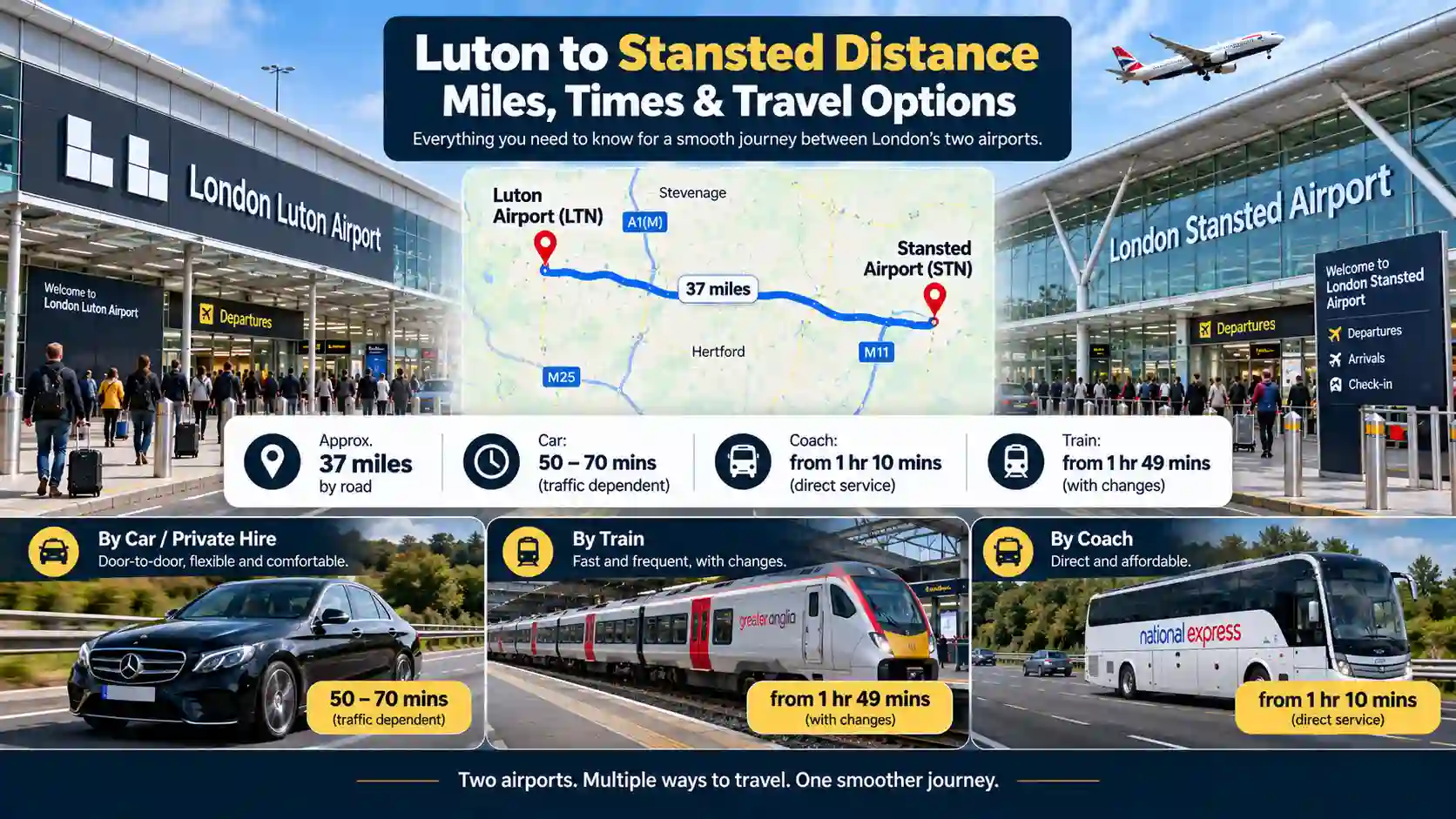
| Luton (LTN) | Direct National Express coach (737) | ~1 hr 35 min (fastest) | Up to 8 daily; first at 01:00 | Check last service — 22:30 from Stansted |
| London City (LCY) | No direct service | ~1–1.5 hrs by road; 2+ hrs via London | N/A | Road is almost always the practical answer |
| Southend (SEN) | No direct service | ~1–1.5 hrs by road | N/A | Road avoids London entirely — most predictable option |
The airport's own guidance applies here. Allow enough time for check-in, security, passport control and baggage collection — not just for the transfer itself. The coach timetable covers one link in a six-link chain.
⚙ Quick Answer: How Do I Connect Between Stansted and Other London Airports?
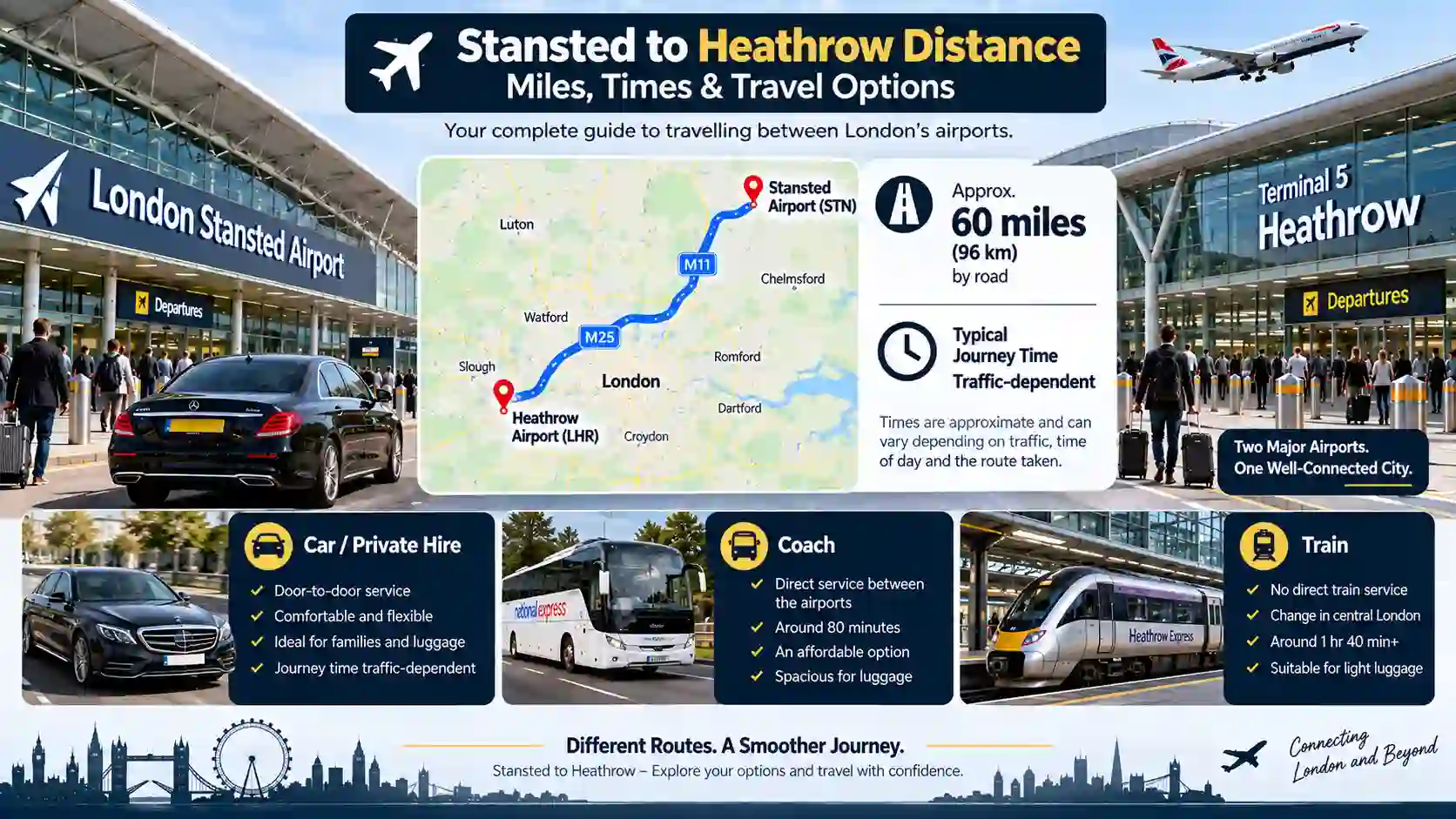
Heathrow, Gatwick and Luton have direct National Express coaches from Stansted — terminal to terminal without entering London. Heathrow runs hourly (1h 30m, from ~£18). Luton runs up to 8 times daily (1h 35m, from ~£18.10), with a first service at 01:00 covering the pre-dawn window. Gatwick runs every two hours (2h 45m) — the difficult one.
London City and Southend have no direct scheduled service. For both, road is typically the practical answer: 1 to 1.5 hours, avoiding a cross-London journey with luggage.
There is no direct rail link between any two London airports. Every rail journey goes via central London with two or three changes — impractical with checked bags.
The critical planning rule: the two flights are almost certainly on separate tickets. There is no protection if the first is late. Build the whole chain — arrival, passport control, baggage, transfer, journey, check-in — and ask: if the first flight is 90 minutes late, does this still work?
Quick Answers
Is there a direct coach from Stansted to Heathrow?
Yes — National Express runs hourly, taking about 1 hour 30 minutes, from around £18 one way booked ahead. Up to nine services a day. Coaches call at Terminals 2 and 3 (Central Bus Station) and Terminal 4. The best-connected of all the inter-airport routes.
Is the Gatwick coach or a car quicker from Stansted?
A car. The direct coach takes 2 hours 45 minutes because it makes intermediate stops; by road it is typically 1 hour 45 to 2 hours 30. The coach's real weakness is frequency — every two hours — rather than speed. Missing one costs nearly five hours on a Gatwick connection.
What is the first coach from Stansted to Luton Airport?
The first departs Stansted at 01:00 and arrives at Luton Airport Bus Station at 02:35, covering the pre-dawn check-in window. The last leaves Stansted at 22:30, arriving 23:35. The service runs to the terminal door, avoiding the separate Luton DART shuttle.
Why is there no train between Stansted and other London airports?
No direct rail link exists between any two London airports. Every rail journey requires passing through central London with two or three changes and a cross-city transfer with luggage. The coach network fills this gap directly for Heathrow, Gatwick and Luton.
What if my first flight is late and I miss the connecting coach?
Change and Go (£5 each way) lets you board any available coach up to 12 hours either side of your booked departure — inexpensive insurance for any connection. Without it, you pay for the next available service. Inter-airport connections on separate tickets carry no airline protection if the first flight delays the second.
How do I get from Stansted to London City Airport?
No direct service exists. Public transport requires rail to Liverpool Street or Stratford then the DLR — two-plus hours with changes and luggage. By road it is typically 1 to 1.5 hours. Road is almost always the practical answer for this pairing, despite London City being geographically one of the closer airports.
Route-by-Route: Stansted to Heathrow, Gatwick and Luton
The three direct connections in detail — times, fares, planning notes and where each one catches people out.
| Route |
Coach time |
Road time |
Frequency |
Indicative fare |
Planning note |
| Stansted → Heathrow | ~1 hr 30 min | ~1.5–2 hrs (M11, M25 anticlockwise) | Hourly — up to 9 daily | From ~£18 one way | Calls at T2/3 Central Bus Station and T4; missing one coach costs one hour |
| Stansted → Gatwick | ~2 hr 45 min | ~1.75–2.5 hrs (M11, M25, M23) | Every 2 hours — up to 5 daily | Check at booking | Treat published time as a floor; missed coach costs ~5 hours; tightest connection at any London airport |
| Stansted → Luton | ~1 hr 35 min (fastest) | ~1–1.5 hrs (M11, A505 or M25 north) | Up to 8 daily; first at 01:00 | From ~£18.10 one way | Runs to terminal door (no DART shuttle); last service 22:30; overnight departure is the key advantage |
- Heathrow — the best connection. Hourly frequency makes this the most forgiving inter-airport route. Missing a coach costs an hour, which is manageable. Coaches call at T2 and T3 at the Central Bus Station (a short walk to the terminals) and at T4 stops outside arrivals. Terminal 5 passengers need to change within the airport. The reverse journey — Heathrow to Stansted — runs on the same service at similar frequency from around £18.
- Gatwick — the difficult one. Two-hourly frequency plus a 2 hour 45 minute journey means a missed coach costs nearly five hours of your day. The road route is noticeably quicker because a car makes no intermediate stops. Treat the published coach time as a floor: the M11, M25 and M23 all contribute, and the M25 section is the least predictable stretch of motorway in the country. If your timing is in any way uncertain on this route, road is the stronger choice. Always check the timetable before booking flights that depend on it.
- Luton — the overnight advantage. The first coach departs Stansted at 01:00 and reaches Luton Airport Bus Station at 02:35 — genuinely useful for pre-dawn check-in. The service runs to the terminal door, which avoids the separate Luton DART rail shuttle and its cost. The last service leaves Stansted at 22:30. These specific first and last times matter more than frequency for overnight planning — confirm the service you need is actually running at your hour before booking dependent flights.
Stansted to London City and Southend: No Direct Service
The two airports with no direct coach link — and why road usually wins for both.
| Route |
Direct service |
Public transport option |
Road time |
Best option |
| Stansted → London City (LCY) | None | Rail to Liverpool Street or Stratford, then DLR — 2+ hours with changes and luggage | ~1–1.5 hours; exposed to east London traffic | Road — geographically short, avoids London Underground with luggage |
| Stansted → Southend (SEN) | None | Via London or regional rail change — neither is quick | ~1–1.5 hours via A120/A130 or M11/M25; avoids London entirely | Road — most predictable route; A120 approach avoids London |
London City. Geographically one of the nearer airports to Stansted, but the absence of a direct coach and the awkwardness of a Docklands Light Railway transfer with luggage makes the road the practical answer despite appearances. The DLR route — rail to Liverpool Street or Stratford, then DLR to London City — involves at least two changes, central London stations, and luggage carried up and down steps and escalators. For most travellers with bags, 1 to 1.5 hours by road is clearly better than 2-plus hours via London.
Southend. The road route via the A120 and A130 avoids London entirely — which makes it more predictable than the mileage implies, since it sidesteps the M25 and central London entirely. The public transport option requires travelling via London or a regional rail change, neither of which competes. This is the pairing where road most clearly dominates every alternative.
Reverse Connections: From Other Airports to Stansted
The same routes in the opposite direction — with three things that change and one trap to avoid.
- What stays the same. Coach services run in both directions at the same frequency and similar fares. Heathrow to Stansted, Gatwick to Stansted, and Luton to Stansted all use the same National Express service in the reverse direction at broadly the same duration.
- Peak direction changes the road experience. Road journeys are affected by which way the commuter flow is running — a journey towards London in the morning meets inbound traffic; the same journey outbound in the morning does not. Both directions use the same roads, but peak direction matters for the total journey time.
- Processing time sits at a different end. On the outbound journey, you need to be at the far airport in time for check-in. On the inbound, you arrive at Stansted and still have to clear passport control and baggage before you are done. Both add time; they sit at opposite ends of the journey and need accounting for separately.
- Timetable asymmetry — the specific trap. First and last services differ by direction. The Stansted-to-Luton first coach leaves at 01:00; that does not mean a coach leaves Luton for Stansted at 01:00. Always check the timetable for the specific direction you are actually travelling, rather than assuming the return mirrors the outbound.
Connection Risk: The Six Links — and Why Journey Time Is Not the Whole Answer
An airport-to-airport connection is not one journey. It is a chain, and every link can fail. The published coach time covers one link out of six.
Link 1: Flight Arrival Delay
The most common failure and the least controllable. An hour late arriving is an hour off your connection, and it arrives at the start of the chain — which means it compounds through everything that follows. Unlike domestic connections on a single ticket, an inter-airport connection on two separate tickets carries no airline protection. If the first flight's delay causes you to miss the second, that is your cost and your problem to rebook. This is not a technicality — it is the most expensive failure available on this kind of journey.
Links 2 and 3: Passport Control and Baggage Reclaim
Passport control varies with how many flights landed simultaneously. eGates are usually quick; a staffed desk queue after several arrivals together is not — 30 to 45 minutes is possible at busy times. Baggage reclaim typically adds 10 to 20 minutes after you reach the hall, and longer if the aircraft parked at a remote stand, where bags are loaded last and unloaded first. Hand luggage only removes the reclaim stage entirely, which can be the difference between a workable connection and a tight one. If you have checked bags, build reclaim time into the chain rather than assuming it is quick.
Link 4: Reaching the Transfer
At Stansted this is relatively short — the coach station sits opposite the terminal, a few minutes' walk across the forecourt. At some other airports the transit to the coach departure point is longer and less straightforward. Factor in the walk, any shuttle within the terminal, and the time needed to locate the correct bay. The clock on the connection is running from when you land, not from when you board the coach, so every minute here is a minute off your buffer.
Links 5 and 6: The Transfer Journey and Check-In at the Far End
The transfer journey is the link the coach timetable does address — but it is still exposed to the M25 on most of these routes, and the published time assumes clear roads. Check-in at the far end has its own deadline, typically closing 40 to 60 minutes before departure. On a separate ticket there is no airline flexibility on that deadline — if you arrive 55 minutes before departure and check-in has closed at 60, you have missed the flight regardless of the reason. Both of these links close out the chain, and both depend on everything that came before them working.
How Much Connection Time Should You Allow?
There is no universal number — any guide giving one is guessing. What there is, is a list of factors that determine yours.
| Factor |
Effect on time needed |
| International arrival with passport control | Adds variable queue — could be 5 minutes, could be 40 |
| Checked baggage | 10–20 min minimum after reaching the hall; longer from a remote stand |
| Remote-stand aircraft arrival | Add ~10 minutes for the bus and steps; bags arrive later too |
| Gatwick route | 2h 45 journey plus two-hourly frequency — miss one and it costs ~5 hours |
| Peak-hour travel | M25 governs most routes; upper-end times apply |
| Non-flexible onward ticket | No margin if you miss — treat the connection as critical |
| Travelling with children or needing assistance | Every stage takes longer — add meaningfully, not marginally |
| Journey requiring a change | Each change is a failure point; count changes rather than minutes |
| Hand luggage only | Removes the reclaim stage — can save 20–30 minutes on the chain |
| Domestic arrival (no passport control) | Removes the most variable queue from the chain |
| Flexible or changeable onward ticket | Lowers the cost of running late, not the probability |
| Heathrow route, hourly frequency | Missing one coach costs one hour — most forgiving frequency |
A workable approach. Build the chain rather than the journey time. Add: flight arrival to terminal exit, plus transfer duration at its upper end, plus check-in requirements at the second airport, plus a genuine buffer for a late first flight. Then ask one question: if the first flight is 90 minutes late, does this still work? If not, the connection is too tight whatever the timetable says.
The overnight option. For a genuinely critical connection, an overnight stay between flights removes the entire risk chain. It costs a night's accommodation but buys certainty — for an expensive onward flight, that is often the better trade. It also opens up connections that simply do not exist between the last evening service and the first morning one.
Direct vs Multi-Stage, and Coach vs Road
Two genuine decisions for every inter-airport connection — with honest trade-offs for each.
|
Direct coach |
Multi-stage via London |
| Changes | None | One or more |
| Luggage handling | Loaded once — driver loads the hold | Carried at every change |
| Failure points | Fewer — the journey itself is the main one | One per change, plus the cross-London element |
| Flexibility | Fixed departures — hourly to Heathrow, two-hourly to Gatwick | More departure options if you miss one leg |
| Practicality with bags | Strong — driver handles the hold | Weak — Underground with cases is slow and difficult |
| When it loses | When you have just missed the service and the next is two hours away | Almost always loses with checked bags; may win without them |
|
Coach |
Road (pre-booked transfer or self-drive) |
| Cost | From ~£18 per person | Fixed per vehicle, not per person — group advantage |
| Speed | Slower — intermediate stops add time | Faster — no stops, direct route, adapts to conditions |
| Frequency | Fixed timetable | Departs when you do |
| Seat guarantee | Yes — reserved at booking | Yes (pre-booked transfer) |
| Traffic exposure | Same roads — no escape from the M25 | Same roads — but can adapt route in real time |
| Best for | Solo or couple, Heathrow route, time in hand | Groups, Gatwick route, tight timing, overnight hours |
The honest comparison. For one or two people with time in hand, the direct coach is good value and perfectly adequate. For a group, the fixed vehicle cost beats per-person fares. For the Gatwick route with its two-hourly frequency, road is the stronger choice. For a tight connection or an overnight hour when coach frequency thins, a pre-booked transfer from Stansted Airport Taxi departs when you need it and adapts to your flight.
Luggage and Inter-Airport Connections
Luggage affects a connection more than almost any other journey factor — and it shapes the mode decision more than the timetable does.
- Coach luggage allowance. National Express allows one large suitcase up to 20kg plus one item of hand luggage up to 10kg per person on Stansted services. The driver loads the hold, which is a genuine advantage over carrying bags through stations. Extra items are payable and should be booked at the time of purchase rather than presented on the day.
- Why luggage matters for timing. Checked baggage adds a reclaim stage — typically 10 to 20 minutes after you reach the baggage hall, and longer if the aircraft parked at a remote stand. Hand luggage only removes that stage entirely, which can be the margin between a workable connection and a missed coach. If the option exists, travelling with carry-on only is the single most effective way to shorten the chain.
- Multi-stage journeys with bags. A via-London journey with two cases is genuinely difficult. Moving bags through the Underground, up stairs, through ticket barriers, onto a platform and then doing it again at the change is slow and physically demanding in a way that a journey planner does not show. If you have checked bags, prioritise a direct service wherever one exists. If the direct service has gone and a change is unavoidable, a pre-booked transfer is worth pricing against the frustration of the alternative.
- Check-in at the second airport. Checked bags need to be deposited at the second airport's check-in desk. If you have managed the reclaim at Stansted, you will need to re-check for the onward flight — allow time for this in your chain calculation, not just for reaching the second airport.
Early-Morning and Late-Night Connections
Connections outside daytime hours behave differently — and the differences are not symmetrical between early and late.
| Time window |
Coach availability |
Road conditions |
Key risk |
| Early morning (01:00–06:00) | Luton: first at 01:00 ✔. Heathrow and Gatwick: limited — check specific times | Clear motorways — but planned roadworks most likely overnight | Planned M11 closures — check works calendar, not just live traffic |
| Daytime (07:00–20:00) | Full frequency on all three direct routes | Peak-hour exposure on M25-dependent routes | Traffic delay on Gatwick and Heathrow routes |
| Late evening (20:00–23:00) | Reducing — Luton last at 22:30; check Heathrow and Gatwick | Generally clear | Last service window — if flight lands late, onward coach may have gone |
| Overnight gap (23:00–01:00) | No service on most routes | Clear but closure risk | Highest-risk window for connections — confirm what actually runs before booking |
The overnight gap is the specific failure point. If your inbound flight lands at 23:30 and your second flight departs at 07:00, the question is not whether a service "usually runs" but whether a service actually runs between those two airports at the exact hour you need. The gap between the last evening service and the first morning one is where inter-airport connections most often fail. Confirm specific first and last services in your exact direction before booking the flights that depend on them.
For overnight connections, road is often the only option. A pre-booked transfer from Stansted Airport Taxi operates around the clock with flight tracking — the pickup adjusts if your inbound moves, which is exactly what coach timetables cannot do at 01:00.
Accessibility and Airport Connections
Connections add complexity for any passenger requiring assistance — because each stage has its own arrangements and each handover is a new coordination point.
- Assistance is arranged separately at each stage. Airport assistance is booked with the airline at the departure end, at least 48 hours before travel, and covers the terminal only. It does not extend to the transfer. Coach assistance is arranged with National Express at booking — coaches are wheelchair accessible with driver-provided boarding help. The second airport requires its own separate assistance booking with the onward airline. Three separate arrangements for one connection.
- Why direct services matter more for assisted passengers. Each change means another handover, another arrangement and another opportunity for something to be missed. A direct coach or a single vehicle removes those intermediate handovers. For assisted passengers, the case for a direct service — or a pre-booked transfer — is even stronger than for other travellers.
- Allow meaningfully more connection time. Assisted journeys take longer at every stage. The guidance for a standard passenger already needs to be treated as a minimum; for an assisted journey, add meaningfully more rather than the same amount. The gap between "technically possible" and "comfortable" is wider, and an uncomfortable connection with assistance at each end is a more stressful experience than a relaxed one with more time.
Booking and Ticket Flexibility
Flexibility matters more on an inter-airport connection than on almost any other journey, because the first flight determines everything about the second.
- Change and Go — the most useful add-on. Change and Go costs £5 each way and lets you board any available coach 12 hours either side of your booked departure. For a connection that depends on a flight which might be late, this is inexpensive insurance that removes most of the timetable risk. Worth buying on every inter-airport journey unless the onward schedule is entirely fixed and the connection time is generous.
- Ticket types. Standard fares offer some flexibility; Fully Flexible allows the most changes. Advance purchase lead fares are cheapest and least flexible. If your travel date is certain and your connection time is comfortable, advance fare is fine. If either is uncertain, pay for the flexibility rather than hoping the standard terms cover a same-day delay.
- Refund policy. A refundable ticket cancelled at least 72 hours before the outward journey can generally be refunded under the operator's terms. That window does not help with a same-day flight delay. For protection against the flight arriving late and missing the coach, Change and Go is the practical answer — not a refund, which only covers you after the journey fails entirely.
- Booking fee. A £1.50 booking fee applies unless you are logged into an operator account when purchasing. For a group or a family, creating a free account before booking eliminates this across every trip.
- Buying on the day. Possible — drivers sell tickets for cash only and may have limited change. Booking in advance secures the seat, usually provides a lower fare, and removes the risk of a sold-out service at the hour you need it.
Where the Rest of This Sits
This page covers airport-to-airport connections only. Other onward journeys from Stansted belong on the pages below.
Related Stansted Airport Guides
The guides that provide context and detail for each part of the connection chain.
Frequently Asked Questions
Q: Is there a direct connection between Stansted and Heathrow?
A: Yes — National Express runs a direct coach hourly, taking about 1 hour 30 minutes, from around £18 one way booked ahead. Up to nine services a day call at Heathrow Terminals 2 and 3 (Central Bus Station) and Terminal 4. It is the best-connected of all the inter-airport routes, with frequency that means a missed service costs only one hour.
Q: How do I get from Stansted to Gatwick?
A: By direct National Express coach, taking 2 hours 45 minutes and running every two hours (up to five daily). By road it is typically 1 hour 45 to 2 hours 30 minutes — quicker, because a car makes no intermediate stops. The Gatwick route is the difficult one: two-hourly frequency plus the long journey means a missed coach costs nearly five hours. Treat the published time as a floor, not an estimate, and check the timetable before booking flights that depend on it.
Q: How long does it take from Stansted to Luton Airport?
A: The direct National Express coach (737) takes 1 hour 35 minutes at fastest, from around £18.10 one way. Up to eight services daily, with a first departure from Stansted at 01:00 and a last at 22:30. The service runs to the terminal door, avoiding the Luton DART shuttle. By road, typically 1 hour to 1 hour 30 minutes.
Q: Is there a train between Stansted and other London airports?
A: No direct rail link exists between any two London airports. Every rail journey requires passing through central London with two or three changes and a cross-city transfer with luggage — impractical for inter-airport connections. Direct coaches are the realistic alternative for Heathrow, Gatwick and Luton; road is the answer for London City and Southend.
Q: What happens if I miss my connecting flight between two London airports?
A: If the two flights are on separate tickets — which is almost always the case for inter-airport connections — there is no airline protection. Missing the second flight because the first was late is your cost and your rebooking problem. A connection within one airport on a single ticket is the airline's responsibility; a connection between two airports on separate tickets usually is not.
Q: How much time should I allow between two London airports?
A: There is no universal figure. Build the whole chain: flight arrival, passport control, baggage reclaim, reaching the coach, the journey itself, and check-in at the second airport. Then ask: if the first flight is 90 minutes late, does this still work? If not, the connection is too tight — add time, add ticket flexibility, or add a night's stay between flights.
Q: How do I get from Stansted to London City Airport?
A: No direct service. Public transport means rail to Liverpool Street or Stratford, then the DLR to London City — two or more hours with at least two changes and luggage through central London stations. By road it is typically 1 to 1.5 hours. Road is almost always the practical answer for this pairing, despite London City being geographically one of the closer airports.
Q: Can I change my coach booking if my flight is delayed?
A: Yes, with Change and Go — £5 each way lets you board any available coach 12 hours either side of your booked departure. For any connection that depends on a flight which might be late, this is inexpensive insurance worth buying at the time of booking. Without it, you pay for the next available service at the standard fare.
For Tight, Overnight or Group Connections — Book a Pre-Booked Transfer
Three of London's other airports are directly reachable by coach from Stansted. The journey time is the easy part. What decides whether a connection works is the chain around it — and the two flights are almost certainly on separate tickets with no protection between them. If your connection is tight, involves a group, runs at an hour when coach frequency thins, or requires certainty that a timetable cannot provide, Stansted Airport Taxi runs pre-booked airport-to-airport transfers at any hour. We track your inbound flight so the pickup adjusts when your arrival time moves — which is exactly what a coach timetable cannot do at 01:00.
- ✔ Fixed fare confirmed at booking — calculated on actual road distance, not a per-person timetable price
- ✔ Flight tracking so the pickup adjusts automatically when your inbound flight moves
- ✔ 24/7 including overnight and pre-dawn — when coach services thin or stop entirely
- ✔ Saloon, Estate, MPV5–8 and Executive — group pricing beats per-person coach fares from 3+ passengers
- ✔ 45–60 min free waiting from touchdown — covers passport control and baggage without a clock watching
👉 Get your fixed-fare quote in under two minutes — book online or call +44 20 3617 7825.
See also our Coaches & Buses Guide, Traffic & Road Conditions Guide, and Arrivals Guide.
Last reviewed August 2026 · Next review November 2026 — coach timetables and fares change seasonally · Sources: London Stansted Airport (travelling between London airports); National Express (Stansted transfers; Stansted to Luton) · Stansted Airport Taxi editorial team.